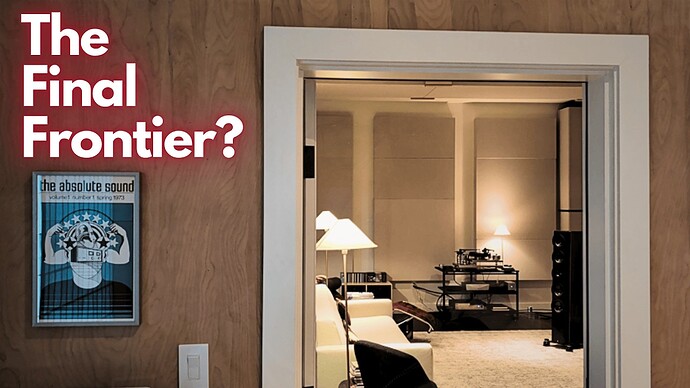
This review seems to give all the advices on how improve your audio system set up and make acoustic treatment. 45 mn video.
Will @Edmund-of-Essex or Thomas agree on the recommendations or be critical with some?
1 Like
Hi FR,
I have taken a break from bending copper pipe to create cheap loudspeaker cables to take a look at the video you have linked.
I can’t find any particular fault with the recommendations in the video - so it seems all good. I do note that the simulations in the video are assuming Magico A5 loudspeakers - so the reviewer obviously has good taste  .
.
However, I think the main thing I would add is that if one is of a technical mindset, doing this kind of thing yourself (employing specialist contractors etc) over an extended period is very rewarding.
My specific alternative recommendations would be to use the tools and advice available from GIK Acoustics website. Also, for simple rectangular type rooms, use the AMROC Room Mode Simulator available online to identify the room modes that one is likely to encounter for your own rooms. Furthermore, use the software tool Room Equalisation Wizard (for measurements and some resonance modelling).
Late on in my project (2024) I also paid for a professional acoustic engineer to visit my home for one day and undertake acoustic measurements. BTW, this is how I got a very quick jump start with REW and afterwards was able to carry on myself.
There are a few ways of improving one’s listening environment and suppliers other than GIK Acoustics are Vicoustic and Artnovion (there are others too). My observation is that quite a few people on this forum have room treatment fitted - yourself included. I can appreciate what you and others have achieved from a visual perspective and can guess and admire what you will be experiencing acoustically.
BTW, thanks for starting a new thread on this topic - but I do wonder if the link would be better merged into the thread that Thomas started?
The main challenge I feel is achieving a final visual aesthetic that appeals. Everyone’s view on this is different. For example in my own case - if you had shown me in 2018 a picture of how my media room is now (2025) - I would have been horrified! However the sound of the room now in 2025 - that is not something I would give up.
PS: I plan to post REW results from my media room on ‘The Listening Room Reality Thread’ hopefully early in 2026.
1 Like
Thanks for the reply. And thanks for your point of view of it.
For myself, I would not say I have a serious acoustic treatment, made with measurements, rev, ..neither using true acoustic panels.
I would more say I tried to break the reflective characteristics of my room and avoid all the nasty consequences.
I am finally lucky to get very enjoyable results without really knowing the subject.
On the other side, when I was in my past apartment, I tried to follow the GIK recommendations. But I didn’t liked the results. A light acoustic treatment and a corner bass trap was preferred to all the panels they recommended me to set up. Hopefully I could return them.
1 Like
Hi FR,
The tricky thing to get right (until one has heard the result of an acoustically ‘dry’ room), is deciding what overall reverberation time one would like. My media room is hyper ‘dry’ - circa 145 milliseconds across all frequency ranges. I guess that your room is more in the mid range of decay time - not ‘dry’ (I.e very short room reverberation) - but very pleasing and balanced.
In regular ‘small’ rooms bass treatment is hard to achieve consistently with balance in the other frequency ranges. By using GIK Acoustics products the benefit in this regard is the patented ‘Range Limiting’ option on the thicker panels. I use the RL option a lot!
In contrast, Vicoustic have interesting corner traps that include some mass loaded damping components that can be ‘tuned’ to room resonance frequencies that are common for typical domestic and studio room sizes but one needs to know what the frequency values are of the resonances - which needs both simulation and measurement. BTW, I think that the acoustic consultant provider for the Absolute Sounds journalist room in the video you linked have used some tuned mass loaded damping type panels.
FYI, in this moment I am experimenting with a single Acustica Applicata DaaD product which is audibly interesting but is not really ‘dry’.
1 Like
I don’t remember which GIK panels I tried in my past room. It was several years ago. But I was assisted by a guy from GIK and responded to a lot of questions at that time.
As for your assumption that my room is on the mid range of decay time, not dry, I confess that I have not a single idea.
When you say “dry “, I have the feeling that the several panels that I ordered from GIK gave indeed a feeling of a drier sound. More direct and upfront, but less airy and agile.
However not sure you were talking about the same.
1 Like
In music recording/production the ‘dry’ sound is as captured by the microphone and instruments before adding reverberation and EQ or other effects. With music production it is adjusted by the engineer to make the sound how they want it. Some things in particular, like a singer for example, definitely sound richer and more interesting with reverb - like singing in the bathroom - but too much gets very muddling. With room acoustics it means minimal reverberation. But the effect of reverb in the room when playing recorded music with is different from the reverb added in the production process, because that is unaffected and was mixed in by the engineer listening in a room that most commonly will have itself been ‘dry’, sounding how he or she wanted it to sound, and in the listening room it is adding more. That said some reverb in the listening room is necessary as it adds a bit of ambience, and if completely dead it would be oppressive when no music is playing, and, Maybe different when using a surround system with appropriate recordings, when the acoustics of the original venue potentially can be reproduced in your room, when a dead room can be beneficial.
How much is right is a matter of taste, (N.B, this is different from other purposes of treatment such as reducing undesirable early reflections and minimising effects of room nodes).
1 Like
Hi FR,
It would be interesting to me to discover how many people on the Naim forum have achieved their desirable room sound by using acoustic treatments WITHOUT either professional or commercial ‘help’ and WITHOUT using a simulation or measurement tool of any kind themselves.
I think that it is certainly possible to achieve success, but without some kind of knowledge gained by personal experiments, I think progress will be slow and possibly inconsistent. To learn, mistakes along the way are almost inevitable, perhaps even essential. However I really can recommend using simulation and measurement as these methods really do save a lot of time and give a lot of confidence to the user.
My casual observation is that a few of us on the forum with acoustic treatments have made mistakes along the way. @Thomas I believe has, I certainly have, and a little bit yourself with the dissatisfaction of your early experience with GIK Acoustics.
FYI, I too have had inconsistent advice from GIK Acoustics along the way. I once asked them a question about the ‘acoustic validity’ of sawing the polystyrene Versifusors (product now renamed GridFusor) into narrow sections (which I wanted to, and subsequently installed, on the ceiling) to place between some thick absorbers. The representative of GIK advised against that. The subsequent measurements confirmed I was right!
2 Likes
This topic was automatically closed 60 days after the last reply. New replies are no longer allowed.