Intersting article Artificial intelligence: Yann LeCun works on more flexible AI - BBC News
1 Like
He seems to understand AI by saying this, but bearing in mind that there are many more people who are smarter than he is. All of them have their own motives.
“Our interaction with future AI systems - even if they are smarter than us - is going to be like the interaction between a captain of industry or a political leader with their staff of assistants - many of whom are smarter than they are.”
I think it’s worth considering what human ‘intelligence’ actually is, it can probably be broken down in to a handful of qualities and abilities, when you see the individual constituent parts that make up our ‘intelligence’ it would be reasonable to ask if a computer/technology could simulate them and do the same tasks albeit quicker and with less errors? I would be inclined to think the answer to that is most likely yes if given time to advance sufficiently. AI as we know it is really only in its infancy and it would be naive to think that what we have now is as good as it gets. The human brain is effectively a computer of sorts but one which took a long time to develop, the physical brain is no different than it was 5000 years ago but we are where we are now through learning and ongoing development.
1 Like
Exactly - as I posted above
Yann LeCun, one of the AI Godfathers, is behind development to develop real generalised artificial intelligence - based on what is often now referred to as Animal Intelligence. Early days - but this will perhaps see the possibility of artificial sentient beings - which is light years away from many of the relatively crude AI algorithms of today.
For those that are generally interested in real artificial intelligence there is much published.
It is interesting in the late 80s I studied some of LeCun’s AI methods or methods similar to his as an undergraduate, specifically on neural networks… I wonder if we wind the clock forward 35 years from now if we might have our first artificial sentient beings - based on some of the newer principles and frameworks such as JEPA being developed - which are quite a departure from current AI systems.
2 Likes
But why on earth would we want to? Luddites like me will just murder them anyway.
1 Like
You are so right, we don’t see the datacentres unless we live in particular postcodes but as a long time gamer who has always tried to run a fairly powerful PC the impact of AI on hardware prices is shocking…
I have just bought a 4TB WD hard drive. A couple of years ago I bought a 2TB WD M.2 SSD for about £100, now the going rate for a 4TB drive is around £480. The situation with memory is even worse.
Graphics cards are similarly affected, AMD’s market share is soaring because Nvidia have almost abandoned supplying the consumer market because they can sell their datacenter GPU’s for far higher prices. There’s only a very limited amount of chip fabrication capacity so naturally prices are rising steeply.
JonathanG
1 Like
Datacentre servers that don’t even have any fancy GPU’s have gone ballistic. What would have been a relatively cheap two socket server at around £20k now sits at about £80-90k with a six month delivery time, during which time it could get worse. 32GB memory dimms might become unavailable and force even more expensive ones instead. I’ve never seen anything like it. I’m not going to bother upgrading my Windows PC. It’ll get ungracefully recycled and the MacBook Pro will suffice. Luckily I’m not into gaming so don’t need the graphics cards!
But why on earth would we want not too.. I think near space exploration would be interesting where once doesn’t necessarily have the aging and biological deep sleep to contend with… but yet the the instinctive animal intelligence to explore and understand or at least make sense and grapple with un knowns.
2 Likes
But also consider outside the US, the US CLOUD Act is driving national data centre production again elsewhere in the world, after many many years of contraction as more and more compute has migrated to the predominately US owned hyperscalers.. so some of this is a consequence of political choices too… and that is not specifically related to AI per se, but more about data and operational sovereignty.
1 Like
While “simulated vs. artificial” is more about wording than real difference, AI has always meant machines doing smart tasks, so LLMs definitely belong, calling them “simulated” actually fits AI’s original spirit.
The main idea really clicks: people often mistakenly think fluent LLM responses come from real intention or understanding, just like Searle’s 1980 Chinese Room shows, shuffling symbols without truly getting it.
I see things a bit differently on hardware: saying silicon or germanium can’t create real AI doesn’t quite hold up, since the material shouldn’t matter if the system is complex enough, meaning our brains use wet chemistry, but that doesn’t rule out silicon!
The leadership takeaway is super important and timely: AI problems often happen when tools are misused by folks who don’t fully grasp either the job or the tech.
2 Likes
This.
Isn’t the challenge with AI the same as with everything in that people to a lesser or greater degree have a propensity to take as gospel what they’re told. An example many years back a certain infamous UK politician announced that 90% of eggs were riddled with salmonella or whatever. Huge public outcry and then later in the day it was announced on the TV that eggs were quite safe to eat. My late mother in law said “there you eggs are safe they said it on the tele!” Well it seems to me AI is the same but on a far grander scale, it’s a fantastic opportunity but people will have to be able to validate what they’re being fed far more critically than hitherto.
2 Likes
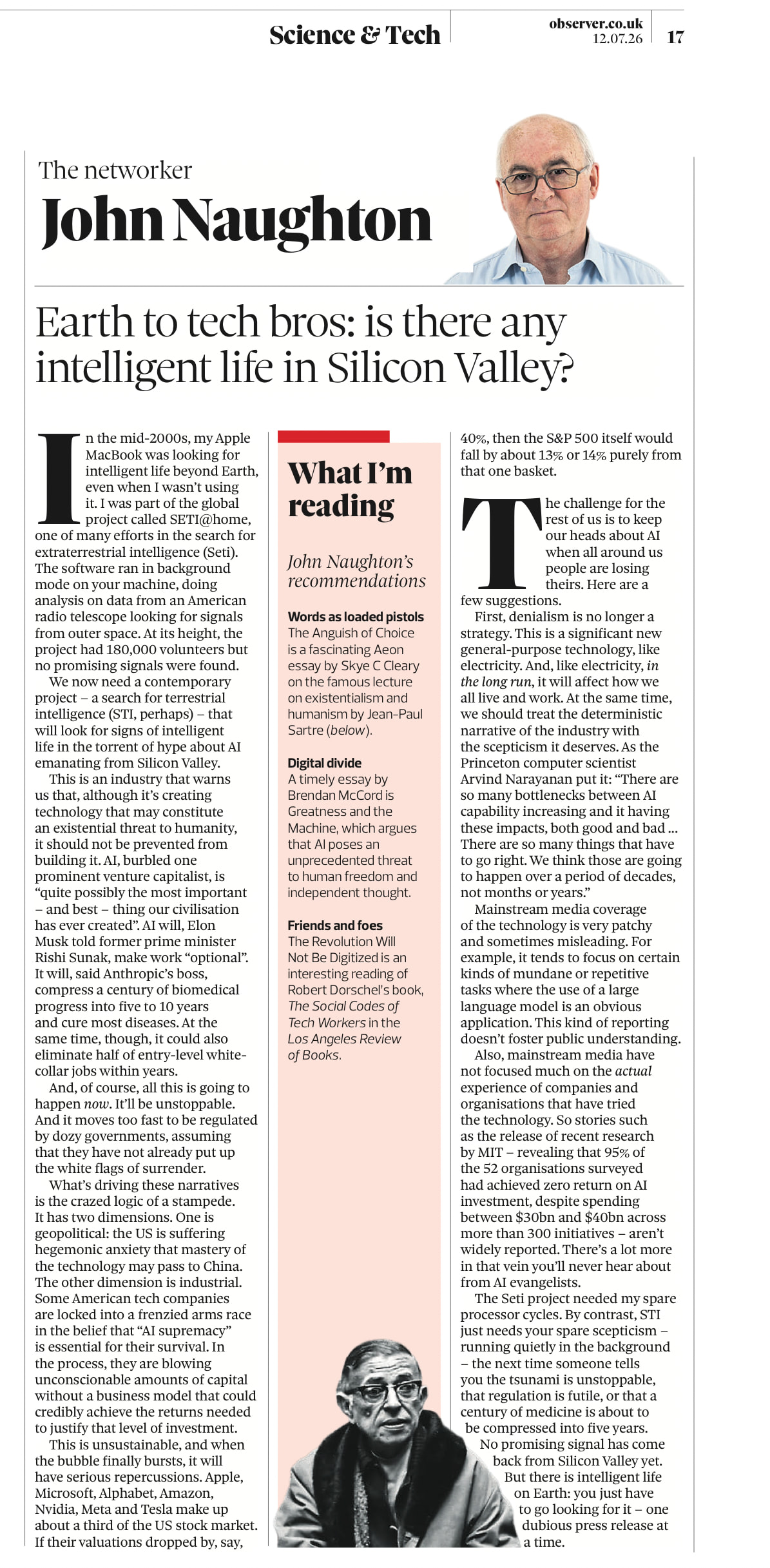
From what I understand, John Naughton is ‘correct enough’ in his specific area of the problem, but it’s important to see his work through a critical eye rather than as a complete picture of what AI could do.
1 Like
What do you think “his specific area of the problem” is? You surely need to define “the problem” first and then an English speaker might begin to understand “correct enough”.
If I were more cynical I’d say your post reads like it was written by AI.
His specific problem areas are democratic vulnerability, cognitive off‑loading, corporate power, but you will have to look beyond large language models and hype cycles.
If my wording comes across as AI then be it. 
While I respect John Naughton as an individual, I do not subscribe to his perspective, he consistently asserts that AI constitutes a financial bubble fueled by speculation rather than sustainable innovation. Additionally/similarly, I have heard some reports from San Francisco incidents in which ‘mentally ill’ individuals have damaged Waymo and Robotaxi vehicles with hammers, reportedly motivated by extreme hate to AI.
I never subscribe to the views of another person as such as though they were some kind of guru. That’s kind of what got us into much of our current mess.
I do think what he says is well balanced. There is of course lots of evidence to the contrary suggesting there’s no bubble at all but, overwhelmingly, and I mean really overwhelmingly, that comes exclusively from those working in AI and/or with a vested interest. Independent research so far backs his perspective and then some.
His academic perspective and specific bias toward open source does mean he’s got several things wrong over the years - he badly underestimated the extent to which the net could be monetised for example - but I tend to find him a voice of reason in a world absolutely dependent on hyperbole.
Exactly, with current AI the trouble is too many people aren’t intelligent enough or able to think enough to be able use it properly to get the best results from it… specifically web based LLMs.
I think I disagree there…. There future earnings forecast of many current AI investment look precarious whilst the Infrastructure vs. Application Debate on profitability ensues … it is so reminiscent, really spookily similar of the dot com bubble of the early 2000z.. I just hope this time we insulate ourselves better from the financial shock.. and there is evidence that may be the case. Having experienced the last one, where it did really personally impact me… I am now wary of this one. Right now AI tech stocks as a sector are adjusting and experiencing increased volatility .. hopefully it adjusts without collapse