I managed to derive a formula with T (time taken for Stephen’s journey) and X (distance between towns) which resulted in a total journey time of 5 hours for Stephen, so arrival time was 3pm.
2 Likes
Same answer from me, 3pm.
I used a graphical approach and a bit of trigonometry:
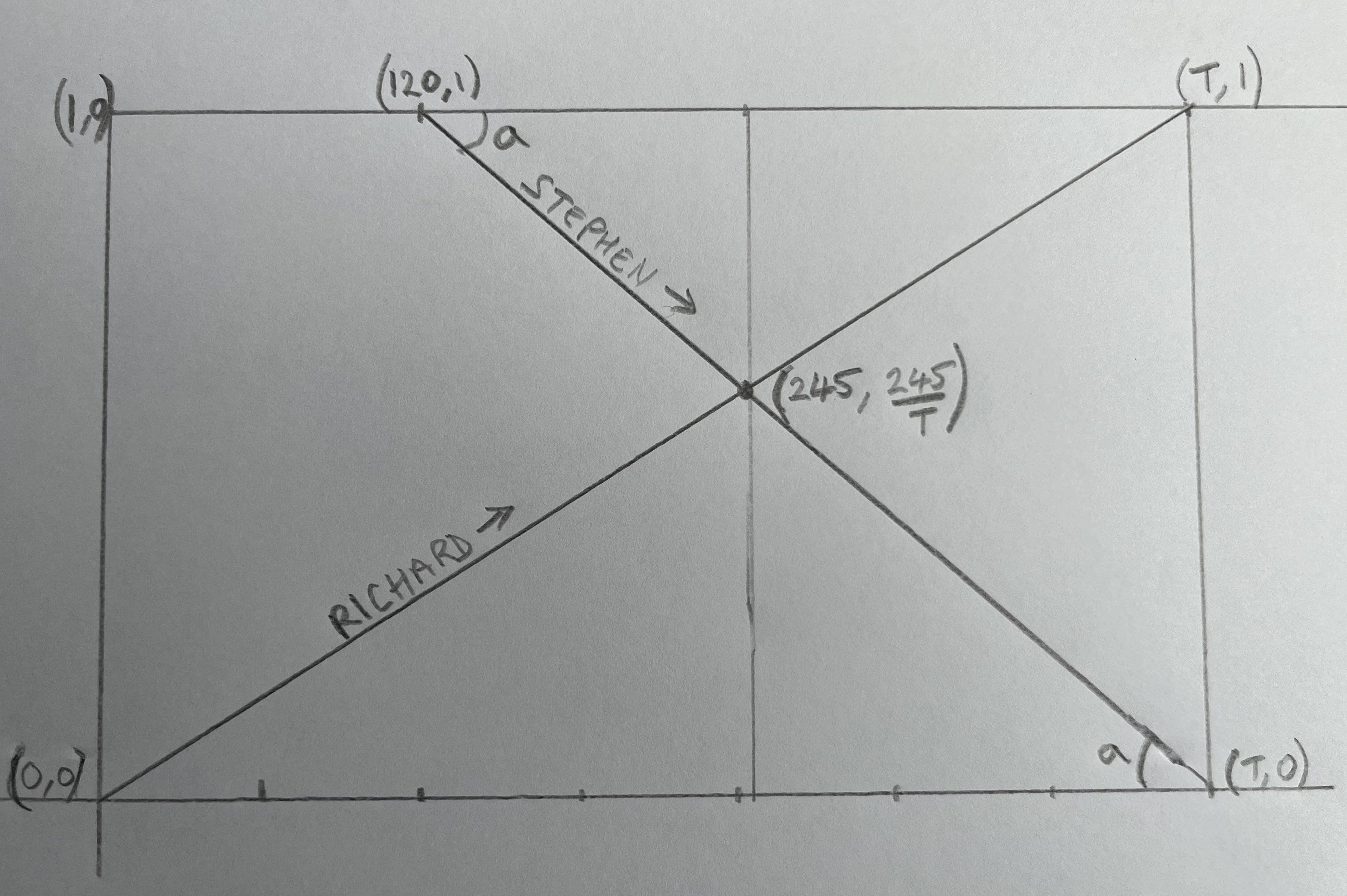
Y axis is distance, with y=1 meaning the distance between the towns.
X axis is time in minutes after 8am.
Crossover point is (245, 245/T) as Richard walks at a constant speed.
Using each angle a:
Tan(a) = (245/T) / (T-245)
Tan(a) = (1-245/T)/(245-120)
Giving:
245/(T-245) = (T-245)/125
245 x 125 = (T-245)^2
T = 420 minutes
1 Like
My trial and error technique started with relative speeds of 3 and 5, followed by 4 and 6 then 5 and 7.
I had expected to have to progressively iterate between (say) [3 - 5 and 4 - 6] or [4 - 6 and 5 - 7] … etc
But was pleasantly surprised when one of these pairings produced the requires outcome !
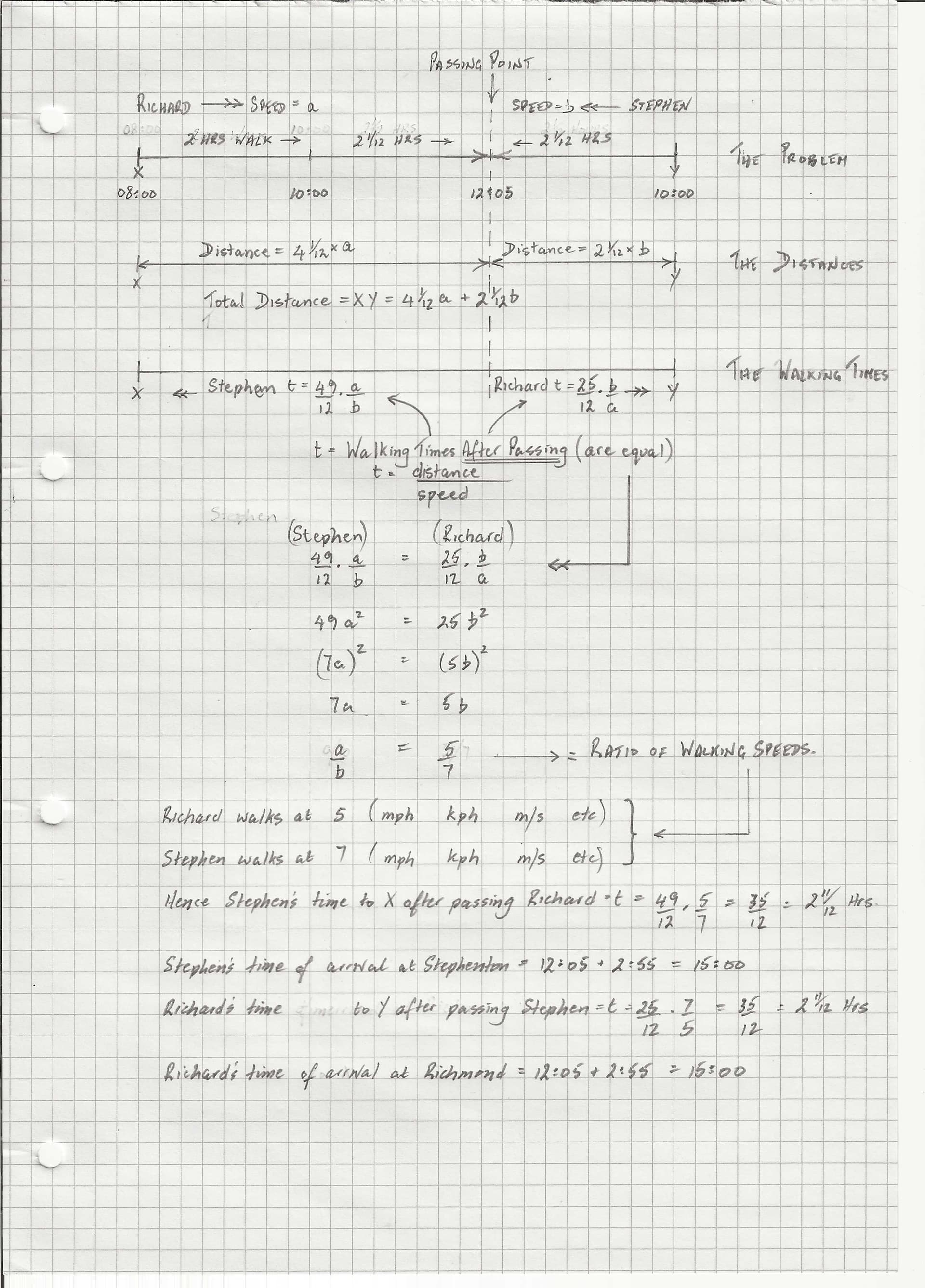
I have since done a bit of Speed = Distance/Time arithmetic to derive the answer. I’ll post the arithmetic in the next day or so to give others time to post their solutions. Meanwhile I’ll mention that mine includes a line that reads as …
(49/12)x(a/b) = (25/12)x(b/a)
… in which a = Richard’s speed and b = Stephen’s speed … and ‘x’ simply means ‘multiply’
I enjoyed Ravvie’s solution and of course SteveD was even quicker to post the correct answer with a teasing explanation !
My explanation is as follows, and uses the equation Distance = Speed x Time.
Say Stephen takes T minutes for his whole journey, then Richard takes (T+120) minutes.
If it is X miles between the two towns, then Stephen’s speed is X/T and Richard’s speed is X/(T+120).
When they meet, Stephen has travelled for 125 minutes, so his distance at that point is 125X/T.
Richard has travelled for 245 minutes so his distance at that point is 245X/(T+120).
These two distances add up to X, the distance between the two towns.
So the equation starts off at 125X/T + 245X/(T+120) = X.
Interestingly you can then cancel out the Xs.
Multiply both sides by T(T+120) you get 125(T+120) + 245T = T(T+120).
So the final equation can be reduced to Tsquared - 250T -15000 = 0
This factorises to T=minus 50 (impossible) or T=300.
3 Likes
Steve, that’s brilliant, absolutely brilliant.
I now feel almost reluctant to post my miserable contribution … but I will 
The -50 solution does make mathematical sense, even if it goes beyond the physical parameters of the puzzle. Hence it is correct to eliminate it.
Your quadratic equation gives solutions to the question “when will Richard and Stephen be apart by the distance between the two towns?”
If Stephen had been walking to his start point then at 9.10 (50 minutes before 10) then he would be 1/6th of the distance before his start point, so 7/6ths before the finish. At 9.10, Richard is at 1/6th of the way in. Hence they are apart by one journey distance.
I just mentioned it out of curiosity
2 Likes
Neat Ravvie, Neat
Once again it is interesting how 3 people have approached the problem from different perspectives.
I always seem to gravitate to some kind of equation, whereas Ravvie and Don often start more intuitively.
3 Likes
I was going to try and bang out some old school algebra too. I’m glad you beat me to it, nicely done.
1 Like
The BBC website today has published the annual GCHQ Christmas Challenge - a series of puzzles partly aimed at schools. Nothing hugely challenging to my 68 year old brain, but I’m sure I would have struggled as a teenager. Great fun.
1 Like
It’s less fiendish than previous years.
I have done all seven clues but only one of the two (?) puzzles from the front of the card
1 Like
I’ve only tackled the seven clues so far. I got stuck on No. 1 so did 2 to 7 before looking at No.1 again.
Surprising how the old mind can get locked into seeing a “dollar”, and thinking the third item might be a “hand-bell”. No point asking Mrs D for help … I know only too well that the buck stops here
Well, I eventually found time to tackle the two puzzles on the front of the card.
The morse code message was quite easy, despite a few letters being obscured by the various animals. (I learned the code more than sixty years ago !)
I guessed what the 4-digit codes associated with each animal related to. But it took a while to re-jig them into an actual message and the purpose of GCHQ.
Enjoyable challenge.
As SteveD said, Great fun.
I followed Santa through the sites and got the message, helped me with my counting (ahem) on one of the locations and finding that my fixation on the ‘Bill’ in question 1 was misplaced and realised I needed to try another solution!
Yes, that Dollar Bill was a concept that I found difficult to overcome.
And even though we’ve been living in Canada on and off this past 25 years, I still say (for example) “that’ll be ten dollars please” rather than use the colloquial term.
Funny old Money
Yesterday I was playing with two of my young grandsons and teasing them with how easy it is these days to add, subtract, multiply and divide when it comes to money. They are 6 years and 8 years old, these two have no problem with 3 x £2.25 = £6.75 or even with 3 x £2.75 = £8.25.
So far, so good !
But when I explained that back in the day when I was only 6 or 8 years old (they had difficulty getting to grips with that concept !!) we used £:s:d (that’s Pounds, Shilling and Pence for the non-Brits reading this, and even the Brits who are younger than 50 !!) they were totally out of their depth. Even when I explained that £:s:d was no more complicated than working in Base 12 and Base 20. Ie twelve pennies = one shilling; twenty shillings = one pound.
Nonetheless, after a few simple examples, they both seemed to have grasped the concepts and could quite happily manage 2 x £2 :11s :7d = £5: 3s :2d. (*)
So we moved on …
I asked them what was 2 x £6 :13s ? (we never bothered with the “d” pence if there weren’t any)
They each correctly answered £13 : 6s !!
Then one of them, the 6 year old, said “Grandad, that’s the first amount backwards !”
“Well I’m blowed” said I, “well spotted, the Shillings and the Pounds have simply changed places !”
I then told them that there was one, and only one, other sum of money, using just £ (pounds) and s (Shillings), and one (whole-number) multiplier, which will produce this situation where the Pounds and the Shillings change places.
They are still working on it – can you help ?
(*) Enjoy a cigar and whisky,if you are under 50 or a non-Brit, and you can explain your workings !
Merry Christmas Don, and thanks again for another year of challenges.
Eventually, with a bit of algebra, followed by some trial and error, I came up with the multiplier of 6 and the original sum of £2:17s.
No cigar and whisky though; I’m over 50, a Brit, and I can’t (adequately) explain my workings!
Thank you Steve, and a Merry Xmas to you and to all who contribute to or browse this thread.
And seeing that it’s Xmas, I think that despite your lack of qualifications, you should enjoy that cigar and whisky - well done !
Cheers
Don
Same result as Steve.
On the boarder line age so workings…
Developed a formula to link Pounds, Shillings and Multiplier pulling everything into shillings.
(20 P + S) m = 20 S +P
This gives S = (20m - 1) P / (20 - n)
Used this to work out ratios of S to P for different Multiples.
Only multiple that looked to give possible integer results was 6 (and 2). With 6 you have the ratio of 17:2 and low and behold it works.
Matthew
1 Like