As Ravvie has said, cryptic answers usually work quite well.
In this instance, (I think) the solutions to both versions can be presented as vulgar fractions. So I might suggest that a ‘D’ an ‘F’ and a couple of “E’s” would be useful ?
Perhaps JR could post one of the solutions (first-come etc) then you could post the other solution.
However, i’m confident that all three of you know both solutions, well-done !
No mathematical or other non-cryptic solutions yet, so maybe I should explain my cryptic answer.
Unlike exam questions (where all information is usually expected to be relevant), teasers often have unnecessary “noise”, which is intended to mask any key information. That didn’t catch out jrhardee who spotted the word “also”, which was the only piece of info that was relevant. Don removed this in the edit which changes things entirely. Two puzzles for the price of one.
Stripping out the noise, the modified puzzle is now: “Given 5 chocolate biscuits and 1 ginger biscuit, what is the chance that the second one is chocolate?” Answer is that each position is just as likely as any other. It might simplify things if we just consider the ginger biscuit instead.
A mathematical answer would be more robust and I think quicker to explain. It’s just that my preferred approach to such problem solving is lateral thinking (or gut feel) to simplify, then justified logic, then maths in third place.
I feel it’s time to put the lid on the biscuit tin and it’s associated teaser(s)
I’ve reposted the teaser in the form I initially intended so that we can focus on that version first.
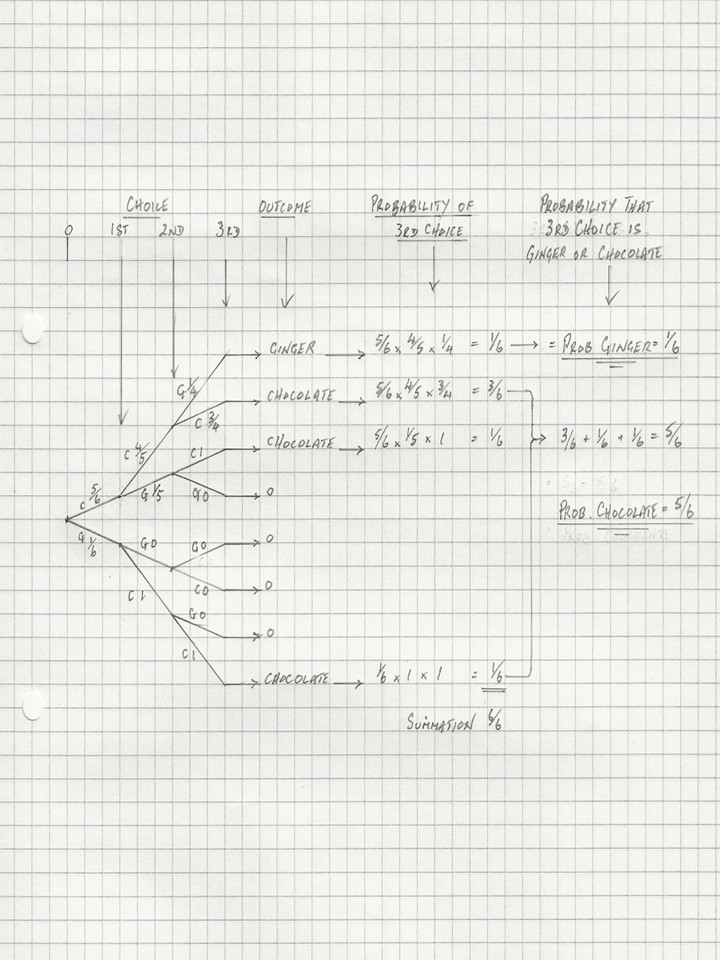
As Ravvie hinted, there is more than one way to tackle some of these probability teasers. I tend to use “tree diagrams” - at least that’s what I think they are called. But even then, as Ravvie hinted, you can either focus on the chocolate biscuits or the ginger biscuit.
The first is chocolate and the second is ginger, 5/6 x 1/5, or 17%.
If the first one is ginger, the second must be chocolate, 1/6 x 1, or 17%.
The first and the second are chocolate, 5/6 x 4/5, or 67%.
All of the possibilities add up to 100%, so I think I got there. The likelihood of the second one being chocolate is 17% + 67% or ~84%, ignoring rounding.
When I did the maths as a check that my logic was sound, I followed the same approach. Getting it to add up to 1 nails it of course.
Mrs R went with the ginger route. It can only be ginger if the first was chocolate, so the probability for ginger at the second round is 5/6 x 1/5 = 1/6. She concluded 5/6 for chocolate. She teaches probability and often uses the neat trick of looking at the thing we don’t want then subtracting from 1.
In my loose logic approach, I went with the ginger biscuit having a 1 in 6 chance of being picked at any stage, and as we are told nothing more, this remains the case.
If Don had asked a harder question, such as he chose and ate a third, fourth (or more) delicious biscuit then my answer would still be 1/6 for ginger and 5/6 for chocolate for the final biscuit eaten. As Don says, a probability tree diagram would show all the possibilities but such a maths approach could take a while especially if it was a large tin with various biscuits.
Thought I might post my Probability Tree, but extended to illustrate Ravvie’s observation that, not only will the second biscuit have a probability 5/6 of being chocolate, but so will the 3rd, 4th etc.
What a mess I created by including the word “also” in the initial text of the biscuit teaser !
Thanks to all who commented, I felt I had to remove the word to avoid potential ambiguity. The following conversation with Mrs D might illustrate the ambiguity I wanted to avoid …
Mrs D asked me “when do we place our bets ?”
I answered “right at the start, before any biscuits have been selected or eaten !”
“Oh !” she said “I thought you were inviting bets, after the first biscuit, (which I knew was chocolate), had been selected and eaten”… She continued … “So, I assumed I was now working out the probability of selecting a chocolate biscuit, knowing there were four chocolate and one ginger biscuits left in the tin !”
By removing that word “also”, rendered the teaser a bit less ambiguous - IMHO.
Note to Self “must try harder next time !”
Hopefully some of us enjoyed the teaser and the muddle. And especially Ravvie’s contribution about the third, fourth or fifth biscuit.
This afternoon, my two grandsons, Andrew age 6 and Brian age 8, (not their real names) told me they had between them £130 pocket money.
This morning, they pointed out, Andrew had given Brian £20 so that they each then had the same amount. How much did each have before Andrew evened up their holdings ?
You should try solving this in your head, which is what “Brian” (ie my 8-year-old grandson) had to do in school yesterday