It would be interesting to know which one sounded better and how that was determined 
1 Like
The one with the white spot and the black spot.
Double blind listening tests. There is a perfectly straight forward scientific reason, but the margins on this I-Pad are too small for me to set it out, so I’ll leave it for Andrew Wiles to explain … 
1 Like
Just as long as he doesn’t make us wait over 300 years for the answer!
1 Like
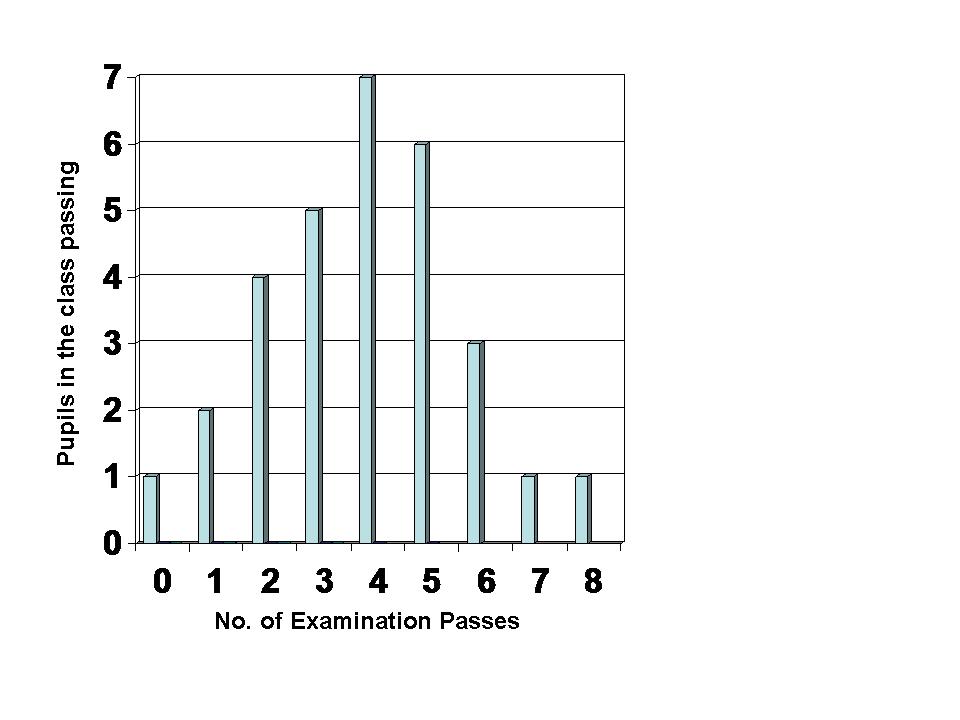
Exam Results
The graph above shows the results of a class of 30 pupils taking their end of year exams.
-
What was the average number of exam passes per pupil ?
-
If the top 5 pupils were not in this class what would have been the average number of exam passes per pupil ?
-
Assuming that 10% of the pupils took 8 exams, 70% took 6 exams and 20% took 4 exams, how many exam papers had a fail mark ?
I am not familiar with the concept of elective exams implied by the data (1 with 0 exam), but should I assume that a student can pass without final exams ? Or that he/she is removed from the dataset?
Maybe this is implicit or evident depending upon the country of the person posting the question: my apologies if it should be Clear
Best,
Louis
The graph shows that one pupil, out of the 30, didn’t pass any exams. That pupil could well have taken either 4 exams, or 6 exams or even 8 exams. They just didn’t pass any !
Does that help ?
Yes, thanks. I was surprised by the context, which is still not clear for the third question,though.
I was interpreting it as “how many times the students had to take the exam to finally pass it.” Out of 174 trials to have 30 final pass mark, il would have left 144 unsatisfactory trials. But that seems inconsistent with the context. I will thus leave it blank.
With this info, I would provide the following answers:
- 3.866
- 3.24
- blank…
Best,
Louis
On reflection, it’s a pretty mundane teaser. It just needs a bit of care. The answers are nothing special either - they aren’t “neat”, either as vulgar fractions or decimals.
So it’s not as if you get a set of answers that ‘click’ into place and make you feel confident about the result.
Between them, the pupils took 174 exams - which you noted. Not all of the pupils passed all of the exams that they took. The graph shows, for example, that five pupils only passed three exams.
Q3 simply wants to know how many exams In total, were failed.
30, pupils, with 116 passes. Gives:
- 116/30 = 3.87
- (116-33)/25 = 3.32
- (3x8)+ (21x6) + (6X4) = 174 exams- 116 passed = 58 failed.
1 Like
Mike,
All your Logic and vulgar fractions look right.
However, I recommend that you ditch that cheap Casio pocket calculator that you used to calculate 116/30
Well done !
Cheers, I’ll claim a typo!
Hi Louis,
first part answer is correct.
second part needs a bit more work - see Mike’s workings above.
third part, again, a quick look at my explanation and Mike’s post above, should help sort this one for you.
Hope the initial question now makes sense ?
Nice try !!
1 Like
Hey, I was using a $2k iPad Pro!!
1 Like
then you’d best swap that out for a cheap Casio pocket calculator after all …
… or try again when that EE8 switch has had time to burn in properly - it might be causing interference throughout your entire residence
1 Like
Re-arrange the letters below to form the First name and Surname of a famous person.
HORC TINS WULL HINC
Winston Churchill (but im useless with numbers)
1 Like
Nicely done Xenasys.
Who needs numbers anyway !
Following on from post by Don
l InhSiv Thnea eiT hFftO stltN Tghie eS i
Rearrange these letters to form a Song Title and Artist
Capital Letters are New Words
Have Fun
It is difficult to know whether some of the letters are “l for Small L” or “I for Capital i”