It is a plastic with graphite granules. It is probably just ordinary PTFE used in bridge bearings and other low friction applications. There are vary many variations that can be bought of the shelf at about €20 for a kilo of this material.
1 Like
That’s what I find always strange, which happens nowadays very much in online forums, when people claim something without even knowing in detail.
If I recall correctly: you have never used the product at all, nor specific details about the ingredients or talked to them to get a decent understanding?
And regarding the raw materials: they may be inexpensive, but that misses the point. Like cooking, it’s the formulation, ratios and behavior under load that determine the result – not the price of the ingredients.
There will always be scepticism about products such as this, which is not to say that they cannot work. I asked Mr Google and found a review that explained what they are made of. Of course, the relationship between the materials used and the end price is not direct, as it will include R&D and all sorts of overheads. That said, your opening post does read like some sort of sponsored advert, you give no information on what equipment you use these devices under, which makes people even more sceptical, and you do seem rather defensive.
1 Like
A Boa snake oil then.
I am always curious about this sort of stuff. I took a look at the manufactures site and looked up the probable materials. I read some reviews. I also read Headphonehonesty’s take on spikes.
Graphite reinforced plastics are used reduce friction and vibrations. But I admit I do not know how amplifiers, CD players etcetera sound better by using these spikes, as the publicity and some reviews state. For a start my amplifier and streamer do not vibrate in any way. My CD player might vibrate internally as the disc spins, but the case does not. So what am I trying to cure? My house and HI Fi support are not vibrating at all, except when we get an earthquake.
I cannot fathom how a metal or stiff plastic spike can induce vibration damping. In fact my Engineering knowledge tells me that spikes have absolutely no damping effect or function. The form of the object is irrelevant.
The damping units I have used to enhance Earthquake resistant structures, are complex layered units using these plastic materials. Machinery often has rubber mountings that do absorb vibration.
I find it incredible that €20 a kilo lump of engineering plastic, moulded or turned on a lathe is being sold for €780.
I am absolutely skeptical (as outlined in my first post) about that type of HiFi components too. And strange when sharing my personal experience is perceived as a sponsored ad 
Don’t know what you are trying to read into my opening post. As I stated clearly I have a vast experience in HiFi and also have been experimenting with isolation components over the years too. And I was just astonished to see that with Graphite Audio compared to the other brands I tried things now made a very noticeable difference. I tried it with streamers like Holo Audio Red, Lumin U2 Mini or amps like Accuphase E-5000 or Devialet 220, sadly SuperNait 3 currently just not available - all placed on a wooden rack. So I am gladly telling you about my experiences, there is nothing to hide.
Vice versa it might benefit your view if you make yourself more familiar with the topic of isolation. You are just stating that things didn’t make a difference for you. So you provide no information at all just claiming things. You see for yourself how this ends up 
I am no spokesperson of the isolation devices industry Just an open minded Hifi enthusiast that is willing to try out things and assess them on their performance. There are so many people far more experienced than me (who are doing reviews and providing science papers etc.) that can give answers to how things have an impact (even a short AI search might shed light on this for you if interested).
In the end I am quite scared to see how this thread evolved, getting offended when I just wanted to share some exciting experiences - which could be about any component in a HiFi setup. But obviously I didn’t know that when talking about cables, switches, accessories has become somewhat of a taboo here 
1 Like
I’m impressed. And some girls are bigger than others.
I don’t think you need to be offended, the replies on this thread are normal when you post about any kind of alternative or enhancement accessory. It’s all part of the way it is on forums, and I will say the Naim forum is more polite than some of the other forums.
1 Like
Well seems I am not used to that I thought for those people interested or willing to try, it might be something to think about, and others won’t care anyway.
Don’t worry about it, people get offended at the drop of a hat.
Last weekend people where offended at the image of an amplifier because they didn’t like the colours of meters, logo and buttons. 
1 Like
Well, probably the most important property of grey cast iron is its ability to absorb vibration.
And by coincidence (or maybe not) it is presence of carbon in the form of graphite flakes that is responsible for this property.
On the other hand spheroidal graphite cast iron (SG Iron) contains graphite in a spherical form. This does not have the same vibration absorbtion property as grey cast iron.
So, I wouldn’t be so quick to dismiss the possibility that a combination of graphite and plastic couldn’t (in a specific form and ratio) be effective at damping vibrations.
3 Likes
I am not offended. You are talking about a very expensive product, that merits closer inspection.
The manufacturer provides no technical backup to his claims. Some frequency graphs would have been cool.
Lets look at spikes. Quote Norman Varney of AV Room services. Your spikes are in rigid plastic BTW
Coupling vs. Decoupling:
To isolate means to decouple. EVPs decouple and “float” resting equipment, while absorbing vibration energy. A proper decoupler must be able to handle the load without compressing too little, or too much, in order to function. EVPs have no natural resonant frequencies in the audible bandwidth. They will even mitigate subsonic frequencies where footfalls and feedback can present problems.
Spikes, blocks and cones are couplers. They act as filters by attenuating some vibrations and amplifying others. Always unique and never neutral. A different sound doesn’t always mean it’s better. Hard feet couple vibrations to whatever they are touching. Think of a tuning fork handle placed against a shelf. The shelf becomes a soundboard. Rubber type pads are limited in bandwidth and in load handling. They too alter the sound, but not eliminate the problem. Decoupling is the correct solution to preventing vibration transmission and removing resonances.
Here is a EVA/EVP
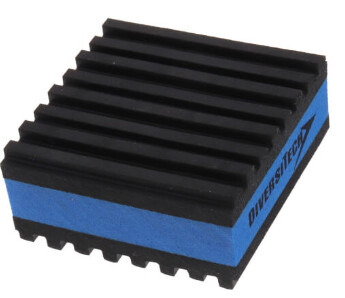
E.V.A. Anti-Vibration Pad, 2" x 2" x 7/8"
Cost $1.09
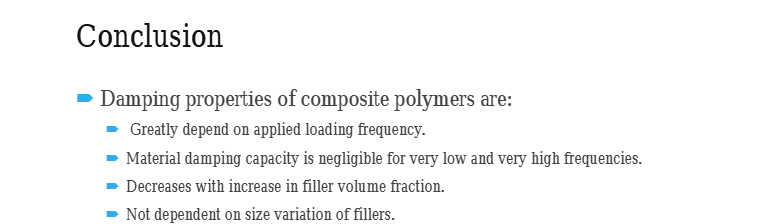
Here is a scientific paper that is interesting (Link)
A study of graphite filled polymer
I have come to the conclusion that this product relies on psychoacoustics for it results.
I will be happy if somebody with solid data can prove me wrong.
One site selling them writes this.:
« Graphene, despite the fact that it is composed of a single layer of atoms, is considered the most solid material there is: it has a breaking strength 100 times greater than that of a layer of steel of the same thickness, which means that it is even harder than diamond!«
Actually around 4, and it is a “fragile” material.
There are few industries where so much money can be made with relatively little proper R&D like HIFI accessories. I am no material scientist and I guess most concoctions and weird and wonderful shapes can re direct/change vibrational behaviour/frequencies one way or another. For good or worse. The material and weight above (and under!) these will likely also influence the result. How can one possibly know the result without sophisticated measurement equipment? I certainly would not want to rely on my ears, unreliable as they are.
Bit like playing the lottery and individual success or otherwise will likely differ.
Then there is the issue of damping or directing energy away.
I personally don’t know the answers but generally tend to err towards damping components and use elastomer like products such as rubber and sorbothane (which then need to be the correct compliance for the weight they need to support). Minefield but at least it’s cheap enough.
My 2ct’s only
2 Likes
Ps. I can’t edit posts but I do of course also rely on my ears when adding accessories like most so my previous remark that I would not is wrong.
Correct.
If you take a look at Naim equipment.
If it has some form of vibration isolation inside the box (spring mounted PCB) the feet are usually rigid. (aluminium).
The lower priced equipment that doesn’t have internal vibration isolation usually has rubber feet.
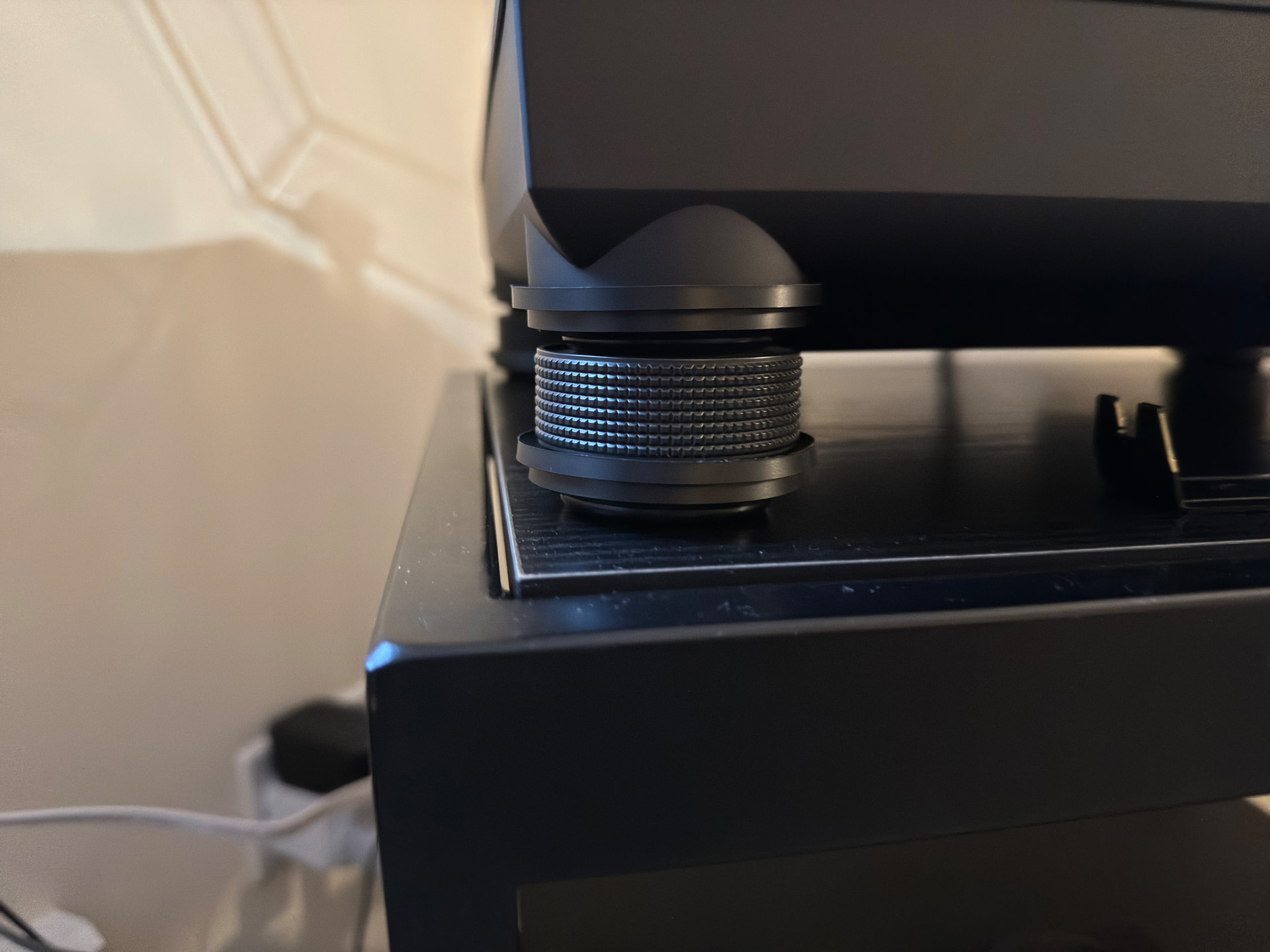
So, as you say, buying equipment cones is a lottery. The guy in the video linked above says cones sometimes work, sometimes they don’t. But he also said the Graphite Audio cones work more often than other cones.
And, let’s not forget there are people shelling out £600 for a power lead because they believe vibrations are prevented from entering the box by AIR. How much does that cost a KG. 
Are people screaming to see the evidence? Is there any evidence? 
I use an nDAC, which surprisingly doesn’t have any internal vibration damping. The Graphite Audio cones might be a good option. I’m torn on how to waste my money. Cones, LPS for my streamer or high quality SPDIF cable.
1 Like
Your DAC has no moving parts, so no vibration control is needed. Check out “AV Room services”, you explain why spikes do nothing and may cause the sound to be worse.
You will better wasting your money on “Wine, Women and Song”. At least you will have fun.
1 Like
But there is a transformer vibrating away in the nDAC.
It’s sat on a rack with two power amps vibrating away and a pre amp power supply vibrating away.
But I do like your suggestion. 
1 Like