Yes its just a couple of taps on the ipad away from being switched on and off.
1 Like
Correct that’s the beauty of it. This way I don’t have to fiddle with the volume knob
1 Like
I could use it on occasions like now when I have roon radio playing classical music in the background. 
1 Like
Steven Wilson remixes have very good dynamic range, there is real intent here to not compress things, I have a few Jethro Tull SW mixes and they benefit from modern mastering/mixing whilst maintaining the integrity of the original recording. I also think some of the Island CD remasters sound very good to my ears.
3 Likes
The first few hours with the NDX2 I think listening FLAC>WAV from the NAS the loudness wars are curbed? Of course a way to go with the run in as well.
Usually not a problem for a decent amp, a bit more a problem for the tweeters, and definitely for older ears!
Congratulations for your purchase, I hope you’ll enjoy it, I love the NDX 2. Now you just need to be patient for the run in. Out of curiosity do you notice a difference between flac and wav so far? I know some will argue with that.
Bear in mind that loudness and compression are not the same thing.
And the loudness wars weren’t confined to CD media either but also players. In the 90s we saw the output voltage of CD players change dramatically to game A/B listening tests for reviews. Things started out at 1.8v and quickly starting edging 2.5v and higher. You put two CD players on an amp and the customer expects you to not touch a dial on the amp, just switch inputs and invariably to the untrained ear in a short dem going for the louder of the two as their winner.
As for the media itself, finding the right recoding level was tricky, Early on in the life of CD it was noted that the noise profile was opposite that of vinyl. CD suffered less at higher recording levels where vinyl at lower.
The recording level doesn’t bother me much. I have a volume knob that so far has miraculously worked fine on any amp I’ve had in the last 30 years. Strange but true 
Compression is a different matter of course. Noticeable compression is jarring and odd and feels like the audio roof has caved in. But let’s dispel the notion that good recordings don’t have compression. This is false. In fact it is needed to make a lot of things listenable and balanced. I used to go to a lot of unplugged gigs and it was atrocious but a great example of what you get with no compression and level adjustment. Which is to say, every band is reduced to one drummer and their backing band. The artistry is in apply it so it isn’t noticeable and feels like a natural coherent ensemble - applying it on certain sounds in the mix at certain times, not the whole thing.
The canons in the 1812 Overture are also a great example. Generally rolled out by enthusiasts to show what real uncompressed dynamic range is like. And yes, a good recording has great range and on a lesser system can definitely damage equipment. But thanks to very skilled production and a touch of compression, your windows will not shatter nor a more capable amp or speaker suffer damage.
3 Likes
Phil @Cymbiosis set me up for FLAC>WAV and the first rule of hifi should be leave well alone. And it’s sounding superb, so leave it there I say. And in any event busy enough

1 Like
I don’t know a solution for older ears but Super Tweeters definitely help !
With my REL Sub and PMCs those canons scared the life out of me!
In November last year, John Darko interviewed a well known figure in the vinyl ripping scene. This piqued my curiosity, so I decided to see what all of the fuss was about. I sourced a few vinyl rips of albums where I already own the CD or the download version. Roon allows you to see the volume of the wave form and the vinyl rips were, without exception, much quieter than almost any CD and far less compressed.
This is interesting - theoretically CD/digital has greater possible dynamic range than vinyl, but due to mastering decisions, the real world reality is often radically the opposite.
This is not always the case though. Some of you might be familiar with the record label, Telarc. I have an old Telarc CD of the 1812 Overture. This track has absolutely massive dyamic range. With the volume loud enough to enjoy the quiet parts of the track, your equipment will be in genuine peril when the cannons fire.
A lot of this comes down to use case. If you are listening in a quiet environment at home, then high dynamic range can be much more impactful. However, in a car, train, or anywhere else where there is a lot of background noise, compression helps to make the track listenable at sensible volume levels.
So vinyl might be seen as the “audiophile’s choice” but there’s no technical reason that those same masters couldn’t be made available on CD/download. However it would be a niche use case, because the majority of people in the majority of real world settings benefit from compression.
2 Likes
Sorry, I missed that you had posted about the 1812 just before me. 
What’s a good online version to test this with? Will it be okay on my system - ND555/552/300.
Not knowing your speakers or how loud you crank it in what sized room, I couldn’t possibly even guess.
But I’m sure someone over in the classical music thread can recommend the best version and I’m sure loads of Naim customers give it some welly and I don’t see any “The 1812 blew up my system” threads.
1 Like
Telarc rather liked creating albums with huge (excessive?) dynamic range. Their version of Ferde Grofé’s Grand Canyon Suite has a real thunderstorm spliced into the last movement which some claimed to shatter windows. Like the 1812 disc and several others it includes a warning about potential equipment damage, but that always smacked of macho posturing to me.
However these are not really representative examples of orchestral music. More so would be large scale late 19th and early 20th century pieces such as most Mahler symphonies. Recordings intended to be played back in a domestic setting cannot realistically accommodate concert hall levels of dynamic range and as others have said need to be balanced by a skilful recording engineer.
I recall attending a performance of Vaughan Williams’ Sea Symphony with a massive orchestra and a choir of over 200 singers. The piece starts with a brass fanfare, then the chorus comes in fortissimo followed by the orchestra. In the Bridgewater Hall it was overwhelming but I remember wondering whether a recording could deliver the same physical effect. As it happened, the performance was recorded and subsequently released as a CD so I was able to check it out. As expected, it comes across as a fine performance but with the impact of the opening toned down. Some compromise for practical reasons is inevitable.
Roger
2 Likes
It’s likely that you will be ear pain limited rather than equipment damage limited. I still contend that any system can be damaged in the right (wrong) circumstances, unless it has protection circuitry of some kind.
1 Like
The classic hifi nut’s version of this is the 1978 recording by Erich Kunzel and the Cincinnati Symphony Orchestra. It was so famous, they re-recorded it in DSD in 1998/99 and released it on SACD. They also released the original 1978 cannon recordings on a sampler disc in 1988. Here they all are:
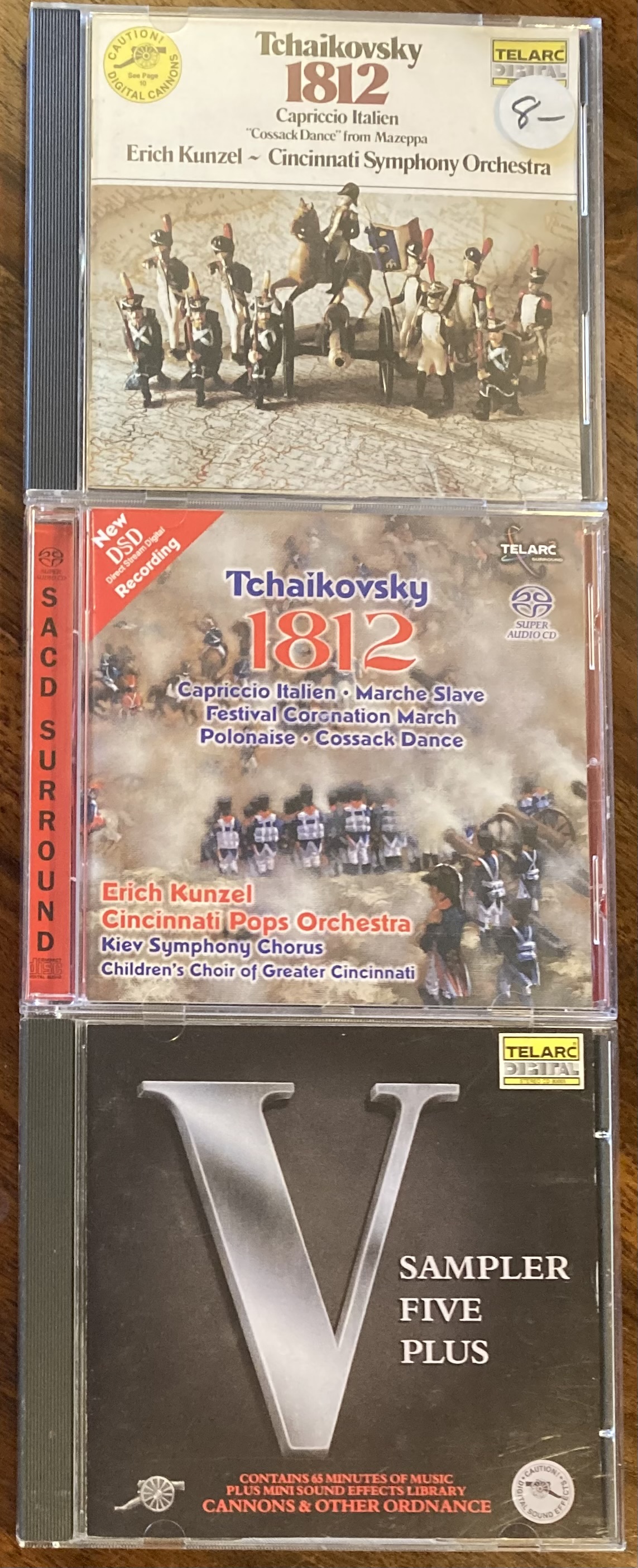
(Yes, I own all three - guilty as charged!)
The first two are currently available on Spotify so hopefully are on other streaming platforms too.
The cannons were overlaid on the orchestral recording in post-production so they are beat-perfect (according to Tchaikovsky’s score), unlike every other recording I’ve heard where the cannons crack and rumble rather randomly.
To be fair to Telarc, they only warn generally of damage to equipment if played too loud. There are plenty of descriptions online of the 1978 vinyl as a ‘famous torture test’ for turntables but the cannons usually just make the stylus jump out of the groove rather than cause permanent damage. Claims of smoking or exploding equipment were, I think, circulated by third party reviewers. Claims of smashed windows might be traceable back to the 1978 liner notes which describe a window being smashed by one of the cannon shots as they were recorded, not as they were played back!
2 Likes
The traditional request on a master was about 65dB dynrange for living-room-listening, thats where the record buyers felt comfortable. Which is about what you can get from vinyl at slightly above 70-72dB.
If you have to turn the volume down the details disappear in environmental noise and the recording sounds flat and boring … like an audiophile record 
1 Like
I had a copy of the Telarc 1812 on vinyl many moons ago and if played too loud the speakers crossovers would desolder themselves which my brother in law at the time used to find really amusing, huge dynamics, happy days😂.
2 Likes