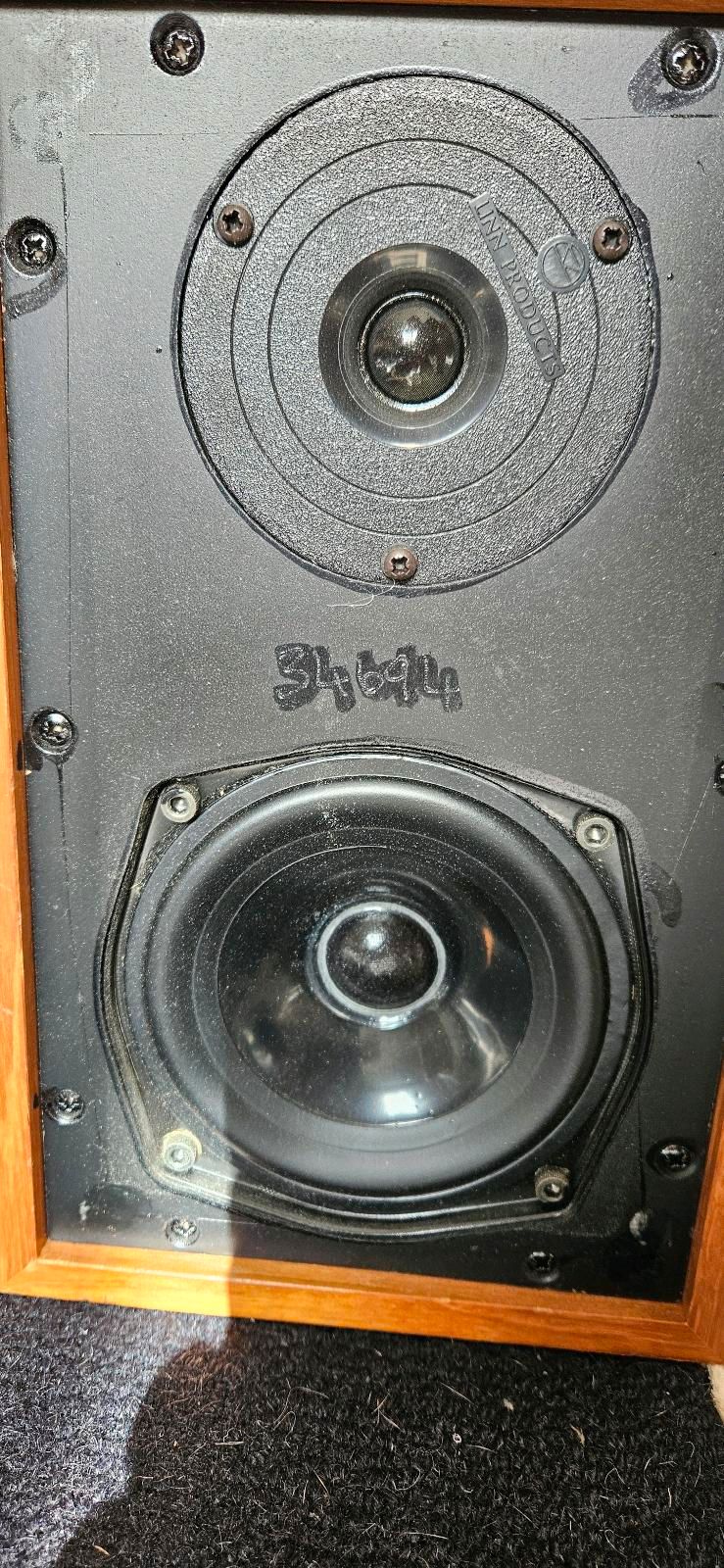
Those Linn modifications are actually surprising important and effective. I’m not sure if pushing a soldering iron through the neck of the driver works (I think this was more for the Saras where you have that 8" driver rising response) but the doping on the surround (on the Isobariks only, though) definitely does work and is doing the same thing as the PVC surround of the later units which is taming that surround impedance mismatch. The black goo also works well, but particularly in making sure that the pressed steel chassis doesn’t buzz against the magnet - so it’s not so much an improvement as a worthwhile precaution. By far the most important thing, though is sealing the cabinet completely. A near seal is nothing like enough and the mistake most people make is forgetting the porosity of the MDF/chipboard. This needs to be sealed with something like roofing tar before sealing round the drivers and terminals.
It’s a shame that KEF didn’t make a version of the SP1228 with the same voice coil as the SP1057 because it is a significantly better driver. I’ve been this route myself, from 1003 to 1057 to 1228 and it is a whole different world once you get to the polypropylene cone (1228). The SP1057 is a step up too and that’s what I would go for with Kans, but with the Mk1 crossover. It probably doesn’t matter much which tweeter, though the different throat treatment seems to give the Hiquphon a bit more airiness, removing some of that Scan Speak darkness. Internally it’s a direct lift of the Scan Speak (and they would end up paying damages to Scan, albeit 10 or 20 years later after they’ve made all the money).
One thing that occurs to me as I write this is that if you are going to drive them actively, it doesn’t matter what the DCR of the B110 is, so you could use an SP1228 as the bass unit and get rid of all that midrange colouration (and, frankly, losing nothing). That and the Hiquphon tweeter, plus perhaps a bit of LS3/5a style treatment around the tweeter, could well be the ultimate Active Kans setup. (Don’t change the bass unit mounting to LS3/5a style mounting from the rear. That’s a terrible idea for all sorts of reasons.)
That’s the Linn version (made by Hiquphon). Linn part code is D20-LP-1.
They are no longer supplied by Linn so it’s either a case of finding a second hand one (easy to do, but there is a risk that they are not 100% right) or else Hiquphon still make one that they claim is a direct replacement, part code OWI-92, costing £300+ per pair. They are hand assembled by the original designer (Oskar Wrønding) who claims many small improvements have been possible over the past 30 years since supplying Linn. If buying new then I recommend replacing both units due to these claimed improvements so that both speakers sound as similar as possible.
I have heard a refurbished pair of Kans with OWI-92 tweeters but many other changes were made at the same time. The upper frequencies were certainly clearer than any other Kans I’ve heard. If you’re sure that you like what Kans do then I think it’s a fairly low risk upgrade to some very old tweeters, also bearing in mind that the undamanged tweeter might not measure very well despite appearing fine.
Maybe. I’ll give you my reasoning for that conclusion. Each time KEF made a change to the B110, which was precipitated firstly by the comparatively huge peak and dip at 1k and 1.5k respectively, then secondly by the need to get rid of the “bextrene bark” by changing over to polypropylene for the cone itself. The PVC surround of the SP1057 did a superb job of flattening that 1k region but it did seem to lose a bit of sensitivity. This didn’t matter with the Hiquphon tweeter, which was also slightly less sensitive than its Scan Speak predecessor - though you wouldn’t have known it from the sound which was airier and more open than the D2008-8512. The SP1228 somehow lost even more sensitivity. I’m not sure quite how this happened and whether it was a slightly heavier cone. Somewhere I have some measurements done at KEF with Andrew Jones (in the early 1990s!) of the 1057 vs the 1228 which will be bang on but they will need a bit of processing and at the moment I can’t seem to find the files. From memory, though, I thought their specified 86dB/Watt was a bit optimistic, versus a very comfortable 87dB/W for the SP1003 (original B110). I ended up designing new crossovers for them but they did work OK in a Kan sized box, albeit with a slightly higher Q. (You may remember that KEF’s Reference 101s used a slightly larger box than LS3/5a they had made up until then.)
Interestingly, the very first Kans used the same crossover as in the Saras which, on the tweeter was just two capacitors and an inductor. In an effort to tame things from that original rather wild and fun speaker, Martin Dalgleish put a resistor to ground across the inductor which was a great little tweak, and I think he also may have reduced the opening capacitor from 4u7 to 4u5 - again, something that works very well. Martin was great at these little tweaks and it was really him that made sure the Linn speakers didn’t lose their magic as they were being improved.
Now the reason I think this might work OK is that the original Kan 1s didn’t have this 24 Ohm or 27 Ohm resistor so you may have a route to taming the treble if you find there’s too much of it. Likewise with the 4.5uF capacitor if a 4.7uF is fitted. You’ll be hard pushed to tell the difference straight away with either of these changes but they each take you one step closer to more controlled behaviour, which is very much a characteristic of the SP1228. The lower DCR of the 1228 (6 Ohms vs 6.7 for the others) will move the crossover point slightly downwards and change it’s shape a little - moving in the direction of a Bessel, though probably not getting there entirely. I do have a simulation of this somewhere, so could let you know what the change should be, but my suspicion is that it will probably be lost beneath the rather more massive change of the drive unit itself. It is just so much better as a drive unit that you’ll be listening to that more than a small change in the crossover. As is so often the case with these things, you’ll quickly assimilate all the improvements and soon forget how much better it is, but your standards will have risen. If you’ve got nice kit beforehand then you might get to hear more of what that’s doing as another part of the improvement. But the important thing is that, when this all settles, you don’t have a balance that’s too heavy on the top end. I think these tweaks, plus the possibility of a Hiquphon tweeter, could just make it OK. I’m not going to bet my life on it, though.
If I can dig out the simulations I did (plenty of years ago) I’ll post what the voltage difference is going to be but I suspect it’s going to be on the borderline of significance. My slight worry is that the cleanliness of the SP1228 might leave the treble slightly by itself, hanging out to dry. If that doesn’t happen obviously then you could well be onto a winner.
I can well imagine that might work quite well. One of the factors that’s always present when designing small speakers is that the packaging tends to mean you have the same distance from the tweeter to its three adjacent edges (or as near as dammit) so the diffraction effects all hit in the same place. I’m not sure I would go quite as thick with the felt as they did in the LS3/5a but some way of ensuring the tweeter doesn’t “see” the cabinet edges or the inside of the grille will almost certainly be a good thing. Maybe a sloped bit of felt, or perhaps what Wilson did around their tweeters (which amounts to approximately the same thing) could well do the trick. Funnily enough, even though diffraction can wreak havoc with the measured frequency response - especially when people don’t bother to sit the tweeters flush with the cabinet - it’s surprisingly hard to hear at higher frequencies and doesn’t tend to change the character of the speaker. Getting rid of it, or controlling it, just elevates the speaker a touch, making it a bit more civilised and controlled - but it’s not as though it was really bothersome in the first place, especially in the context of energetic, fun speakers. I suspect that part of what the LS3/5a felt did was both reduce and push the diffraction effects up in frequency to a less audible region. This might be worth recommending to @Schnuffsche as well.
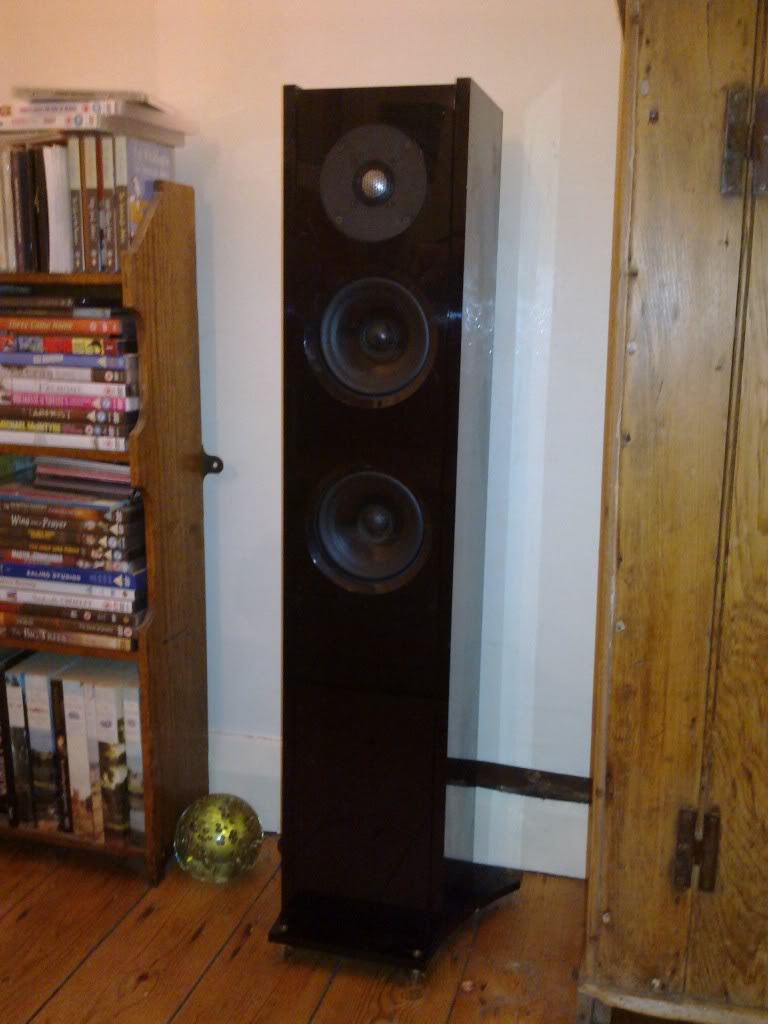
I haven’t used Kans for ages but I guess my favourite ones are the later Mk1s, when they had run out of the Swisstone LS3/5a boxes and went over to making the cabinets in MDF. If they did those with the Hiquphon tweeter (and I think they might have for a bit) then those would be what I’d go for. The problem is that you really need them to settle into your system and have you get used to the colouration. When I’ve had them come through the house they really are just too coloured when you first put them on and I’m not sure they really make the cut for what I’m used to nowadays. However for a full decade or more I did use something similar with SP1228s but each with an extra bass unit to extend the low frequency cutoff to -6dB at 38Hz. I used various different tweeters on them, including the Focal tweeter that Wilson and Neat used (though I think the Wilson version was a bit older). If this photo uploads, they’ve got a SEAS tweeter in this photo, which probably would have been better in its fabric dome version. These were in a system that was deliberately non-critical (as I was then doing critical listening almost every day) and were on the end of a 32/SNAPS/NAP120. It was actually a truly gorgeous system (as you can probably imagine from the amplifiers) and just kept on performing year after year, really never putting a foot wrong. It also kept my sanity when I made mistakes like trying to use aluminium coned drivers. The precision was always impressive but they were never going to give the long term satisfaction and freedom from getting upset that the older tech was so obviously giving. There’s nothing quite like getting to the end of 10 years and realising you’ve never once complained about the system, even to yourself. Of course the amplification played a big part in making that possible - and nor was this predominantly vinyl either, it was any source at all from TV to YouTube, DVDs and CDs. It has always been a source of wonder to me how well Naim amps work on sources that weren’t even around when they were designed. I had once thought that the magic was probably in the phono stages but that just isn’t so.
For general information, those cabinets are 16 litres nominal, so effectively 3 Kans high, with the other dimensions being approximately the same. You can also see the mistake I made putting the tweeter the same distance from each edge. These days the tweeters would go in a waveguide and there are a fair number of other things I would do differently like sharing out the displacement of the drivers a bit better.
Thanks Thomas, including sharing your speaker build.
That’s certainly a nice pre-amp you had there, esp. with Kans. Unfortunately, I’ve never heard the NAP120.
I too find the coloration can be quite severe by modern standards although I find it varies in form between iterations, or perhaps it’s just the way my units have aged - there’s no way to know. My SP1003/Hiquphon pair (lightly restored) are more shut-in but have more bass, so sound more balanced. And my SP1057/Hiquphon pair (untouched) are clearer but sound thinner and are more peaky in the upper mids. The best Kan 2s I’ve had in recent years were more neutral but not as magical.
I am in the process of building my attempt at super Kans - job commitments have prevented me finishing this - but this project will be restarted in 2025 (when I retire - yipee!). My Kans…use an 18mm rock solid birch ply heavily braced cabinet - too many details to list…I have constructed 85% - I just need to rebate the tweeter. I will be mounting the crossover externally in a box at the base of the speaker stands. I have hard wired the crossovers…but I am not happy with the iron core inductors and capacitors - so will be looking to use air core inductors, decent poly caps … matching the original values…I am hoping having a remote crossover will improve sound quality - as the crossover is outside magnetic flux of the driver. Time will tell…I will do a full update when tested.
I am amazed by the level of knowledge and detail you have on the Kan particularly and on speaker construction in general. As I joined this forum only recently and hence might have missed, may I ask you if you were professionally involved in the Kans at any time?
Interesting,I tried 3 pair of Kan on top of each other with a 3 way Naim Snaxo active crossover, it sounded rather good ,but in the end I preferred
on pair of Kans.
I have had about 20 pairs of Kan ,I think early Kans with SP1003 and Scanspeak tweeters are the most musically fun to listen to.
I remember a forum chap from long ago did a home brew rebuild of
Kan /IBL
He built the Kan drive units etc into Naim IBL cabinets.
I never heard them though.
Wow,interesting and good to know if my IBL´s should need replacing of Bass/mids ! The IBL Bass/mid were based on Kef B110 baskets, but with Paper cones ,I’ve heard.
My whole thing with the Kan … started when I made up a little sealed midrange box for a 3 way speaker…based on a Kef kit. I tried the B110 driver with just a 3.5ltr cabinet - made of 9mm ply and stuffed with glass fibre wadding. I tested the drive unit - in this cabinet and was blown away by the clarity and naturalness of voices… I later auditioned Kan Mk1s which I liked but as a poor student could not afford them…always liked their verve… I quite liked the polite LS35A less boogie but more full bodied…and then there was the Kef 101 Reference which was also very good a sort of halfway house between the Kan and LS35A. The 101 uses a slightly larger cabinet which is around 6.5ltrs I think…which improves bass a little… My Kans have around 6.5 Ltrs - so it should be interesting…for some reason the B110 unit although old tech…is very natural in the voice range…just love them. The white paper produced by Kef indicates that its ok to use this unit …with up to 8 ltrs of volume.