Are they finally transitioning to 100% Olympus??
1 Like
Soulution 717 in “The Absolute Sound” February issue 
1 Like
Another option has come up: Gryphon Antileon EVO …
3 Likes
I auditioned the Gryphon Antileon Evo yesterday. Sadly not with Magico. The dealer had the Gryphon hooked up to Wilson Alexx V’s fed direct from a dCS Bartok streamer/dac. So a “mullet” system, even though the back end electronic were by no means budget bin stuff!
Hard to say what was the electronics and what was the $157,000 loudspeakers, but wow that Gryphon-Wilson rig sounded good. I heard the Cleveland Orchestra do an outstanding performance of Shostakovich’s 11th last week, and the Gryphon-Wilson combo did a credible job of making a recording of that work competitive with my memory of the live performance.
For those keeping score, the sound was very much in the same family, to my ear, as Pilium Leonidas + Magico A5s. Both amps have just astonishing grip. Liquid but not smeared. Precise but not analytic. Really wonderful.
Comparatively, the Gryphon-Wilson rig sounded a bit darker, not veiled at all just more foundational. Not sure if that was the electronics, though, or the 10.5 inch and 12.5 inch woofers of the Alexx V. The Pilium-Magico to my memory was a bit faster. Both VERY different from Naim, which is also of course absolutely great but in different ways.
Lots of fun. If I go further down the Gryphon road, I will start a separate thread.
6 Likes
Hi @Middle
Be careful not to fall into the trap of that kind of demonstration
Good loudspeakers will always sound good, even when driven by more modest electronics.
As I mentioned earlier, I ran a Hegel H590 with my Magico M2s for some time.
That’s what you’d call a “mullet system”.
And honestly, it sounded really good. I’d even say unexpectedly good!
The speakers are doing a huge part of the “job”, so that’s something worth keeping in mind.
Another point to consider: the Gryphon Antileon Evo is pure Class A, and it runs very hot.
For a while, the Gryphon Apex Stereo was on my shortlist.
What ultimately took it off the list was its sheer size and the fact that it’s Class A
It’s a genuine radiator !!!
Great in winter, but once spring arrives… it becomes a bit of a challenge.
I wasn’t expecting this, but I actually have a similar issue with the Soulution 717.
It’s not strictly speaking Class A.
It’s Class A/B with a very high bias : 300 watts.
In other words, it operates in Class A up to 300 watts.
Which means, class A most of the time.
That’s great, because you get everything Soulution is known for, combined with the liquid, effortless quality of Class A amplification.
But it really is a toaster. One has to be ready to live with that.
That said, I have absolutely no regrets. IMO, the Soulution 717 easily sits in the top 5 of what’s available today.
So… be careful what you wish for 
Cheers,
Thomas
5 Likes
In other words, it operates in Class A up to 300 watts.
Which means, class A most of the time.
Err i don’t think so, the 300 watts is its power consumption at idle, this is high for a class a/b amp, believed to be implemented to try to enhance sound depth and temperature. So it doesn’t ever run in just true class A, its a class a/b amp, plus it certainly doesn’t run 300 watts in class A as in power output to speakers, i think its a 150 watt amp into 8 ohms.
4 Likes
Again?! 
You do seem to enjoy contradiction…
Dunc, you’re once again presenting your opinions as facts…
I spent a couple hours in Dulliken (CH), with Fabian Morant R&D director at Soulution ; the guy behind the 717.
What I stated above is perfectly accurate.
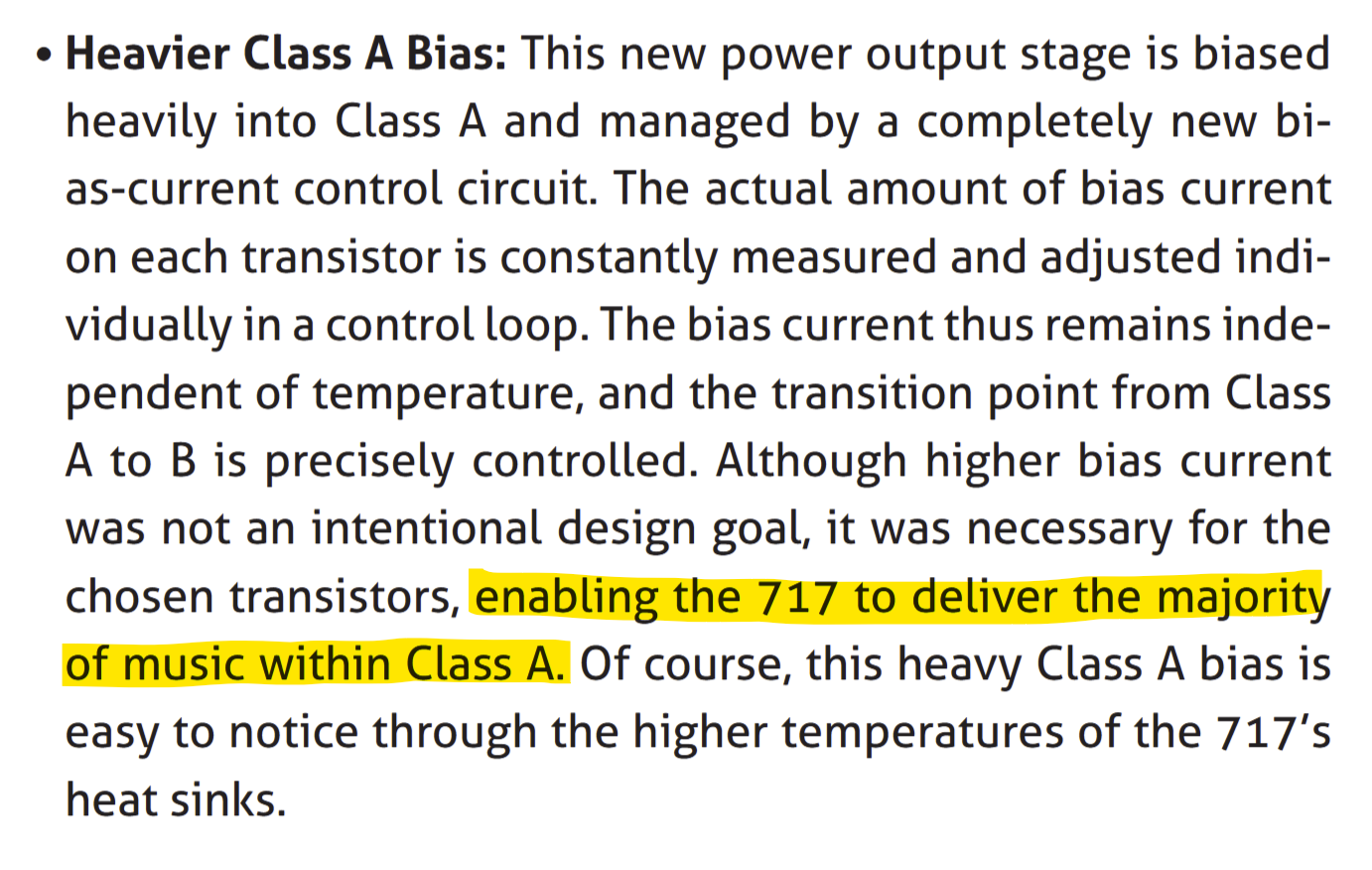
You can also read Fabian’s interview in the latest issue of The Absolute Sound, where he explains what I summarised above.
This is a response from Fabian, taken from the latest issue of The Absolute Sound. :

3 Likes
@Dunc is correct. The Soulution is a Class A/B power amplifier; which means it uses complimentary pairs of transistors to amplify the positive and negative portions of the signal. Class A bias is used in A/B designs to, among other things, minimize crossover distortion.
Very much like my 30 year old Nelson Pass designed Adcom GFA-5500, the 717 uses significantly more Class A bias than is typical. My Adcom, as it came from the factory, gave you the first ~8w in the high class-A bias region and resumed normal A/B operation past that. I’ve since had it heavily modified and upgraded and now it gives the first 15w (into 8r) in the high bias mostly-Class-A region.
However, this does NOT mean that your amplifier becomes a Class A amp. Class A amps only have one set of output devices and they are all on, all of the time. It’s both simpler and less efficient than high bias A/B designs. There’s “no biasing into Class A”, because they can’t be anything other than Class A.
This is why they say that the output stage is “biased heavily into Class A”. The bias control circuit is to keep the amp from moving into an unfavorable thermal condition (where the heat sink dissipation rate can’t keep up). Hence the control loop; it is working to get the highest amount of CLass-A bias (read: on-time) possible from each chip.
They are stating what Nelson told me in my direct communications with him about my amp (and other Pass designs); you don’t chase the maximum bias level, but you choose what sounds best.
The author of that blurb then switches metrics and says that the mentioned design choices above enable “the 717 to deliver the majority of music within Class A.” Well, the word “majority” is actually supposed to be an integer (or range of integers), and by “music” did he mean RMS or program level?
@Dunc is correct in what he is saying. He’s drawing a finer distinction between high-bias Class A/B designs and pure/true Class A designs. The Soulution 717 is a high (sliding) bias Class A/B amp that delivers the first few watts in the high-bias Class A region where both sets of output devices are in the “on” state for nearly the full duty cycle. Amps like this can sound very good. The 717 likely gives the first 10-20 watts in a near-Class A condition and transitions to A/B above that.
But it’s not a Class A amplifier section. And I think that is Dunc’s point.
5 Likes
My knowledge of amplifier design is, needless to say, quite limited.
That said, as I mentioned earlier, I took a close interest in the Gryphon Apex Stereo and therefore in how it operates.
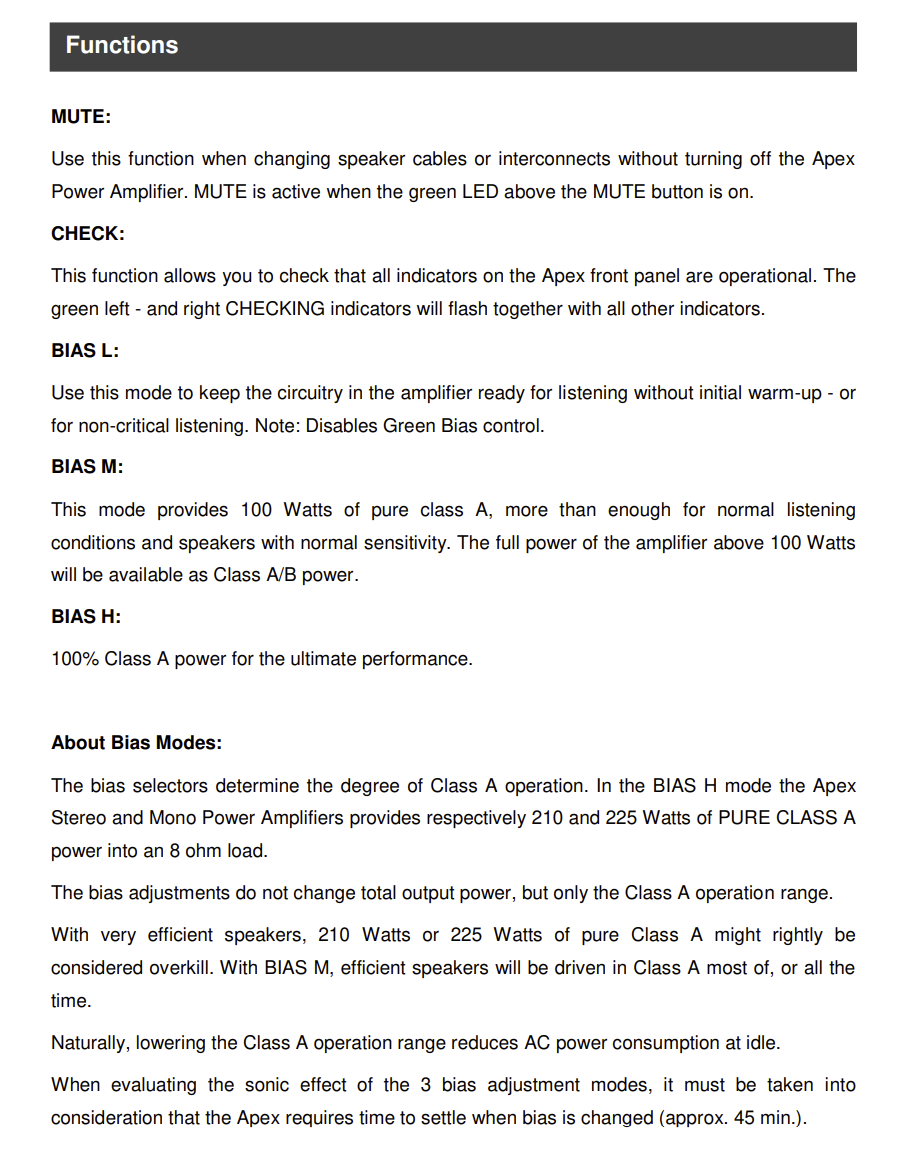
Although it is generally regarded as a pure Class A amplifier, it can also operate in Class A/B, as you can read below (excerpt from the Gryphon Apex manual).
This does not really go in the direction of what you are stating.
In the case of the 717, what was explained to me by the designer himself is that the amplifier operates in Class A up to a certain power level, and then transitions to Class A/B , which corresponds to one of the operating modes of the Gryphon Apex (even though the designs themselves are abviously entirely different).
Gryphon Apex user manual
–
That said, the purpose of my comment to @Middle was, to some extent, to help him with his amplifier choice rather than to cross swords over fine technical details.
It would be a shame if this thread, which has so far had a friendly tone, were to take a less positive direction.
2 Likes
I have never heard about a Class A amp that goes up to 300W. Generally it’s 50W max.
But I don’t write facts however.
4 Likes
Thanks for the tip @Thomas!
Getting us back on topic a bit maybe: auditioning these various amps with super-transparent Magico speakers really does reveal the character of the amps.
I feel like I know exactly what Naim and Pilium and Luxman and Esoteric and McIntosh sound like, because I have heard them through Magico speakers.
Gryphon I’m still not sure, because I have only heard it through Wilsons. “Lesser” Wilsons than the Alexx V [edit to add: the Sabrina X and WattPuppy 50th Anniversary, which are amazing loudpseakers] have colored the sound a bit compared to Magicos, in my auditions and to my ears. That doesn’t mean they are worse than Magicos! They might be better! But not quite as neutral. Maybe the Alexx V has Magico neutrality, but I just don’t know.
2 Likes
If you like the Borresen sound, I think that you can get a lot of what you like from some of the lesser expensive standmount Borresens; you don’t HAVE to spend M2 money.
2 Likes
Hi @Middle,
If you can tolerate reading deep technical information - in the Stereophile magazine (online) there are subjective and technical analysis reviews of the Wilson Alexx V and the Magico A5.
My summary is the Wilsons present a slightly easier phase consistent mostly ‘resistive’ but demanding load (circa 2 ohms) to the amplifier. In contrast the Magico A5 combines a low ‘resistive’ and not consistent (circa 2 to 6 ohms) load with a highly reactive phase component in the bass region.
Meaning: One might have greater amplifier choice with the Wilson Alexx V?
However, for all the supposed time alignment benefit of Wilsons (i.e. what the Stereophile reviewer suggests), I am not aware of any scientific experiments with listeners that have proven or established that time coincident alignment of drivers delivers actual acoustic benefit over the time coherent driver alignment as used by Magico (and many other loudspeaker manufacturers).
3 Likes
Choosing an amplifier isn’t easy, especially when there’s so much choice.
I was in a similar position when I bought the Magico M2s, although I’ll admit I probably spent less time on it than you have.
I’m not always the most patient person, and I tend to have too many other things going on.
This evening, for example, I had a go at a new 8a climbing route. I had a great time, it was really fun. You should try it! 
Coming back to amplifiers, I hesitated between CH Precision, Gryphon and Soulution.
In the end, they all sounded very good, and I could probably have lived quite happily with any of the three.
What ultimately ruled out CH Precision and Gryphon for me were also fairly practical reasons, not only sonic reasons.
In the first case, there were just too many boxes and cables; in the second, I would have ended up with a 200 kg radiator in the room.
So in the end I didn’t overthink it and went with the first one I listened to, which also happened to be my favourite : Soulution.
Practical considerations, and even aesthetics, definitely matter too.
3 Likes
It’s important to get this type of technical info correct. Lest poor or misinformed purchase decisions be made based upon it.
If any amplifier has a Class A “bias” function, it is by definition a Class A/B amp. True Class A amps are huge, heavy, have massive heat sink area and have ZERO bias…because there is no bias; they are always running in Class A.
That screenshot proves my point.
I have found our back and forth friendly thus far. It is just vitally important to ensure this info is correct as research is bieng conducted based upon it.
I’m a huge fan of Gryphon, Soulution, et al. Gryphon has some pure Class A designs. They are fundamentally different than their A/B designs.
@Middle You’re looking at several superb amps, of which I am a fan. I just want you to understand what you are and are not getting with them.
2 Likes
I would like to consider floorstander only haha. Btw what’s the general consensus on Focal vs Magico. Is it like known fact that Magico is always better than Focal? I seldom listen to may speakers so rely more on other ppl experience. Or Focal and Magico are equivalent peer
Cheers guys, i already knew i was right but thanks.
True class A is quite different to A/B
4 Likes
Although @cb01 has brought some nice/interesting clarifications to the table, I’ll leave the debate about what is or isn’t “Pure Class A”, “True Class A”, “Class A mode”, or “within Class A mode” for another thread.
It was never claimed that the 717 is a “true Class A” amplifier , which it obviously isn’t.
The topic here is about which amplifier to pair with a pair of Magico A5s, and the potential downsides of choosing an amplifier leaning into “toaster mode”.
Anyway, have a great weekend everyone! 
Time to make the most of all this snow!

3 Likes
I second that….it’s that whole combo thing…and this is the great thing about he dealer network…
1 Like
There is only class A, all the other names are for the same thing.
Also you can get class A amps that dont run hot and dont need fans to cool them etc.
My vitus sia030 is just that, had it running constantly for over 8 hours at the maverick show at a fair volume in that big room and when i switched it off at the end off the day it was just warm. But the designers did take years to design it and that was one of the main objectives.
But class A certainly has a wonderful sound to it and is why most people prefer it over other amplifiers
2 Likes