I think given the size of the KEF speakers you could try a sub woofer
1 Like
I have LS50s on S2 stands with my Atom. I find the bass is fine, though I am not a massive big bass fan.
I do suggest as some others have done. That is, firstly the stands should be only 75% filled and then just play around with the position. I would think that the optimum position will be dictated by your room size, shape and furnishings. Hopefully that will help resolve things for you with no extra expense. Good luck.
2 Likes
It was with an Olive NAP 180, it changed the sound from bright, thin and shrill to full and rich.
1 Like
I’ll second Cardas… I have the Iridium, they really tamed the harshness with loosing details…
2 Likes
Presumably you are using this Cardas cable with a non-Naim power amp. It would be an extreme mismatch, as would any Litz type speaker cable. The effect could be quite extreme on a separate power amp. Later integrateds and Unitis would be less drastically affected, but they still wouldn’t like it.
1 Like
If you want to shift the needle on bass response in a meaningful way you either need different speakers or a sub (like the KEF KC-62).
There’s no such thing as a free lunch.
Better cables are certainly worth it but but they can’t make a small speaker go deeper.
3 Likes
Not the best match with Naim in terms of sound IME. QED cables tend to be brighter and lighter in balance than say NACA5 or Chord cables. I would ditch the QED as a first move no matter what else you do or don’t do. Get some NACA5 or Kudos KS-1 and take it from there. Also your Nova hasn’t had long to run in and should settle down and the sound should fill out as it runs in more.
2 Likes
The following chat might e helpful
If you need bass use the tellurium black , if you need refinement use kudos ks1. Nova is a killer for keff meta and it can kill the sound if it’s mismanaged . Don’t forget to add a subwoofer in your config.
Happy listening
Are you say nova is a killer for kef in a good or bad way ?
And thank you for your advice
The KEF LS50 Meta hits a hard physical wall at 79Hz due to its small enclosure and driver size.
Even changing the speaker cable you won’t gain a massive difference ,
I had the exact same experience you are having now. It actually took me a couple of years to finally accept this reality. In the end, I stopped trying to force a fix and simply changed the speakers. In short: trust your ears. If you can, try different speakers. It will save your ears—and your pocket.
Welcome to the cruel word of high-end audio 
Not at 79Hz, the port is tuned to 51Hz.
It might help
The trick: Frequency Range (-6dB) vs. Frequency Response*(±3dB)
What 51Hz means (-6dB):
is the lowest frequency where the speaker can technically move its woofer cone before the sound completely dies out. But at 51Hz, the volume has already dropped by a massive 6 decibels In acoustics, a 6dB drop means the bass volume is cut in half. You can barely hear
The 79Hz means (±3dB):This is the official Frequency Response. 79Hz is the absolute lowest point where the speaker can play bass at full, normal, balanced volume. Below 79Hz, the bass volume falls off a cliff.
Or add a sub.
Way over my head
At 51 Hz, there is minimal cone movement, it’s almost all resonance of the port which is tuned to that frequency. The -6dB down point comes after the port tuning frequency, not at it. Below 51Hz is where you get the massive drop, as shown in the graph below (actual measurements taken from a KEF LS50 Meta)
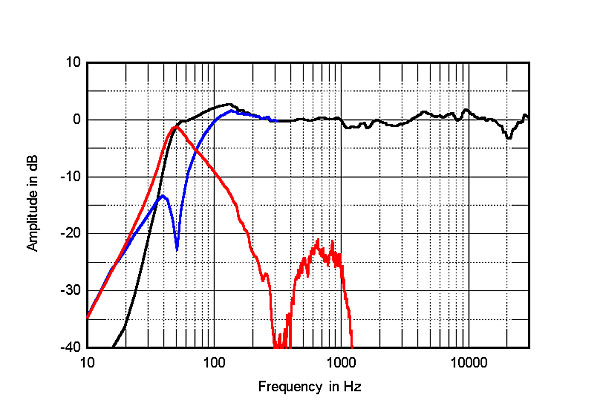
Black is the sum of the woofer (blue) and port (red) outputs. It can be clearly seen there’s no drop at 79Hz, no “hard physical wall” being met, that only occurs after 51Hz (Fb). There’s is also plenty of bass output between 79Hz and 51Hz.
The frequency response stated by the manufacturer (79 Hz - 28 kHz) only means there is no deviation in amplitude larger than 3dB within that range, nothing more.
I apologise, confusing the arbitrary ±3dB boundary (79Hz) with the true port tuning frequency at 51Hz.
1 Like
QED cables are just like that. If you want detail and civilized treble, buy Vertere. If you want the same spending a fraction of it, buy Duelund speaker wires. If you want peace of mind and forum approval, NAC A5.
1 Like
Whilst all these work, QED seems to be one of few companies that supply detailed measurements of their cables. Not in itself a guarantee it suits but imho something most should do, especially but not exclusively at elevated prices where pseudo babble science talk is still prevalent.
On the other hand, Naim just put the bare essentials in (cross section), not choosing to add unverified c**** that makes zero sense. I still prefer that.
NAC A5 has precise L, C and R specs published and the reasons for those. Plus, the lesser strands of thicker wires make NAC A5 closer to solid state wire than the previous NAC A4. All this makes sense to me, and I prefer it too. The Duelund wire I mentioned is tinned copper wrapped in ‘cooked’ and oiled cotton, still somehow ‘boutique’ but replicating the Western Electric design of the 40s. I have had QED and found them bright and unnaturally tiring.