Swap Moon 260D/Qutest DAC for CD5si?

It is up to the system to convey the excitement in the music, not to make the music exciting. The system should not ‘dumb down’ the elements of PRaT that are so vital to all music.

Take my own JBL 4309’s. They are certainly what I would call an exciting speaker. Very very different to say the BBC type speakers typified by the LS3/5a’s. These are not exciting sounding speakers. You may say that the JBL’s exaggerate certain elements to sound more exciting. I may say that the LS3/5a’s suppress the rhythmic and dynamic elements of music and in so doing sap the life out of it. One could say that without knowing what the sound was like at the recording session it’s not possible to say which is the most realistic sounding speaker. There’s some truth in that of course. But more importantly I would say, is which of these speakers sounds more like someone playing live instruments? To my ears easily my JBL’s. When I hear say a busker playing an acoustic guitar in the street the sound has impact and vitality. It sounds immediate and alive in a way that the LS3/5a’s simply completely fail to reproduce. This is what matters, at least to me. A system should convey the essential elements of live music effectively. It’s not really a question of “is the system making it sound more exciting?”, but rather “does this system sound like real music?”. Real music always sounds exciting to me. Whether it’s a rock band, a church choir, someone playing a flute or a full blown orchestra. It has impact, speed, vitality, immediacy. Any system that fails to capture these vital elements to me is a failure.

That’s missing the point. The most important thing is the source. Having the amp or speakers as a weakest link is fine, but never the source. An excellent source with much a much less capable amp and speakers will always musically better a less capable source with a better amp and speakers.

This is clearly incorrect in the general sense, though perhaps it does apply to you. If it were correct then most people here, including me, wouldn’t be able to properly enjoy listening to music on their systems. My previous Klipsch speakers were far more ‘full range’ than my new JBL’s. However this new system is very easily far more musically coherent and involving than my previous one. Down to primarily the source and then also the amp. Also of couse the ability of the speakers to preserve all the essential musical elements. Bass depth isn’t musically essential. The brain is very good at extrapolating and filling in the missing depth. Not in the sense of imagining it to be there when it isn’t, but purely in musical terms. Give the brain enough of a clue and it will do the rest. Some speakers, including my JBL’s and also Kans, are very good at covering their tracks here. Quality of bass is infinitely more musically important than quantity or depth.

Small speakers like Kans can’t replicate the scale and impact of say an orchestra. But driven by the right system you don’t notice it. You’re too involved in the music to even care.

1 Like

You won’t loose much money on the 555PSDR 2026 if you decide to sell it on, which I very much doubt. It will be like taking the duvet or curtains off the sound.

I have had XPSs x 3 and know how much better it will sound. The Nait 50 will love you for it. @Blackbird has one on his 333 into Nait 50. And he prefers it to his previous 552 and 500 amps. He has kept his 555PSDR as it’s Naim’s best power aupply for sources even with 300 series.

I hope this helps.

4 Likes

It does. Thanks Dan

The BBC were very invested in loudspeaker design and needed loudspeakers that were accurate enough to reliably monitor the sound quality of broadcast material over the airways. Radio broadcast technology quality improved and the BBC wanted to maintain the highest quality of output and started research and development at Kingswood Warren into appropriate speakers that would be used in the program sound monitoring. The research resulted in designs of speaker that were capable of reproducing sound that accurately reproduced the sound heard in the studio, without adding or subtracting anything (I suppose in the way Quad amplifiers were seen as the closest approach to the original sound). Several monitor speakers were developed, and used in various aspects of the BBC, and were Grade One, Two and maybe others. The BBC wanted a small sized speaker for near field monitoring at the desk, and outside broadcast vans for example at the Prom concert broadcasts, and the LS3/5a was the design from the research that also was licensed to manufacturers. The design is made to very tight specifications.
To dismiss the LS3/5a as suppressing the “rhythmic and dynamic elements of music…” seems to miss the point. Are you suggesting the BBC research team are incompetent.

4 Likes

Exactly re first part, but what PRaT is is an unknown factor, far from clear as these threads discuss [Links]: https://community.naimaudio.com/t/good-sound-how-much-do-i-need-to-spend/42290 https://community.naimaudio.com/t/that-lovely-prat/34121

Mine does to me, just play at or approaching the sound level of a live performanceb and it creates a pretty good illusion on the music I play, from full orchestral to chamber, from heavy rock to prog rock, from opera to solo piano, etc. But if the system were to curtail some part of the music significantly, or, say, overemphasise rhythmic elements, then it wouldn’t sound like live music - unless the venue has bad sound balance whether due to acoustics or sound system (if amplified) - and of course it is always down to the recording as well, some far better than others.

The fact that many people might enjoy music limited in some way doesn’t mean it is the best way to hear it - Some at least might never have heard a quality full range system (which inevitably includes the room), so may be limited to what they have heard, which may include poor full range systems.

We hear harmonics, and if the fundamental is missing the brain may well not notice, taking the lowest harmonic heard to be the main note, and if we know what the fundamental is supposed to be our brains might imagine that (I don’t know). But that is quite different from hearing the full note as played.

I have not suggested poor quality bass, pointing out that to play low bass well inherently means expensive speakers and an amp adequate to control them, and the room is important. As for infinitely more important, it is all relative, and depends also on the music - as one example, music with sharp rise and decay times to notes are more demanding than notes with slower rise and long decays.

I haven’t heard Kans, but from what I have read I suspect I wouldn’t like them because of their colouration. But I can certainly enjoy music from small speakers with missing bass, and get involved in the music even with a crummy flat screen TV speaker, but never as good enjoyment as from hearing the music fully in all its glory as it should be - and after all, isn’t that the theoretical aim of hifi?

Clearly you and I have quite different triggers to our musical enjoyment and engagement, just as we have different reactions to fads and to the risk of psychological influences etc etc. (The very things that make discussions interesting - it would be a boring forum if we were all identical!). So we will have to agree to like different systems (and indeed different musical styles …and sometimes I wonder to what extent that is significant in sound system preference), however, for balance I will always point out the other side of things when the opposite of my experience is pushed, and it can be interesting and thought provoking to explore such differences.

2 Likes

No. The LS3/5a was developed primarily for speech monitoring and not for the reproductrion of music. Hence the design focus on ultra low clouration in the midband. It achieves it’s design aims spectacularly well and makes most other speakers sound quite broken in this respect. At the frequency extremes and in terms of speed, dynamics and it’s ability to convey timing and rhythmic information it is rather less successful and easily surpassed by many other designs. Not surprising as this was not part of the design’s intentions and was irrelevant to it’s intended use. Trade offs have to me made in any design to achieve specific goals and these were the trade offs chosen here to achieve the extremely low midband colouration.

The LS3/5a’s are unsatisfactory for the reproduction of music, unless your primary concern is to achieve ultra low clouration, openness and tonal accuracy in the mid band, and you are prepared to accept, at best, mediocre to poor performance elsewhere. For those that appreciate what the LS3/5a does exceptionally well and can’t live without it then this is a perfectly fair trade off provided one can accept it. In these circumstances there is little that can match the LS3/5a IMO. It’s deeply flawed, but then so are most of the best speaker designs IMO. I love Linn Kans, and they are certainly a deeply flawed design. I greatly admire the LS3/5a for what it does well but I couldn’t live with it because for me it just doesn’t convey what music is all about.

You’re absolutely right. It does miss the point because the LS3/5a design was never about these things. But I don’t dismiss it. I merely make the point that it doesn’t do these things well which makes it unsuitable for me. But make no mistake - it’s a superb loudspeaker for those whose tastes align with it’s strengths and weaknesses.

1 Like

You make some fascinating and intriguing points. This is probably deserving of a thread of it’s own because to debate it to the extent that it deserves here would be inappropriate. It’s a fascinating thing to contemplate and discuss and I’ve got plenty to say, as I’m sure have you. It potentially opens the door to all kinds of philosophical considerations regarding what the reproduction of music in the home should be about. A discussion well worth having - but perhaps best left for another time.

2 Likes

I’m a tad busy at the moment, but maybe at some point in a few weeks if I have an idle moment I’ll start a thread - unless you do first!

2 Likes

Fascinating post, but can you explain the above comment please?

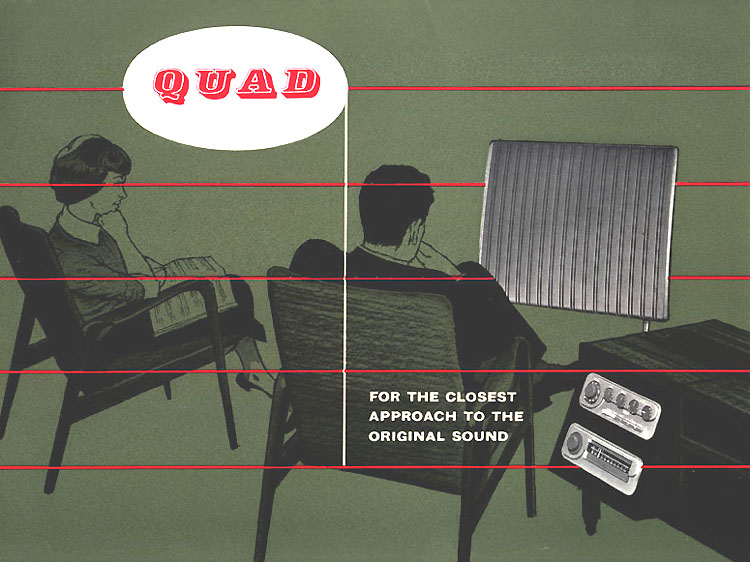
I assume the intention was to say the ‘closest’ approach to the original sound but no doubt auto correct sabotaged this. This was (is?) of course Quad’s slogan.

Quad are a bit like the BBC LS3/5a’s in my mind. I would love to like them, they are an important part of British hi-fi history. They were around when I was growing up so I used to see them in pictures and in hi-fi shops a lot. I absolutely adore the look of the 33/303 and the old 405. Lovely things, but just not my cup of tea for performance.

1 Like

Ah, sorry, I didn’t get that at all.

1 Like

I too feel a bit burned out TBH after sorting out all the system change that seems to have totally monopolised my time over the past several weeks. But in a few weeks time we’ll do it!

This was their ‘tag line’ in advertising material, in the 1950’s and 1960’s I think

1 Like

It was, but as I say, it’s the ‘closest’ approach, not ‘closed’. Anyway just looking at your profile and that’s a lovely system you have there. Absolutely no need to upgrade at all IMO. I don’t know why you would think it makes you a fraud here, just because you’ve kept those Naim pieces for so long. Some here don’t even own any Naim gear at all!

1 Like

Through time, the marketing guys had some amusing and re-engineered ideas :face_with_open_eyes_and_hand_over_mouth:

1 Like

It’s also a book about the company history too.
:thinking:

I remember the ads well.

2 Likes

Ah I see.

I cannot type at the best of times, and missed this mistake in spelling. Now corrected!

Of course “Closest Approach to the Original Sound”

2 Likes

All this Quad nostalgia is enough to make me want to get the new 33/303. I could almost buy it for its looks alone! That and a pair of Wharfedale Dentons would make a lovely alternative second system - if only we had the room. Bizarrely the new Quad 3 CDT is only a transport, and the new 33/303 is analogue only. Someone perhaps didn’t think this through too well… :thinking:

The Quad 3 CDT is designed to match the Quad 3 preamp, which has digital inputs.

3 Likes