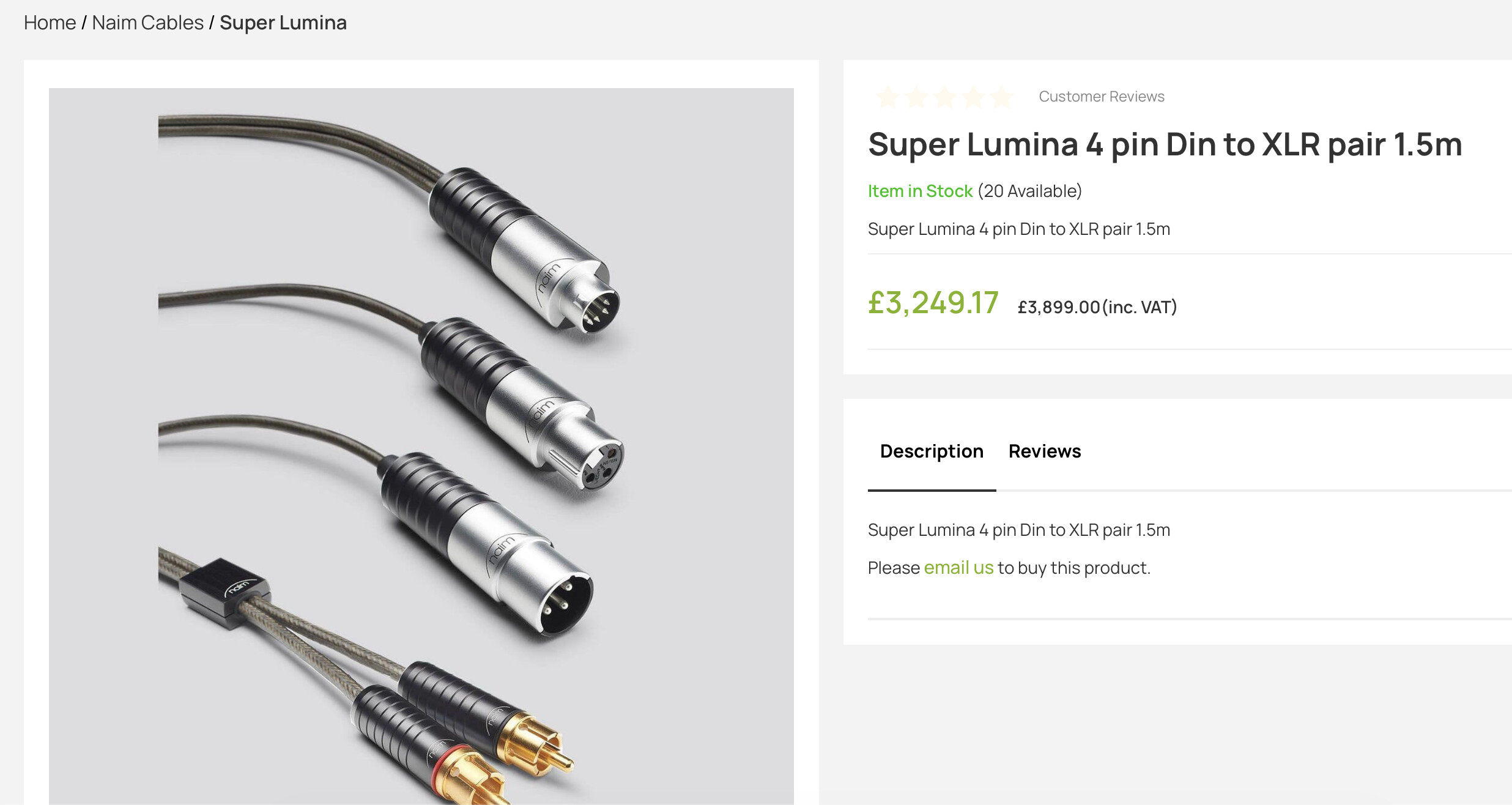
Unlocking the 300 Series: My NAC332 Pre-Power XLR Shootout

Well before spending €1700 on a bit of fancy wire, I want to know if I am being scammed.

The cable insanity was started in the 70s by Bob Fulton of Fulton Musical Industries - his Fulton Gold speaker cables could be used for arc welding. Since then, the “High-end” cable industry has exploded. The only contrarian along the way was the chief engineer/designer at McIntosh who rightly claimed that ordinary copper wire of adequate gage is all that is required.

Edit. This was a reply to a post that I cannot see anymore.

I think it’s perfectly fine for members to post their listening impressions of whatever kit they wish to here, regardless of the price tag. No need for measurements or blind testing - it’s not an examination. This is a place to discuss such things in a relaxed and friendly environment, and giving a subjective opinion on how things perform is all a part of that. No need for any axe grinding. And let’s not forget that Naim do include a set of decent quality cables for anyone not convinced that spending any more is worthwhile.

25 Likes

In cryo treated cables, does the cryo effect wane over time? Or is it permanent? I checked at the AV Options Website and although they explain the process, they don’t say how long it lasts

I found that Naim were spot on in recommending NACA5 speaker cable as it performs very nicely in my system without spending a fortune

I happen to also like the DIN cables and have just ordered an original Naim RCA/DIN cable for my streamer into XS3

2 Likes

Not too far from my findings with the Signal XLR. I found it to have a balanced, cohesive sound from top-to-bottom, without emphasizing one frequency over another. And yes, it did take quite a while to run in.

2 Likes

Well, without that the entire exercise is a waste of breath. If you cant measure it, blind test it. If you cant detect a difference with blind testing, it doesn’t exist. It’s not rocket science, just basic research methodology.

1 Like

Did you actually buy your LP12 after blind testing with another turntable :rofl:?

7 Likes

No, once cryo’d always cryo’d. There’s nothing to go away after the fact.

2 Likes

I think DBTs are just as bogus. If you know your being tested that changes things too. Perhaps the only real way to do it is a triple blind test, where the test subject doesn’t know they are testing anything.

I once worked for a Linn/Naim dealer that liked subjecting me to DBTs in the showroom, but he was a jerk and had a reaction if I didn’t validate what he thought was right. The pressure of being a test subject affected how I listened and heard things. Ever since I have dismissed DBTs as equally flawed as anything else.

If you know you are a test subject for a DBT that alone can pollute the test. There’s a good reason why discussion of it is banned on some forums. It just as bogus and never ends well.

8 Likes

I had a friend over tonight, and we played three cables on my Boulder phono-stage with both stereo and mono tonearms. We tried the Siltech Classic Legend 3880i and 680i. Both are balanced cables and I used a XLR/RCA adapters on the RCA inputs of my 252. The third cable is my custom built AV Options XLR→DIN5 Y-cable.

After two hours of listening to stuff I like and other stuff he likes we ended up in agreement on preference for all three cables. In order from the best:

  1. Siltech Classic Legend 680i
  2. AVO XLR→DIN5 Y-cable
  3. Siltech Classic Legend 380i.
6 Likes

Swapping in the Audience FrontRow felt like stepping into a dedicated vocal booth. I would like to be very clear right out of the gate: if your musical diet consists primarily of female jazz vocalists, singer songwriters, or any genre where vocals are the absolute star of the show, you might want to stop reading here and just demo the FrontRow.

From the very first track, the FrontRow pulls off a rather startling trick. It grabs the vocals, pulls them front and center, and renders them with a crispness that is chill inducing. There is a specific magic happening here that makes voices sound startlingly present, stripping away veils until you are left with just the texture of the performance. It offers a level of clarity from the midrange all the way to the top frequencies that simply eclipses the two cables I’ve discussed so far (at a cost, of course).

The FrontRow isn’t just about the tone, it’s also about the interplay. This cable nails cohesion, I repeatedly felt like I had better insight into the subtle communication between musicians. It also maintains PRaT, the toe tapping factor is fully intact, but it does so with a polish and transparency that goes beyond the previous contenders.

However.

Coming from the thunderous, floor-shaking low end of the Grimm and the juicy and fluid bass texture of the AVOptions, the FrontRow initially feels lighter on its feet. When I first started listening, I immediately noticed a reduction in pure bass quantity. The bass is very taut, fast, and well-defined, but there is simply less of it. If you are running bookshelf speakers and want to squeeze out every last drop of low end extension, this will likely be a dealbreaker.

That said, the brain is a funny thing. After leaving the cable in for a few days, that initial sense of “missing weight” was greatly diminished. The presentation started to feel incredibly well-rounded and coherent. You realize you aren’t missing the low end information, you’re just adjusting to a different presentation. On my floorstanders, this slightly leaner presentation actually worked nicely to clean up some room interactions, but it’s a characteristic you need to be aware of.

In terms of spatial performance, the soundstage has tremendous depth and width, projecting well beyond the physical boundaries of the speakers. Interestingly, I found there is less air between the individual instruments compared to the other two cables. This is not at all a criticism, just a note on the flavor of the presentation - the FrontRow presents the music as a tightly woven fabric rather than a constellation of isolated points.

Ultimately, this cable is a masterclass in midrange clarity and vocal realism. It might not bring on the seismic slam, but for pure, unadulterated connection to the singer, it is in a league of its own.

Next up, we enter the heavyweight division.

9 Likes

My friend who was over uses Audience FrontRow, and offered to loan me his.

However, I don’t think a cable should be good for one kind of music versus the other. I think a great cable is just great, no matter what you listen to and that’s what I seek. I feel that way about all gear, including speakers and phono cartridges, etc. If it’s truly great, it shouldn’t matter what genre you like, and that’s how I have voiced my system. I don’t want to swap stuff in and out, depending on what I feel like listening to.

5 Likes

Sorry if I came over as being agressive, I am just interested in the debate. But for some of us with a technical background, certain arguments and comparison methods are difficult to accept without comment.

These cables are extremely expensive and maybe it is worth examining and debating their real usefulness. I would be curious to know what the Naim engineers and designers have to say about this subject.

It is good that Naim provide cables with their gear. I certain that they get the best out of the equipment they are sold with.

1 Like

There you go! Just get yourself the best Naim cables and be happy :rofl: you really made my day. this is hilarious

1 Like

Look! Naim cables! Expensive ones! What?? I heard a coat hanger is enough. They are fooling us all! Expensive = evil!

4 Likes

Ah the infamous coat hanger test!

You do remember the results I imagine.

No, it is a question that cables altering the sound in any significant way is a myth. Maybe you can prove to me that it is not. That would be great.

I was born with two ears and a very capable brain that has evolved during +300 000 years as homo sapiens. A brain and ears that scientists till this day don’t know how to replicate with instruments and tools. I rarely measure my food, wine and things that smell or sound before I enjoy them. I trust my senses and have an open mind to that not everything we feel can be measured. You seem to have a complicated relationship to your senses and need to trust measurements made by others more than your own self. That’s sad but that’s your choice.

Mostly you enjoy telling everyone they are wrong but to try it out yourself, that is not an option even if it is for free (have in mind your system is not good enough for good cables though). I have problems understanding these kind of persons and think they are slowing evolution down because they are not curious themselves to found out if there might be a different truth out there than the one the person next to you with a probe in the hand told you about.

19 Likes

This argument is predicated on the assumption that the signal carried by a cable from one component to another is binary, that the signal either gets passed or it doesn’t. But we know from basic science and physics this is not the case and that cables degrade the signal to some extent and the ideal cable is no cable, something that only exists in theory.

So if we accept that the cable has a (deleterious) effect on the signal then we must accept some variance exists between different cables. Whether that variance is audible and if so whether it is worth the price is another matter altogether and down to the individual.

But cables do alter the sound.

8 Likes

Yes they do.. so synergy is important as in pairing to minimise the alteration . Most time, not that the cables that’s incapable, but the synergies and alterations that’s not to one’s liking .

I had spent 11k on a pair of XLR , although expensive, but it suits my listening and pairing.. and the synergy ..

And I had 2 pairs of them .

3 Likes