Yes it can. I have a relatively small CD collection, around 200 discs, which I won’t be adding to significantly. So storage and access to what I want to play is very quick and easy. If I had thousands of CDs as some people do then that would make streaming a far more attractive proposition despite the downsides.
2 Likes
That is very sound (sic) advice that matches my experience too.
Bruce
3 Likes
It would also appear that the uncompressing of files such as FLAC or ALAC is done by the SHARC in the newer Naim streamers as what is put in the music buffer is the compressed file, if it all fits…
So for Qobuz/Tidal connect I presume the decryption of the internet stream must be being done by the streaming board or ARM processor, leaving the unencrypted audio stream (usually FLAC on Qobuz) in the buffer for the SHARC to fling at the DAC… So if your system is sensitive to noise from the network/streaming board/ARM processor, then the Connect services should in theory be the worst option.
The non-connect streaming from Qobuz via the Naim app seems to work similarly to local streaming where the file gets copied as quickly as possible into the buffer (again assuming it fits) with no encryption, so in theory should generate the least amount of network processing noise for non-local streaming.
id be interested if you can show me where that is described. I believe in the past this was done in the streamer transport module for isolation purposes.
It may be Naim found the Analog Devices SHARC processor more efficient at transcoding than the streaming transport module - interesting it has DSP operands for this. But in the past(still is?) LVDS was/is used by Naim to isolate the streamer transport module from the core streamer so as to minimise conducted noise.
1 Like
Well the transport board will be doing the session key negotiation and decryption as that is an integral part of the network protocol operation.
@khan84 first agreed even Qobuz is ear bleeding in comparison with local rips. But I honestly wish  you hadn’t started this thread because I’ve ripped all my CDs on the Core to FLAC, because of the metadata issue, but just, and against my better judgement, re-ripped On Every Street, The Famous Blue Raincoat and The Nightfly, the first CDs I purchased way back, to WAV, and e.g. on On Every Street and that haunting “the three chord symphony crashes into space” the piano has obviously better depth and the sax on the Raincoat richer textures!
I’m off to sit in the garage and read a book on fly fishing in the Yemen!
2 Likes
It’s not really the right place to go into great detail here, but the issues I encountered were all related to network noise. At least that’s what my interpretation of it was, though I could possibly be misinterpreting the data as it were.
The Melco required ethernet connection to the router for control purposes, no wireless option here. To be clear, files were played directly from the Melco to my Qutest DAC via USB, but the ethernet connection nevertheless had a great impact on the sound. Even down to it having a very audible effect according to what support platform the router was sitting on! I know this sort of comment will be dismissed by some people as pure fantasy and if people want to take it that way then so be it. I can only report what I experienced and I’m not prone to imagining things. Incidentally my wife heard exactly the same thing and this without any prompting from me. Anyway the point is that network noise was getting into the system and adversely affecting things. It even affected CD replay. Once the ethernet connection was removed CD replay was noticeably more musical.
I tried various noise redection strategies. An EE8 switch, two EE1 noise isolators, and Chord Groung Arays. I had two of these plugged into the ethernet ports of my router. That’s over £1K’s worth of Ground Arays in the router alone. So I can’t be accused of not trying! All of this helped - but not nearly enough to satisfy me. The next logical step would have been a much more costly network switch, maybe the top Melco model. But at over £10K we just couldn’t afford it. And it’s getting into the realms of what even I consider to be daft money for that kind of thing. It just shouldn’t be necessary.
So after considering all my options a return to CD seemed the most sensible one. Another possibility I did consider was something like a top of the range Astell and Kern portable music player. No ethernet and no wi-fi. Wi-fi is also death to music. Ours is disabled on our BT Smart Hub 2.
So those were my experiences. I’m not suggesting that everyone abandons streaming and returns to CD. Some appear to get along fine without any issues. Maybe it’s down to specific environments or systems, or just variation in personal sensitivity to such things. I don’t know and I just ended up thinking life’s too short to be messing around with this stuff and I’ve always got along just fine with CD for many years so it just seemed like the obvious thing to do.
3 Likes
It’s an assumption based on the amount of buffer reported as used in the diagnostics web page matches exactly the size of the compressed file being played as long as it’s less than 50MB, otherwise you get to 50MB and then it replenishes at the speed it’s emptied.
As the DSP doesn’t appear to be on the DAC board, I would guess the SHARC DSP can access the buffer itself to then generate the I2S LVDS signal sent to the DAC board, but as I say it’s a guess.
Also the streaming card doesn’t appear to be involved in the processing of APTX bluetooth so the DSP is definitely doing some work there, likewise the DSP appears to do the DSD to PCM transcoding too.
I don’t which of the three CPU names on the diag page equate to which actual processors, that might help narrow it down further.
A good CD set up, and a record player as well for that matter, do have the clear advantage that they are way less susceptible to noise pollution (other than the power). I have recently learned that streaming can be a lot of effort (and cost) to get right - primarily by the need to isolate network noise. A CD can bypass all of that, as can a Uniti Core using the direct BNC connection. I’ve got my local streaming on par now, but at some considerable effort.
1 Like
It’s great that you’ve got your streaming set up to point that you’re satisfied with - well done with that. I just couldn’t. When I first got my Melco I was aware of network noise issues but I believed it to be a peripheral matter only and of no great concern. How wrong I was. It gradually dawned on me that far from being a peripheral issue, reducing network noise was of absolutely crucial importance to achieving musical satisfaction from streamed files.
Maybe I’ve been a bit defeatist by abandoning streaming but it got to the point where I felt the required expense and extra complexity to achieve what I would be happy with was getting out of hand and even if implemented would probably still struggle to equal the musical involvement of our Moon CD transport through the same (Qutest) DAC. The other factor which swayed me was my desire, since retiring, to make every aspect of life as simple and straight forward as possible. So CD is certainly the right option for me. Having said that, if I believed, as I did when I originally embarked on it, that streaming could give me better musical enjoyment than CD for a similar or even slightly higher outlay then I would have persevered with it.
I do wonder how many of these network noise issues are down to an engrained habit of thinking all cables need to be shielded, and nice shiny metal connectors are better than cheap plastic ones. 

Not many home network routers or switches are actually grounded (cheap DC PS is the clue) but all ports are connected via ground (the cable shield) even when the switch has no ground connection…
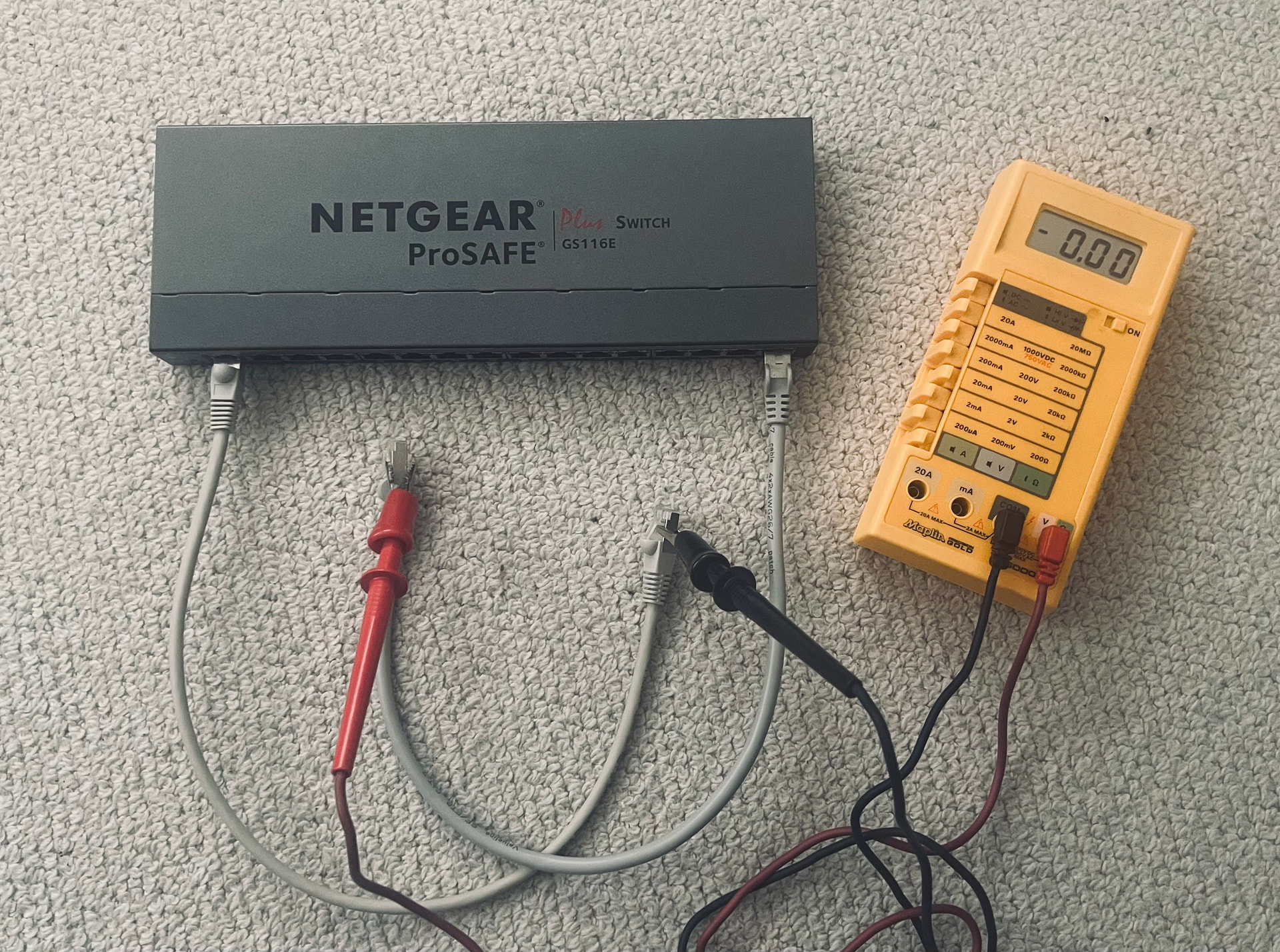
So if you’re not careful, you create an antenna network of shielded cables and sink all the ground plane noise through your grounded Naim streamer.
I don’t think it’s coincidence that switches like the more expensive Melco’s provide a proper ground, and that all the boutique cables for ‘streaming’ only terminate the shield at one end which is the end you connect to their grounded switch. The idea clearly seems to be to avoid sending all the ground noise of your network through the most sensitive devices. So there might be cheaper ways of ensuring your streamer is not the ground sink.
4 Likes
I preferred AIFF and local streaming with my OC kit but can’t tell a difference with my NC kit.
That’s true of Naim streamers, but some other makes do feed DSD direct to the DAC if it can play them directly. That’s the case with my Linn streamer at least up to DSD256.
Roger
I used Chord ethernet cables. My understanding is that these are shielded but the shield is floating, ie. it is not connected at either end of the cable. It is the same with all their cables as I understand it. So in that case they wouldn’t act as antennas that introduce noise into the ground plane. This, again as I understand it, is something fundamental to the Chord philosophy.
1 Like
I was not considering DSD, only LPCM based streams.
As understand it, Naim do not process DSD files in the same way traditional DSD-native DACs do.
They use a process called DoP (DSD over PCM) and the protocol carries pure DSD data inside a standard 24-bit/176.4kHz PCM stream.
When the streamer receives the DSD/DoP signal, it goes to the internal DSP stage where it converts the DSD bitstream into a high-resolution LPCM signal.
2 Likes
Indeed, some of the chips used by Naim support DSD but the ones in the ND555, NDS, and nDAC don’t. However, it’s not a used feature even on products that do use compatible chips. Applying real time DSP to DSD is extremely non trivial and the approach taken was to be consistent and treat everything the same and feed everything through the SHARC as PCM where it can be processed the same way.
This is separate from DoP though. DoP merely uses PCM as the carrier for DSD but the receiving endpoint knows the data is in fact DSD not PCM. It’s not really a PCM conversion.
While converting DSD to PCM is technically lossy, the bit depth and rate is sufficiently high as to render that an acceptable compromise. It has some advantages too such as theoretically eliminating some of the quantization issues inherent in native DSD reconstruction.
For this reason, you’ll find that Naim’s approach of shifting DSD to PCM is not all that rare. Quite a few DSD compatible sources opt for the same solution.
1 Like
Hi f_z, just to finish this (for completeness )
DoP is not a conversion. It only wraps the original unaltered DSD data inside a standard PCM audio frame.
I have NDX that plays DSD how whatever it is that Naim do with it, plus Synology NAS that has the option to select stream DSD as DSD or to stream as DoP.
I’ve tried it both ways and cannot detect any difference.
I’ve set it for the NAS to wrap DSD as DoP.
My logic is that it relieves the NDX of the DoP wrapping load (I guess this is minimal anyway, but if it all helps, it helps)
But it seems that logic is flawed. According to a conversation at Naim on a visit … while DoP is technically transparent, in the case of NDX allowing the device to process the native file gives better audio than having the extra load of processing the DoP wrapper.
I have a mix of WAV and FLAC files (long story) and think I prefer FLAC overall. Ive always thought it was to do with the fact that the earth is flat..
2 Likes
Metal connectors can sometimes create distortions. It’s the case with my Lumin transport, who prefer plastic ones.
With the Nds as streamer, the Audioquest diamond with its telegartner connectors sound very good. Not with the Lumin.
That the earth is flac, yes.
2 Likes