They don’t. Peak around 8kHz and fast roll-off after. Could that be described as dull and harsh by someone young with good hearing? But that doesn’t mean that people can’t like that sound. Simple preference, having grown accustomed over the years, or simply that their hearing has deteriorated sufficiently with age that it actually compensates / falls outside their audible spectrum.
2 Likes
Thanks n-lot. I get the fast roll-off after 8kHz. Are you saying that there is also an unrealistic increase (peak) at 8kHz as well, or that’s just when the roll off begins?
1 Like
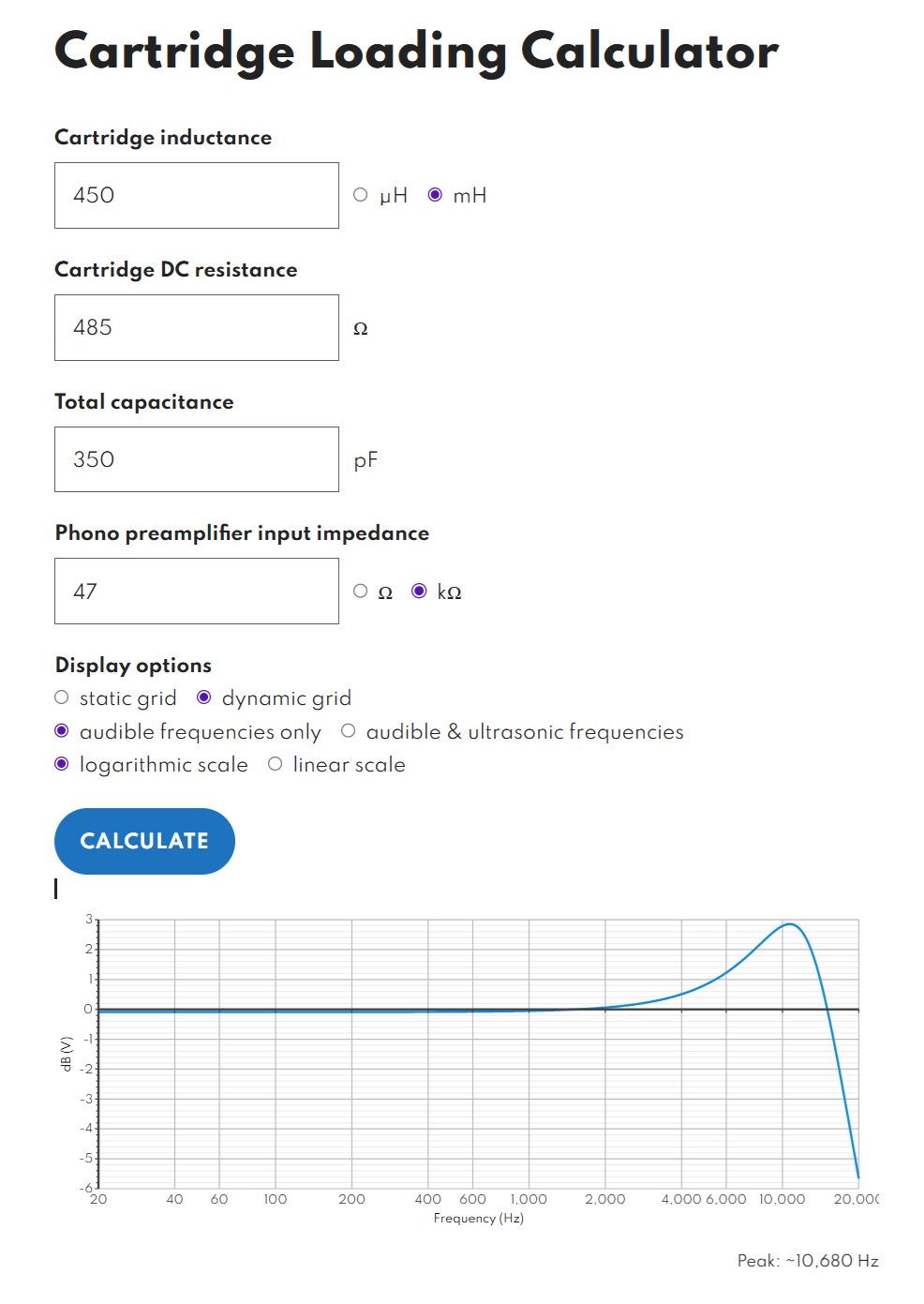
You get a peak at the resonance frequency, after which it begins to roll off:
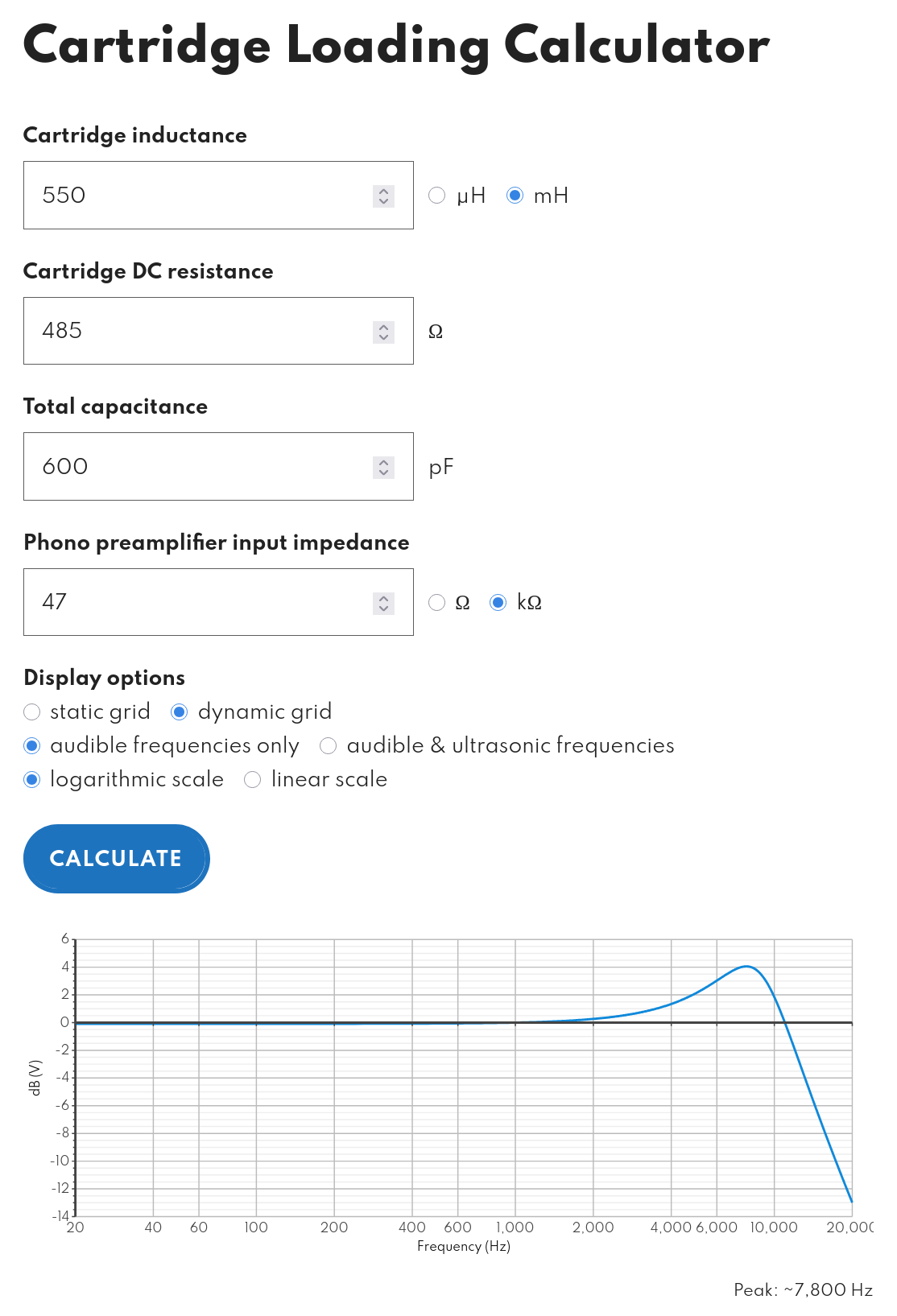
If you google “Cartridge Loading Calculator” you can find a few different ones. I like the alignmentprotractor one for it’s nice graph, but the Hageman one is on a page that’s well worth a read.
The height of the peak will differ with loading as well, see this example:
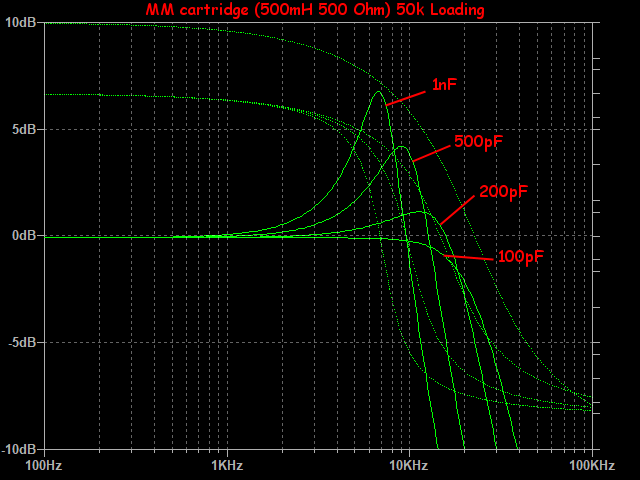
(Image from Hagerman technology / hagtech)
2 Likes
Wow, very scientific - thanks. The graph makes it perfectly clear
2 Likes
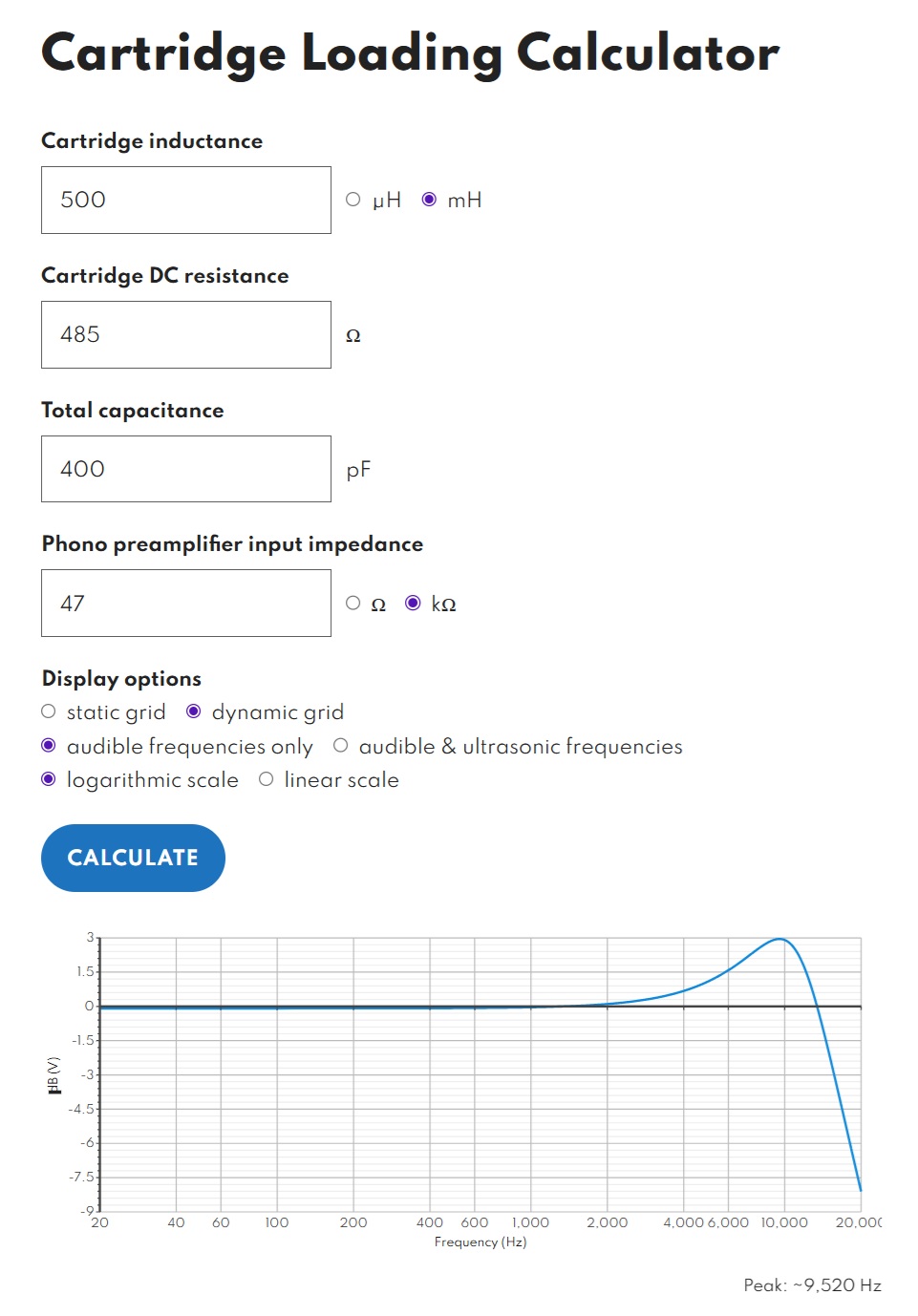
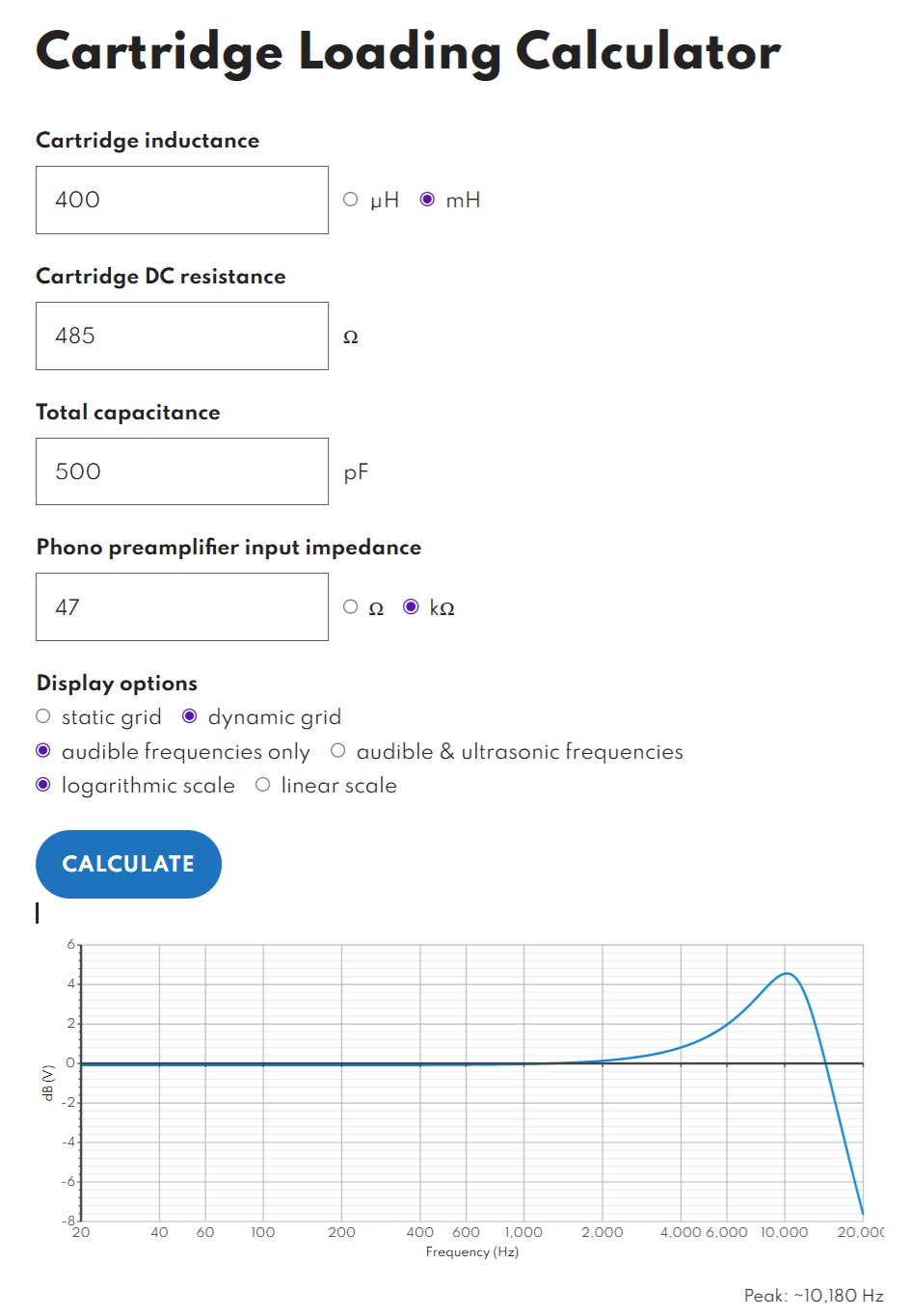
The first Naim MM phono was the 322 card in the 1970s and it seems to have set the way Naim did MM phono stages for decades. What do you think of its settings when partnered with a 1970s Grace F-9 or 1980 Linn Basik? Still very peaking but the peak has moved up the frequency…
Grace F-9:
1980 Linn Basik (and 1986 Linn K9):
1 Like
Resonance for the Grace is higher up in the frequency, but also a bit lower. For the Linn it’s similar in height to the AT. Eyeballing the roll off is at -3dB @17-18kHz for both these carts. Where the AT-VM95 would be at ~13kHz.
Of course frequency response is just one aspect (crosstalk, distortion, tracking etc.), but if I was forced to choose and this is all I had to go on, I would choose the Grace. If you have them lying around of course also use your ears.
2 Likes
It was more out of curiosity trying to understand how Naim got to their phono settings back in the day.
Linn Adikt has always worked quite well for me and is similar to the Grace…
Welcome @Drude, you are right on, the P6 is the sweet spot but frowned upon by the upgrade crew, unfortunately.
1 Like
My local Rega dealer says the P6 is the best value
2 Likes
Someone mentioned the Rega P6, which is a steal for the price, especially used. I’ve had a P6, P8, a P10 and currently have an LP12. The P6 holds up amazingly against these decks and I could actually be happy with one myself. Moorgate acoustics sell plenty of used or open box P6’s, so you could get a good deal from Paul… then it’s just the cartridge to consider
Oh, I didn’t realise we needed permission….
I have an LP12 /Dynavector SN1 so not the same but stay with me here.
I was using the Dynavector phono pre for years it was good but not magic. my local shop let me take home a Rega Aria MKIII for the weekend. WOW!! I had no idea what a difference the phono stage could make. I’d try that it’s a super easy audition much more so than swapping new carts. If you up grade your table and/or just the cartridge you will never be able to use a MC cart. So you are still limited. A new and better phono pre opens things up for long term upgrades. If nothing else you now know. Good luck
Have a P3/ND5 and in my head, I’ve though that a P6/ND7 would be the upper limit for a SN3.
You’d be amazed at how fast you’ll hear “ upgrade to P8” or “ go straight to P10” when you mention P6 around here…
1 Like
I think one would be very happy with a P10 or LP12 with a SN3.
4 Likes
Why would this be the upper limit? I’ve used a P10 and a P6 with a Hegel H590 and a Supernait 3 and both have been fantastic, and the Supernait is over half the price of the Hegel…
In fact, purely as an amp, I think the Supernait is better, so why an upper limit?
3 Likes
Absolutely, my experience would support that…
1 Like
I like some of the combinations NickSeattle refers to in his post. I have been running a 2003 Rega Planar 3 (red color) + exact 2 into a SN3 for a few years. The sounds was good, but wasn’t close to what I could hear from my other sources - CD player (Rega Saturn MK 1) and Streaming setup (Qobuz+Audirvana—BNC converter into Naim DAC, loosely modeled on a post by @Riko ). The P3 did have a more analog sound - but not as holographic.
After 6 weeks of tinkering, researching, conversing with my local dealer (and some cash  ), I decided to venture into a dedicated phono stage - a moving coil. I did consider a ND7 - but was unsure if that would limit future decisions of TT upgrade. For the phono, I wanted to stay with Naim - as I love the sound, upgrade paths and simple aesthetics! My research led me to a Superline.
My local shop advised me on a Hana ML, moving coil cartridge. He swapped the Exact 2 and I just switched it on this evening. Wow! Simply wow! The sound is truly Sublime. I can say the P3 + Hana ML + Superline + SN3 rocks!!! It’s hard to believe a 23yr old P3 could be so!
I will at some point upgrade the P3 to a nicer TT. But for now - I am going to enjoy my vinyl!  .
.
Long story…but I assure you - there is a cartridge / phono combination that will work for you and your budget, simply know that the P3 and SN3 are outstanding ‘bookends’.
Enjoy this journey - of discovery - it’s the journey - not just the destination  .
.
1 Like
The whole concept of “too good” is strange description to me. A system is as good as its weakest link, so if anything you won’t get the most from a P10, at worst it will not actually be better than a P6. Some seem to imply it will somehow magically sound worse…
If upgrading one thing, just get the best component you can. If upgrading a whole system, of course it makes sense to not waste budget on one thing to then have something else be a weaker link than necessary.
1 Like
Of course, the system depends on its weakest link.
However, the most important element remains the record itself: a well-recorded and pressed vinyl record will sound better on an average system than an average vinyl record on a superb system. A high-quality turntable and cartridge that are properly matched will transmit the information more completely, provided that the phono stage and preamplifier are capable of faithfully reproducing the sources. With a high-quality source, a system with a modest amplifier and speakers will sound more appealing than a superior amplifier and speakers with an inferior source. This is without neglecting the harmonisation of connections and cables.
Translated with DeepL.com (free version)