I could or just go with octopus. As said will have to do something in late August anyway so will see what best suits my needs then.
Thank you for your interest but I’m not too bothered about this. I think the designer knows what he is doing.
Two of the three roofs do have significant shading issues, as we live in an urban area and the third has none now because a close tree in a neighbour’s garden has been recently pollarded. But it will no doubt grow again and it took a while (~5 years) to get him to trim it back last time. Also the route from the roof space to the PW3 is complex, so simplifying the cable run makes a lot of sense to me.
The micro-inverters have the same peak VA input as the solar panel output, so I think clipping is probably not too much of an issue.
Regarding the article in your link, there will be a Gateway 2. Anyway it is what it is. I have placed the contract now and I’m happy with what is proposed.
2 Likes
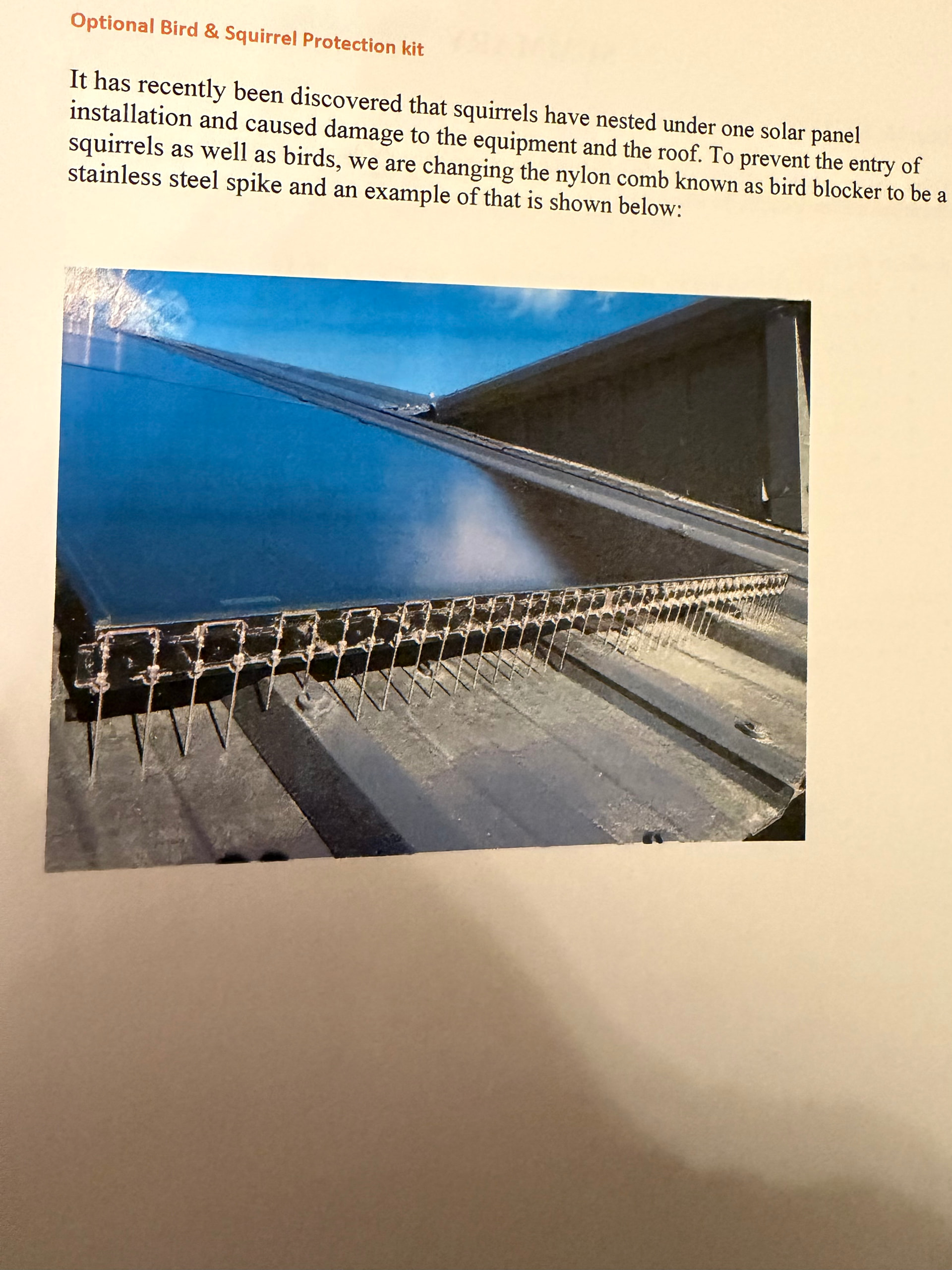
Blimey, that looks serious. We have a strong mesh to keep out the birds and while we have the odd squirrel on the lawn they have never, to our knowledge, got onto the roof.
1 Like
Sorry, I was just trying to pass on some advice having been through this a year ago. I had several firms offer a variety of solutions, but I did my own research in some detail to understand what made sense. Perhaps that’s just me - I like to know in detail what I’m buying to ensure I’m getting a fair deal.
2 Likes
No apologies needed! I’m glad of your input, especially as it’s a whole new learning area for me.
Thanks, that does look extreme, we have strong mesh that seems to have worked well… perhaps it’s the type of roof tiles you have… any wood good luck with the installation.
I hope that by going slightly off topic, nobody feels I am blowing the discussion off course but it does seem better putting this here than starting a new discussion.
Has anybody got a wind turbine or investigated that option? There are helical ones that are quite small and not too expensive (I see prices from £300 to £800). What I wonder is how much do they generate and how do they integrate into the inverter set up?
@TimOopNorth has a shared large wind turbine and might be able to give some advice. The smaller ones were promoted quite heavily a few years back, got the impression they were not very reliable as a power supply.
1 Like
Hampshire squirrels are pretty tough too. I recently had to get a leaky roof sorted by my local roofing chap. He brought down the damaged bits of roof for me to see. The squirrels had eaten their way through the lead sheeting used in a couple of places on the roof. Apparently they like the taste of lead! My recently installed solar panels have been installed with plastic coated galvanised steel mesh all round. It remains to be seen how squirrel proof that will be, but i guess it will keep the pigeons out for a while.
I have never yet seen a small wind powered generator that works well but I should acknowledge that I haven’t been actively looking! Over the years I have seen a number of reports of small wind generators but none of successfully working ones. I have had conversations with several farmers locally (not a statistically significant sample by any means) who have turbines (similar size to ours) and most of them have found them to be quite unreliable and expensive to maintain. There was one the same size as ours at a school locally and it was scrapped within five years as it broke expensively.
A major problem with wind generation is turbulence - that kills generation which is optimal with a steady supply of wind. We have quite gusty wind which is a bit of a problem - the rotation speed is fixed and generation varies by variable resistance. That cannot act as quickly as the changes in wind speed. Also, growing trees have ruined the generation which is roughly 20% less than in the first few years
Our 11kW turbine cost £60k in 2011. I think a full replacement would be £120k now. It would not be financially viable to do again - only viable from the Feed in Tariff. And our maintenance costs have been significant - we have had two new blades, one full new nacelle (the bit the turning blade hangs off) and a new generator. Annual service is £600 ish with occasional oil change extra £500 ish (we have had 3 of them in 15 years I think). One of the blades and the generator we had to buy in the last couple of years and the cost (about £18k) is a bit over two years’ income. And I have to reset an error code between 1 and 3 times a week. If a major part needs replacing you have to wait until the fields are dry as you cannot get machinery up there (v soggy at the moment) so that is several months out of action completely.
From 1 October we moved onto Octopus agile tariff (I added more house battery then) and I reckon that has better returns than additional wind power would. However, the prices are low when it’s windy - last Wednesday was outstanding with our share of generation (100% our solar and one third of turbine) at 80kWh. The average price per kWh achieved was 6p (on that day alone) but that means that if we didn’t have the wind turbine our imports would have been all of £4.80 higher
So my view is that batteries and a time of use tariff are way better than any attempt with wind. Once the tariff ends in five years it may not be long before it’s not worth repairing the turbine
6 Likes
Hi @petermjames I was going to report on my latest investigation into batteries, and if you bare with me, it may be that the end of this entry may be of interest to you.
As mentioned before my 5KW panels which are on a 20 year Feed-In-Tarif (FIT) are now in year 8, and my investment was returned last year. I dont have batteries, but I do have a Solar Diverter which gives me all my hot water needs for most of the year.
Hoping that battery costs had reduced, I contacted a company (recommended by Gary Does Solar) to see what the cost would be. Being on FIT, as I understand it, I would not be able to export, but my target would be to use the excess generation to cover the 250-300Watts my house uses overnight. They came back with a 5KWh battery with a £4.2k cost, and unfortunately that would mean a 12-20 year ROI. (BTW I recon that £2k of that cost is labour which makes no sense as the installation is right next to the solar inverter and consumer unit in the garage, and would be done in a couple of hours.)
I’ve been in touch Gary Does Solar, and he confirmed that it probably wouldn’t make sense, but suggested looking at plug-in-solar. He will be doing a report within a month but kindly directed me to UpsideDownFork YouTuber who has had one for 8 months.
Plug-In-Solar is due to be approved and available in the UK (Lidl) this summer and expected to be using similar standards to Germany. These systems are available now, but at the moment you have to hard-wire it to the consumer unit. Because they are available now, you can get an idea from people that have installed them. The idea is that you buy a DIY package consisting of some Solar Panels (which you fit to a balcony, or wall, or fence) then feed that to an all-in-one battery/inverter which plugs into a 3 pin socket anywhere in the house. An Ecoflow Smart Ultra X is a good example of this, and you can look these up now. These devices will be restricted to feeding your house with a max of 800Watts as part of the regulations. I’m currently looking at one of these (without the panels) as for me, it would more than cover by 250-300Watt overnight energy usage. Also at £1.5k for 3.9KWh battery/inverter, it’s a massive discount to the £4.2k I was originally quoted.
So @petermjames I dont know if this helps, but these plug-in-solar boxes use a standard import plug that you would get with the panels, so I cant see why a small turbine wouldn’t have the same connector providing it was within spec of the inverter. Ultimately I suggest you wait to see what plug-in-solar finally means in reality to the domestic DIY market.
1 Like
I’m having a Tesla expansion pack fitted to my Powerwall 3 system next month. After the current promotion rebate of £375 it will cost £4,500 fitted for 13.5 kWh. Not cheap, but nowhere near the cost of £4,200 you were quoted fir 5 kWh.
1 Like
Thanks GM
I already have solar and a battery. Incidentally the cost of 4.5KWH panels plus a 9.5KWH battery along with inverter and gateway was £6.5K so I think the price you were quoted is very high.
1 Like
@petermjames @MrFixit I suspect its a case of having to look like they offer the service but not really wanting the work. My original installer just does Commercial now. The Plug-In-Solar does look like it could take on, so a cheap way to dip your toe in the water. Of course my ideal will be when the batteries from your EV can run the house, but that idea never seems to have moved past trial as yet.
1 Like
The people who did our solar and heat pump will supply and fit a 9.6kWh battery for £2,000. If you are near to Emsworth, just let me know.
It’s a nice idea to power your house from your EV, but there are a few things to be mindful of. Firstly, if you need to drive the EV the house loses its power source  . Secondly, you still need to charge the car from a charge point source somewhere, and public ones are expensive! But I guess when you are home and there is a power cut it would be great.
Thanks for the offer, but over 200 miles away
@MrFixit, being a low energy user, being away from home would only be a 250-300Watt loss for that period. Charging wise is the reason I dont have an EV as yet. I’d want to be able to get down south (250miles) at a moment notice, and given that even the best long range EV’s recommend not charging above 80%, or dropping below 20%, then there are cold weather drops in efficiency - it just doesn’t work for me yet. I brought a new petrol car last year, and so hopefully that will see me through to better EV batteries and Vehicle-To-Home/Grid technology.
The 80% rule is really only saying don’t regularly charge to 100%, and definitely don’t leave it like that for a while. Charging to 100% before a long trip and then driving soon after is fine, and should be done occasionally as the battery will recalibrate itself then. Obviously on long trips public charging is often necessary, but it only works out to be similar to petrol costs. If you pick a charge card like Electroverse you can charge more cheaply at a many different Charge Point Operators (CPOs) for a lower rate without resorting to a credit/debit card which generally attracts the highest rate. We live in North Yorkshire and our EV is our 2nd car that is mainly used for local trips. That said I took it to the NEC and charged there at 52p per kWh with BP Pulse in order to get back.
2 Likes
I don’t think we will see much development of vehicle to home hame applications…really feels like an idea looking for practical use. Domestic batteries are getting cheaper and smaller and typically use different technology and chemistry to EV batteries, as the charge and draw profiles are quite different… typical use of a domestic Barry would likely shorten the life span of an EV battery. Domestic batteries are designed for daily full charge and drain cycles… with constant 100% top up / trickle charge from excess solar.
Domestic batteries are fit and forget… I can see no practical advantage of having an adhoc vehicle battery supply … other than emergency backup up power supply for extended multi day power cuts …. which are than fully rare… ie the EV what be an alternative to diesel generator potentially, or the use of powering a remote temporary structure like a caravan etc.
1 Like