Strange old game which we are learning in our first year. Today seemed as sunny as yesterday……..but had a strong breeze, cooling the panels?
Despite the family around for Sunday lunch, main oven, on air conditioning……we will generate and export more than the day before. We had a high of 9kw at one point.
We did 56 kw today and 54 yesterday.
Generating so much each day, we can’t use it all, and giving about 20 kw to the grid for free most days.
About to get a second electric vehicle (van) so this will obviously take some, but even running the house, charging the batteries back up from each night, air con units on, hot tube on, car charging, we still have more.
As said i need to look at probably getting a pay back scheme set up for next year, if next year will be just as sunny. But locked in till late August.
But its fantastic being able to run basically anything we want for free and been like this since April. No fuel costs for house or car. Just the poxy standing charge for gas and electric each day.
But it has generated 5301 kw’s since it went live middle of last November, very happy with that. But 801 kw’s have gone back to the grid for nothing, so basically about £100 in credit lost.
I was expecting British gas to pay for our exports every 3 months, but they decided to pay us from end of May until beginning of July…..£210. That with the £360 from the first credit for March to May, is better than we were expecting. Now we are in July the import/export rates are less favourable, so we will be making less money.
Just an update on our Octopus export shenanigans. Everything aligned on the 14th and the switch took place, export is being recorded and credited so that is all good.
On another note, whilst we were watching TV last night (we use the Hi-Fi for TV sound) it struck me that the previously ‘vocal’ 350s are now as quiet as church mice since we’ve had the Solar install done.
Apart from the click clack of relays as they come out of standby, they now produce little external mechanical noise. The transformer hum can now only be heard with an ear close to the case, unlike from the listening position that used to happen before we had the installation done. Another bonus !
I suspect more about improved wiring at the head end/consumer/inverter end?
The inverter will be creating more noise on the mains, but should be at a very low level and likely not noticeable at all or even at below the current noise threshold from the grid at your location. It has to be very low level now to be permitted to export. Most use PWM waves now as opposed to genuine pure sine wave kind of like a high quality SMPS or Class D amplifier.. but with additional harmonics typically filtered so appears to all intents and purposes as a sine wave. Old style inverters could be quite blocky and noisy and were stepped to a low resolution..
I noticed no side effects on my hifi with the inverter installed - but I did notice ever so slightly more RF noise emerging from the panels when my HF radio was pointing at the house. Possibly HFI on the DC chains.
Our system is now in its second week after installation, which went without hitch. 17 panels, 6kW Fox ESS inverter, and 23 kWh total battery capacity, though only u20.7kWh usable as the system has a default discharge limit of 10%. Presently awaiting various certifications and G99…
In the past week of mostly sunny days but some a lot more cloudy we generated 304kWh and exported 203. We are presently with British Gas so that exported amount would have earned us at least £24 had it been paying straight away based on having been told 12p. When I spoke with BG I asked if there will be an increase in the standing charge, and when I asked if there was any difference in tariff with the time of feeding in I was told yes, but no detail until I fill in their forms, which I can’t till I get all the certifications and G99…. Based on others’ experiences it may be some weeks before anything happens!
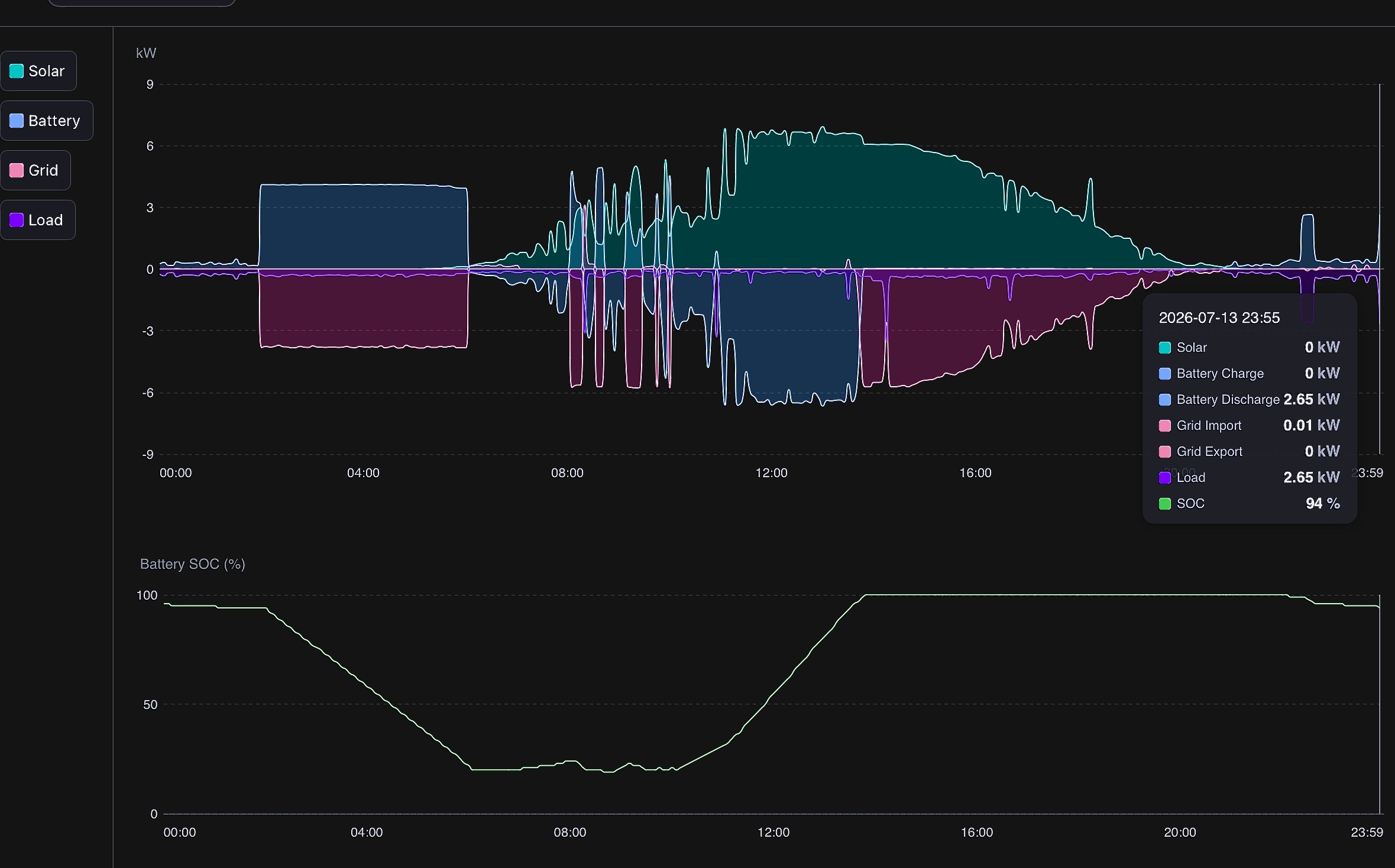
One thing I have noticed is that although theoretically our panels can produce up to 8kW, and there have been peaks up to 7.8, it caps off at 6.05, flattening the generation curve on the sunniest days. This I presume is it being limited by the 6kW inverter with just brief peaks getting through when sun suddenly appears. Howeverby playing with it I found that if I empty the batteries shortly before the sun reaches its peak, then on those sunniest days it was achieving just over 6.6kW, dropping to 6.05 once battery full. On that basis it would be possible with our battery to squeeze up to an extra couple of kWh out of it on the sunniest days, but whether worth the effort is another matter!
Pic is from the low battery higher generation test day:
I asked Gemini how pure the sine wave from a Tesla PW3 is and it replied:
The Tesla Powerwall 3 outputs a pure sine wave, emulating utility-grade electricity so perfectly that it safely runs all sensitive household electronics. While Tesla does not publish a specific Total Harmonic Distortion (THD) number, industry consensus on user forums confirms the output is clean, typically achieving a THD of less than 3%—surpassing the IEEE standard for grid and backup power quality. [1, 2, 3, 4, 5]
Key Characteristics:
Waveform: Pure sine wave.
Total Harmonic Distortion (THD): Typically < 3% (industry-standard for high-quality inverters).
Frequency/Voltage: Emulates the exact frequency of the incoming grid to ensure a seamless transition when the power goes out. [1, 2, 3, 4]
And this is what Gemini says about embedded noise.
For a high-end audio setup, the electrical noise carried on the 230 V sine wave from a Tesla Powerwall 3 is low enough to meet strict utility grids standards, but it is not completely sterile or “laboratory grade”. Because it uses high-frequency pulse-width modulation (PWM) to reconstruct the AC wave, it carries minor harmonic artifacts and high-frequency switching noise that highly sensitive audio gear can resolve. [1, 2, 4]
Audiophile consensus on platforms like Audiophile Style and the **Naim Audio Community**highlights how this power interacts with high-fidelity systems: [1, 2]
How Inverter Noise Affects High-End Audio
The Low-Frequency Benefit (Lower Noise Floor): When running off-grid or from the battery at night, the Powerwall 3 isolates your home from grid-born pollution. It eliminates DC offset (which causes massive hum in large linear transformers) and filters out the industrial “hash” from your neighbours’ appliances. Many audiophiles note that the overall background noise floor drops significantly, resulting in cleaner micro-dynamics. [1, 2, 4]
The High-Frequency Trade-off (Switching Artifacts): To generate a 230 V sine wave, the PW3 flips its internal transistors on and off tens of thousands of times per second. While the internal line filters smooth this into a pure sine wave, ultra-high-frequency remnants (switching noise) can pass through onto the mains line. If an audio component has a poorly shielded power supply, this radio-frequency interference (RFI) can find its way into the analog signal path, resulting in a slightly “dry” top end or reduced soundstage depth. [1, 2]
The Charging Variable: When the Powerwall 3 is aggressively tracking solar inputs via its MPPT (Maximum Power Point Tracking) controllers or rapidly charging, the high-current switching increases line noise. Audiophiles report that critical listening is best done after sunset, when the system transitions to a steady battery-discharge state. [1, 2, 3, 4]
Real-World Mitigations for Your System
Because consumer solar storage systems are designed for home efficiency rather than dedicated audio performance, the standard Powerwall 3 filtering will not match a bespoke audio regenerator (like a PS Audio PowerPlant). If you are integrating a PW3, consider the following: [1, 3]
Dedicated Radial Circuit: Run a separate, unshared circuit from your consumer unit directly to your hi-fi listening room to isolate it from domestic appliances running on the PW3 line.
Passive Power Conditioners: Use a high-quality passive power filter or isolation transformer on your source components (DACs, pre-amps) to strip away any residual high-frequency PWM switching noise. [1]
Avoid the PW3 for Power Conditioning: Do not view the Powerwall as a replacement for high-end audio power conditioning; view it as a cleaner, stabler alternative to a noisy electrical grid. [1, 3]
We have a gateway on our system, and you can see the voltage either side, the mains incoming is much more variable…….but i like my hifi sound more. But so many other changes including earthing rod, 100 amp fuse etc.
Hi Simon, possibly but it was a lot simpler before the instal with just the meter tails split via a Henley block to feed the house CU and the Hi-Fi CU.
Now there is an extra 100A double pole switch after the meter and this connects to the Tesla Gateway (as does the Tesla Powerwall and AC output from the panels (they all have micro inverters). This now feeds the Henley block where the feed to house and Hi-Fi CUs split.
Interesting you mention the RF noise. I always have a scan through the latest RadCom mags at work and the EMC section has carried some interesting info on some of the issues with solar panel installations so good to hear that yours are nice and quiet, not surprising given your Amateur Radio interests and minimising extra RF noise in your local environment. A good practice in any installation.
@davidhendon Hi David, Of course, the PW3 is powering the house in the evening when we are watching TV so the 350s seem to like this. Like others mention, I’ve not noticed any issues with SQ which was one slight concern with going down this route. The silent 350s being a pleasant surprise.
We had the 100amp fuse, but now have an additional earth rod, which only comes into play if we have a power cut and the house islands.
I’ve started measuring our local mains voltage as I was curious to see what it’s doing as we’re in a cul-de-sac of 25 houses and 5 of us now have solar installations. Peak generation (6.5kW) at lunchtime today was peaking up to 250V so we’re getting near the top end of the allowed range. Interesting to see what it’s like later when no solar generation is occurring and we’re running off the battery.
I expect you’ll see the highest Voltage in daytime, after your battery is full so that you are exporting most of your generated power. Ours fluctuates constantly: it rises as the sun brightens, drops when you put the kettle on, and so on. Bracing myself for a battle with our DNO who are trying to pretend that it’s not a problem.
Yep, we were exporting from about 11am this morning once the battery had charged as probably were our neighbours, so the high readings around lunchtime aren’t unexpected. It’ll be interesting to see what they look like over a few days.
Grid balancing is certainly more of an issue these days, given the amount of renewables and the reduction in high inertia generation. It’s going to be an interesting few years with demand on the grid increasing and the slow upgrading of grid infrastructure.
Is this based on a multimeter or what the Inverter says? Just saying as my Inverter was measuring 10v over what my meter says, but I was able to adjust it under the Inverter settings. And in case you were wondering, my multimeter has been checked against one that SP energy had.
It’s just a multimeter to start with just to see what the local mains is looking like. If my measurements are out of nominal limits then I’ll engage with the DNO who can provide the appropriate calibrated equipment to log voltage readings to see if there is an issue which requires any adjustment of our local distribution transformer.
Glad your installation went well IB. Looks like a good setup there.
As you say your 6kW inverter is clipping at max power from the panels, but I’m presuming your battery is DC coupled, hence you have a bit more headroom to use the power from the panels to charge the battery before the battery is full. Perhaps cycling the battery more will work better for you, although it looks like you have plenty of capacity there - more export potential at peak rates ?
I’m glad I don’t understand any of this stuff! So long as everything is role I’m happy. We run on grid power overnight, until 5.30AM, so the batteries are full at that time. Today we started exporting at 6.05AM and have been exporting ever since. We do a forced discharge from 6.30PM to 11PM, so today we will be exporting for 17 hours.
There is another high grid demand from 8PM to 9PM tonight, where we can get paid for using less. Of course, we don’t use anything at this time, rather we export power. We always sign up though, and somehow we make a few pennies.
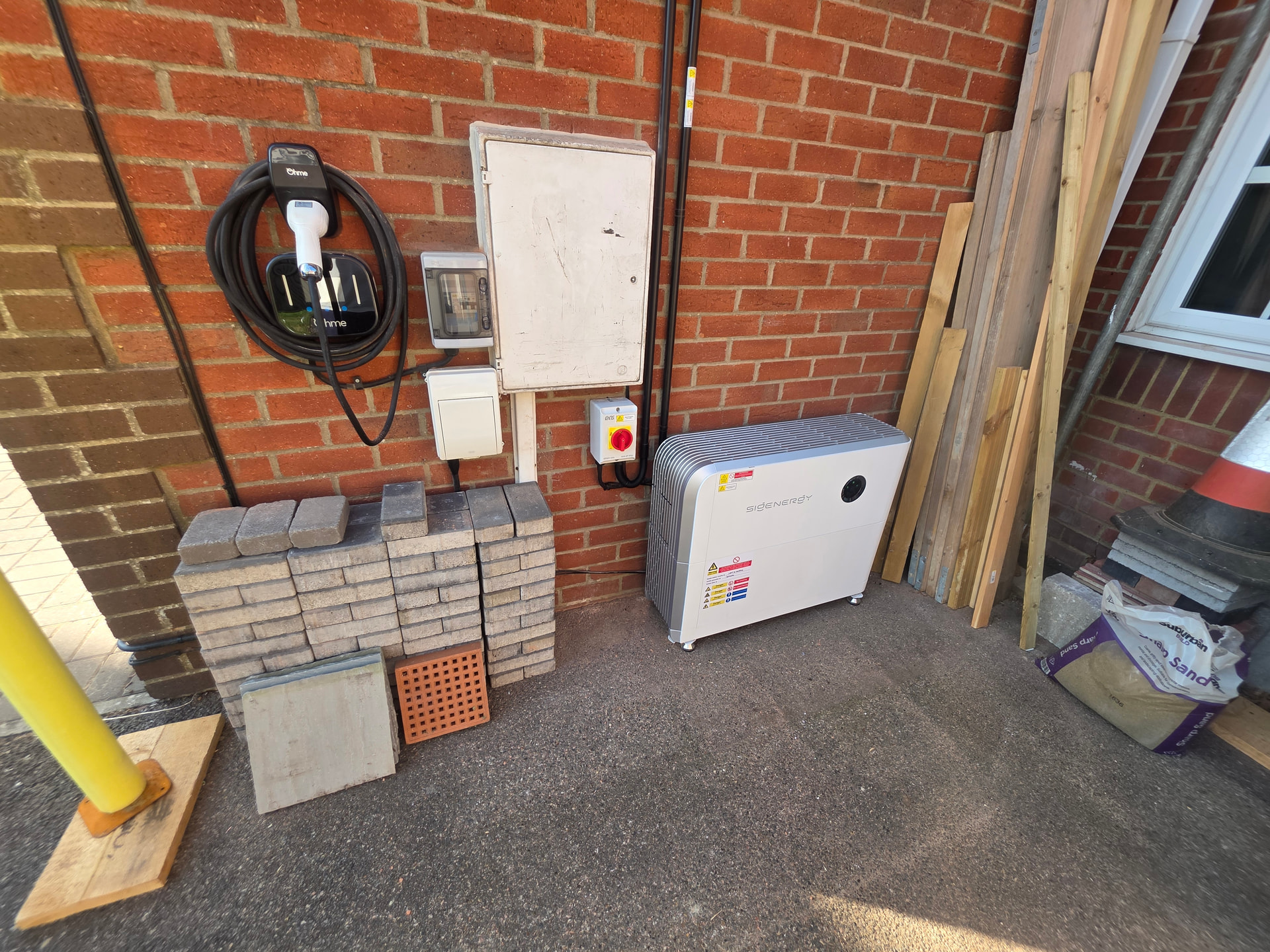
So, my Sigenergy Sigenstor Solar system installation was finished yesterday. 12 x 465 watt solar panels. Sigenergy inverter and battery are stacked on top and looks very neat. 5kwh Hybrid inverter and 9kwh Battery.
That sounds good, Nigel. I think you’re about a year ahead of us on the solar journey so we’re still working out what’s best for the long term, especially once we’ve gone through the winter period. So far with a new efficient boiler and top spec controls, our gas usage has dropped quite considerably so what we do with Solar is still in the exploration phase, especially when we add an EV into the mix.
Out of interest, is your heat pump providing hot water at the moment or do you have another option for this ? Apologies if this has been already covered. It’s a long thread !