I have used search facilities on the forum to see if there is much info about types of solder for cable terminating - unfortunately, not much information has come up on solder type.
I need to construct some short (~1m to 1.5 m long) loudspeaker cables using a variety of bulk cable types that I intend to trial versus some off-the shelf ‘high end audio cables’.
Anybody have any views on types of solder that have been used (for audio benefit)?
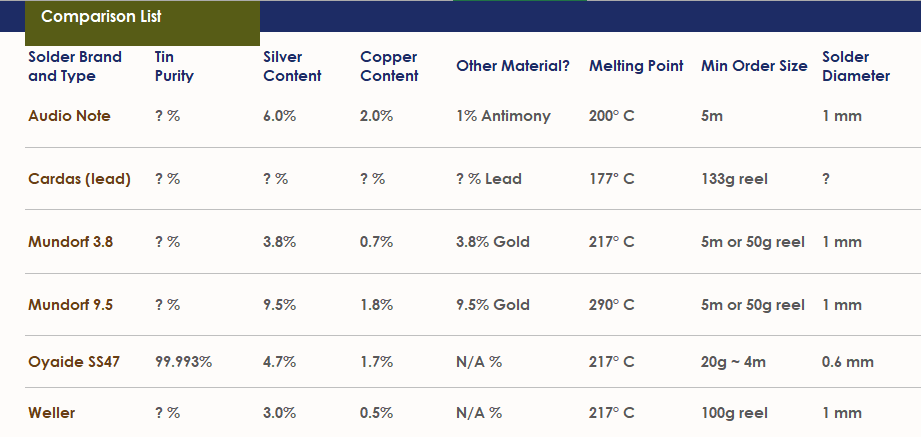
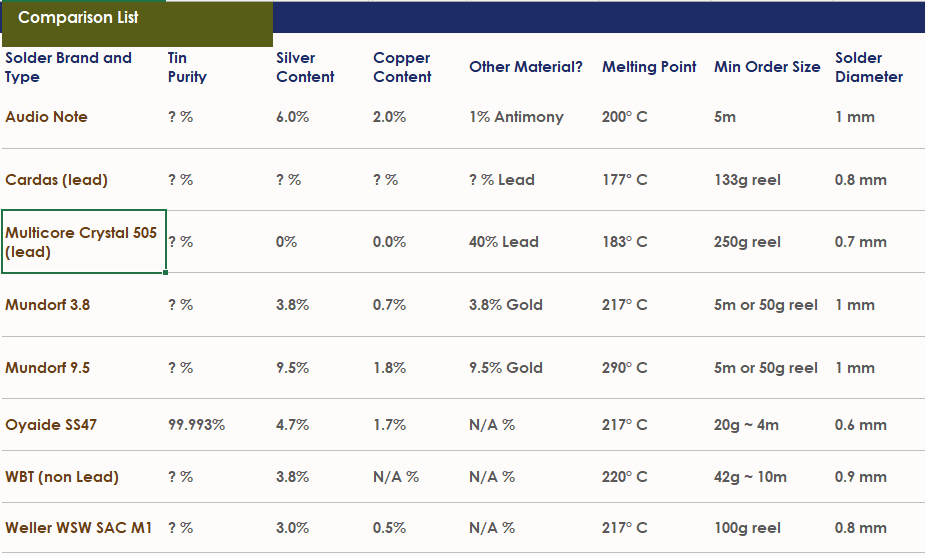
PS: There is of course a solder type assessment chart under construction…
I would just use what Naim use for pre-ROHS kit and cables - Multicore Crystal 505. It’s what the Naim guys (as well as a number of Naim dealers) still use for making speaker cable terminations as it’s ideal for the job.
I assume with such short lengths you will not be using a Naim power amp for your tests?
I’m not sure solder has that much effect, or at least it shouldn’t.
The wire and terminal contact should be a reasonably snug fit such as NACA is in the Naim SA8 plug slots, The electrical contact should be from wire to terminal, not via solder. The solder should just tin the surfaces and act more like a binding agent.
If the wire is a loose fit in the terminal and its jointed in a ‘lake’ of solder, that joint will electrically (resistance) not be good and will fail eventually.
I’ve been using Cardas Quad Eutectic solder for the last ten years I’m only a hobbyist but have built dozens of amplifiers and cables using cardas quad eutectic. Its high quality and flows well and generally really nice to work with.
"Easy-to-use solder. Ultra-pure tin/lead/silver/copper with activated rosin core flux. Cardas’s quad eutectic solder is perfect for joining the connector to the conductor.
In UK lead solder is restricted but not banned. Its prohibited for use in water systems, but is
available for other professional uses.
Multicored electrical solder (which is what we are talking about) is available, or at least I’ve never found it hard to find. But I notice it’s getting harder to find in DIY shops and some ‘trade’ outlets.
Personally I’ve moved over to lead free silver content solder for making ‘new’ joints, it’s not quite as easy to use, but it’s not difficult.
I only use 60/40 for working on old joints.
Thank you so much for the contributions. Following your inputs I have expaned the table to include more of the brand and type suggestions of forum members - thanks for the thoughts.
However I think I will select one of the non-lead solders.
I did not fully explain that the ‘cable’ metal I am planning to join to the connectors is either pure(ish) copper wire for high current electrical applications or a similar (but solid) copper based product. The connectors are high grade banana plugs, which as far as I can establish are ‘high current’ rated and made as gold plated brass.
However, before I place an order, perhaps any other members with qualified metallurgist experience may offer their views (@bruss perhaps)?
Thanks for this suggestion, I hope you are enjoying this thread on what I consider to be a very serious topic.
I have been very surprised at the speed and engagement on the original question posed. I was not sure I would get any responses.
However, having seen what has happened since lunchtime, perhaps I should have also posted all the analysis I have undertaken on how to select an ‘Audio Grade’ Soldering System?
I swapped over to what Naim were using back in the early '80s and have hardly looked back since. You could certainly do a LOT worse. At least half the advantage is its smaller dia. of 0.7mm which is so much easier to use and probably slightly less wasteful. The “audio” styled solder tends to have ultra-agressive flux which is almost certainly a good thing but can be pricey. The rest of the additives are a bit like cable itself and you may or may not want to add silver or gold - you may not actually want OFC copper either, it seems. My experience of silver plated copper wires are that they don’t take over the sound of your system but you can tell they are there. Very much a matter of personal taste and the purist may want to do without. I’ve always had other more pressing things to do than change a plated cable for a standard one but it would be a surprise to find a pure silver interconnect anywhere in my system. If you are going to find sound quality differences in the solder alone I would guess that is going to boil down to preparation - such as cutting back the cable sufficiently for there to be no oxidised copper - and getting a good single melt joint. Really the same sort of things as will generally make the joint last properly!
If you are going to be trying bulk cables I have found that the tri-rated ones (for fire and smoke) tend to sound better for not much more money. Of course I can’t be sure exactly why but a reasonable guess would be that they give the copper an easier time chemically in general but especially during manufacture. I’d definitely say that choice makes more difference than varying the solder joint at their ends.
I just posted the only thing I remember from other out of here discussions.
Normally you won’t see any other posts on that subject from me, or maybe some on east siberian food
I think that a good crimp sounds better than solder. A good crimp certainly has a much lower failure rate than solder. Audioquest, Cardas, WBT and numerous others use crimps
Viborg do some really nice solid ofc copper banana plugs and RCA connectors with various or no plating the banana plugs are around £30 for a set of four and use a double hex allen screw for attaching the wires so no soldering which makes it easy to swap over if trying different cables.
Or if looking at RCA connectors Duelund make some premium UP-OCC (Ultra-Pure, Ohno Continuous Casting) body that are gold plated and don’t use any plastic or ferrous metal in construction which are not to outrageously priced.
I’ve been on a mission to avoid using anything that’s brass plated in my cables and connectors over the last few years and have used the Viborg Banana plugs with Duelund DCA16 for my speaker cables for around five years now.