Thanks for the information. I bet your system sounds fantastic!
Your confirmation of the Apertura Altra loudspeaker impedance, internal crossover design and sensitivity etc is very helpful - not too much current will be demanded across the audio spectrum.
The loudspeakers will be easy to ‘drive’ (very unlike the Magico’s that I have) and the Apertura Altra casework has very well considered internal shaping to provide good acoustic energy dissipation within the casing and to prevent acoustic resonance build-up.
I only have one more question (not serious)…
Why oh why does the French Nation tend to keep all the good stuff to itself?
I mean, this situation has been happening for centuries!
Like with wine, cheese, brandy and lace products for example?
The Apertura loudspeakers have NO distributor or dealer in the UK (as far as I can determine).
It is almost as if I will need to smuggle some into the UK on a ‘small boat’ or something if I want to get my hands on a pair to have a listen.
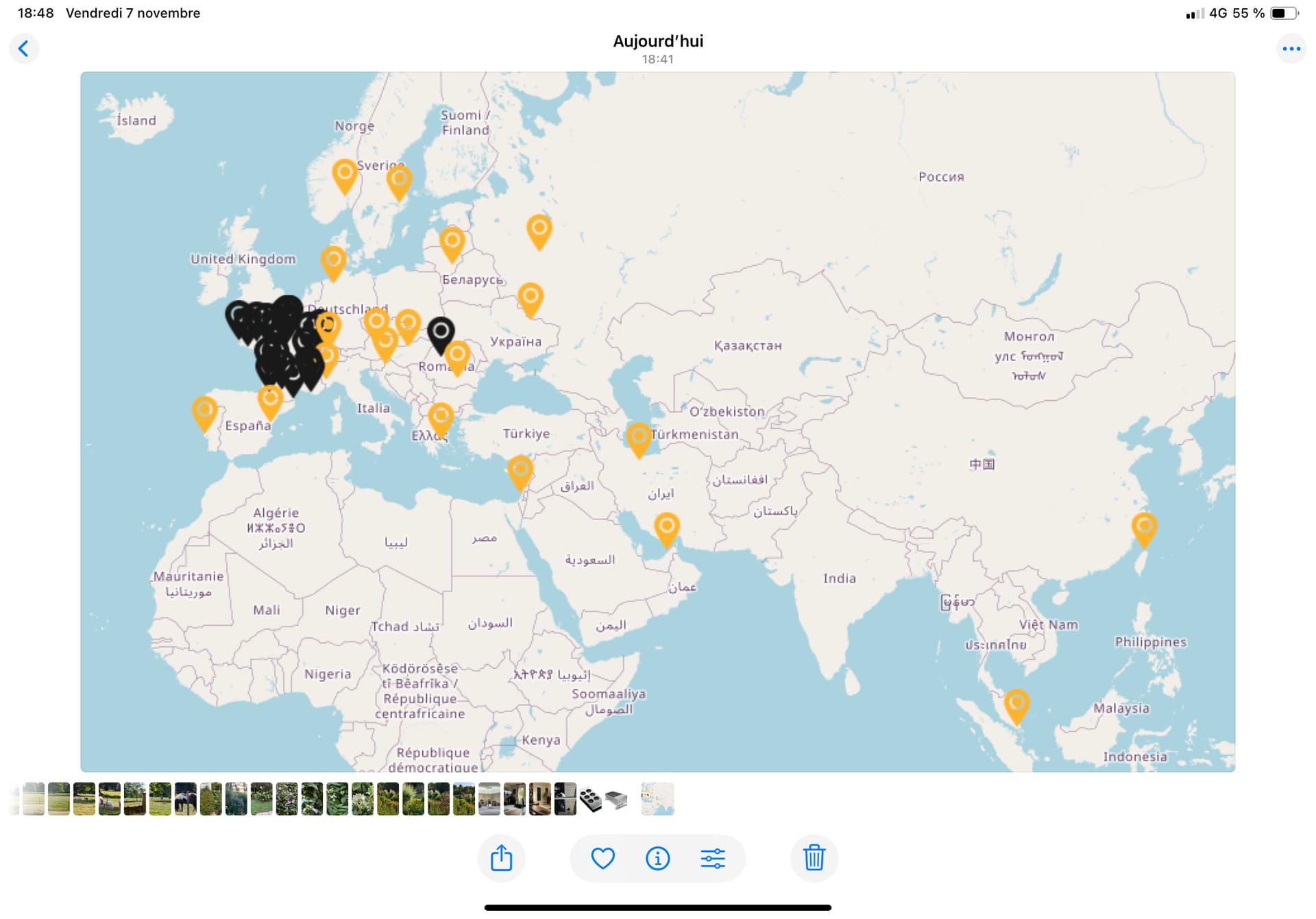
See the map, all the places in the world, but indeed no UK. Maybe because UK has maybe the most exhaustive brands all over the world, so the competition would be hard?
Stereophile made a very good review on the Apertura Everest.
In the UK, my Google search has not yet not offered me the suggested review in Stereophile magazine - was it a different HiFi publication that did the review?
Or was it a different Apertura Loudspeaker - such as the Apertura Enigma MKII? (FYI, I found two reviews of this model). Or some other specific Apertura loudspeaker type?
In any case, I am very interested in learning more about the Apertura Everest but have not yet found the review that you mentioned. If you like, just give me a ‘free text’ Google search suggestion for me to use written in the French language.
Apologies for the delay as in post number 208 I had promised to:
The wait is over:- here are the Assessment Criteria to evaluate the cable company Brands.
These criteria have emerged as a result of asking the cable companies for the two values (for lossless cable) or four values (for lossy cable) of electrical parameters required for the LT Spice model simulation.
My thought was to have a simple rule: two ‘strikes’ of NO and the Brand is out of the competition.
Does the Brand offer Direct Online sales or a UK Distributor and Retailer?
Do the Brand representative(s) respond to any relevant questions submitted by email or telephone?
Do the Brand representatives respond to one (or two with prompting) simple request(s) for simple electrical parameter information (L and C per metre)?
Once I realised that not much data was forthcoming from the Brands (that I had asked), I realised that practically all the technical information I needed was already available in the public domain. This data had been collated by Alpha Audio in their Megatest review of 32 Loudspeaker cables (April 2024).
Even though the cables in those Alpha Audio tests might not be suitable for my system (because the characteristic impedance to high or current handling would be too low), I thought the following additional two part question (4(a) and 4(b)) might be a sufficient final filter whilst retaining the ‘two strikes and Brand is eliminated’ rule.
4(a). Did the Brand offer loudspeaker cable(s) to participate in the Alpha Audio Megatest review of 32 Loudspeaker cables (April 2024)?
4(b). If Yes to the above Question:- Did the measurement data for any of the cable types submitted by the Brand meet the EofE definition of ‘critically damped broadband transient response’ when applied to the measured electrical waveform at the load in the propagation variation test?
Note: For question 4(b) the quality threshold is determined by inspection - i.e. looking at the pulse risetimes, pulse tops and pulse decays and the pulse propagation variance with applied signal level (variance should ideally tend to zero).
Naim Forum Members:- Do you consider that the above assessment criteria are reasonable, fair and equitable?
PS: If any Brands want to appeal to the FIFA adjudication committee (on eliminations). The Brands will need to present their arguments, along with full electrical parameter data for their cable type(s) to be reconsidered.
Yes, I forgot to say “DO NOT try this at home!”
I perhaps will add an edit to the post?
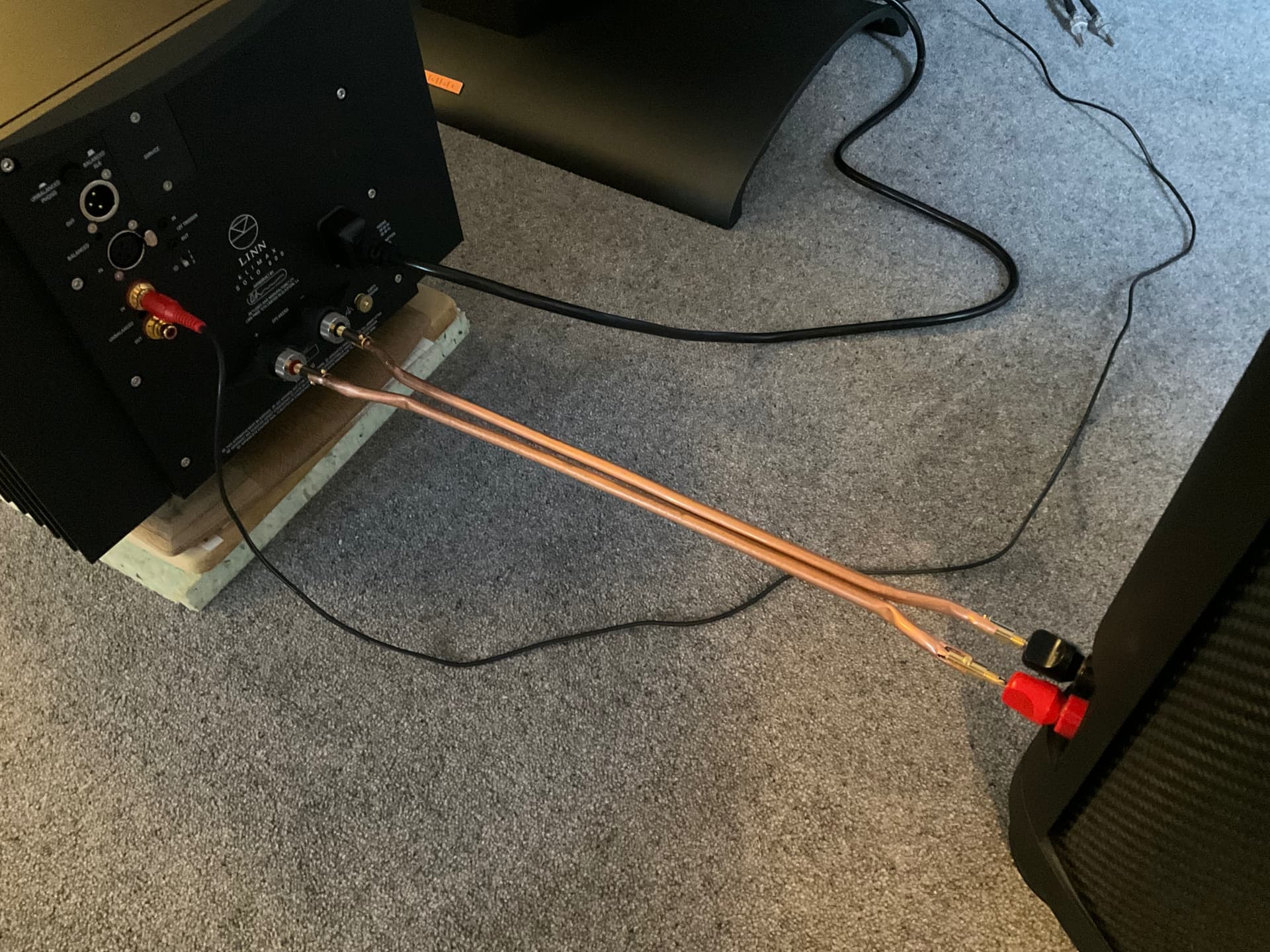
But the potential problem (for the connected amplifier) is not high Capacitance - as the (self) Capacitance is very low for this ‘cable’ arrangement (less than 4pF). Similarly the Inductance is very low for the arrangement.
FYI, I am exploring the limits of some other ‘cable’ aspects which I hope to share soon once I have completed these experiments.
It is worth repeating DO NOT try this at home (unless you really know what you are doing). And certainly don’t try it on a Naim amplifier!
Sorry EoE, I am a bit tardy in responding to your many (all interesting) posts, and I have to admit to not having fully studied all you had written regarding the LT Splice simulations you had planned to do.
The absence of data still from some manufacturers need only mean their exclusion from simulation - you can still do on cables for which data available. However, it may be that with some cables you could make a reasonable estimation of characteristics, e.g, with their two cables in your list Chord declare wire gauge, that the wire is silver plated copper, that they are insulated with a proprietary material called Taylon, and have an overall copper screening sheath, with a polyethylene layer over that, they are described as twisted pair, but visibly the twisting is sparse (if needed, twists per metre could probably be guesstimated from the pictures). The dielectric constant of Taylon are unknown, it might not be unreasonable to assume not hugely different from PTFE, and whilst the screening termination is unknown it might be reasonable to assume it is not connected to anything, as from photographs it is appears that nothing on one wire is connected to the other, and simply connecting each sheath to the inner wire would likely reduce any effectiveness. On this basis I think it may be possible to use one of the online cable parameter calculators derive reasonable estimates for the capacitance, inductance, resistance and characteristic impedance. I had meant to have a go but so far time availability has eluded me.
As for your question about Assessment criteria, part 4b, I am not clear as to what is your definition of ‘critically damped broadband transient response’?
Yes I certainly would expect a pair of conductors arranged like that to have low capacitance (and indictance) - assuming 8mm diameter and about 4cm separation would mean about 12 pF/m, and I guess that’s about 0.2m? The primary thing that would concern me once connected like would be the fact of fully naked conductors, available for easy shorting or visiting kiddie play, however mechanically it would be quite a challenge to connect two heavy items via two rigid tubes without putting strain on connectors, while I don’t know if transmission of vibration to the amp might be more than otherwise just through floor and air, and if so whether significant.
Very many thanks for this link. It has saved me lots of time recently as I have not had to ‘do’ the Maxwell’s equation evaluations (for my DIY cables) using my scientific desktop calculator!
Very short loudspeaker cables are definitely NOT recommended (as Richard also pointed out) - unless you really know what you are doing and have previously established that the amplifier will not be at risk of damage.
Regarding your other prediction - I might need your help and input.
For instance, I had considered that next would be the ‘Interconnect’, e.g. RCA vs XLR and all the various cable topologies and Brands that one might consider. Nevertheless, I consider the Interconnect conundrum less of a problem than the loudspeaker cable - so it should be easy.
But your suggestion of looking next at the Power Cable is perhaps more valid. I have some anxieties in this area and some acoustic measurement data anomalies* that need investigating.
FYI: I am using wireless (WiFi) at the moment for music listening.
When doing measurements with the calibrated microphone and REW I use HDMI input on the LInn Klimax DSM streamer for signal source and USB A (from the Microphone) into the MacMini control computer for measurement.
*Note: It is possible that the acoustic measurement anomalies that I have observed could be part of the measurement system characteristics and behaviour.
@frenchrooster , what do you think I should tackle next? - Interconnect cable or Power cable?
Firstly I must thank you as I owe you a debt of gratitude! Had you not alerted me to the Inakustik cable brand I would not be in the situation I am in now! You might notice in the background of my recent photograph an example of Inakustik loudspeaker cable.
This is not to say that the Inakustik is the ‘selected’ loudspeaker cable - there are other brands and types in the media room out of the picture. Nevertheless with this cable type I have the possibility of comparing the acoustic results with some of the more extreme values of Capacitance and Inductance that are present in other cable arrangements (Brands and Types).
The Inakustik is a pleasant ‘middle ground’ if you like.
So, regarding you observation of me needing a ‘standard’, ‘datum’, etc, you are correct - however it is the Inakustik cable that presently has that particular purpose.
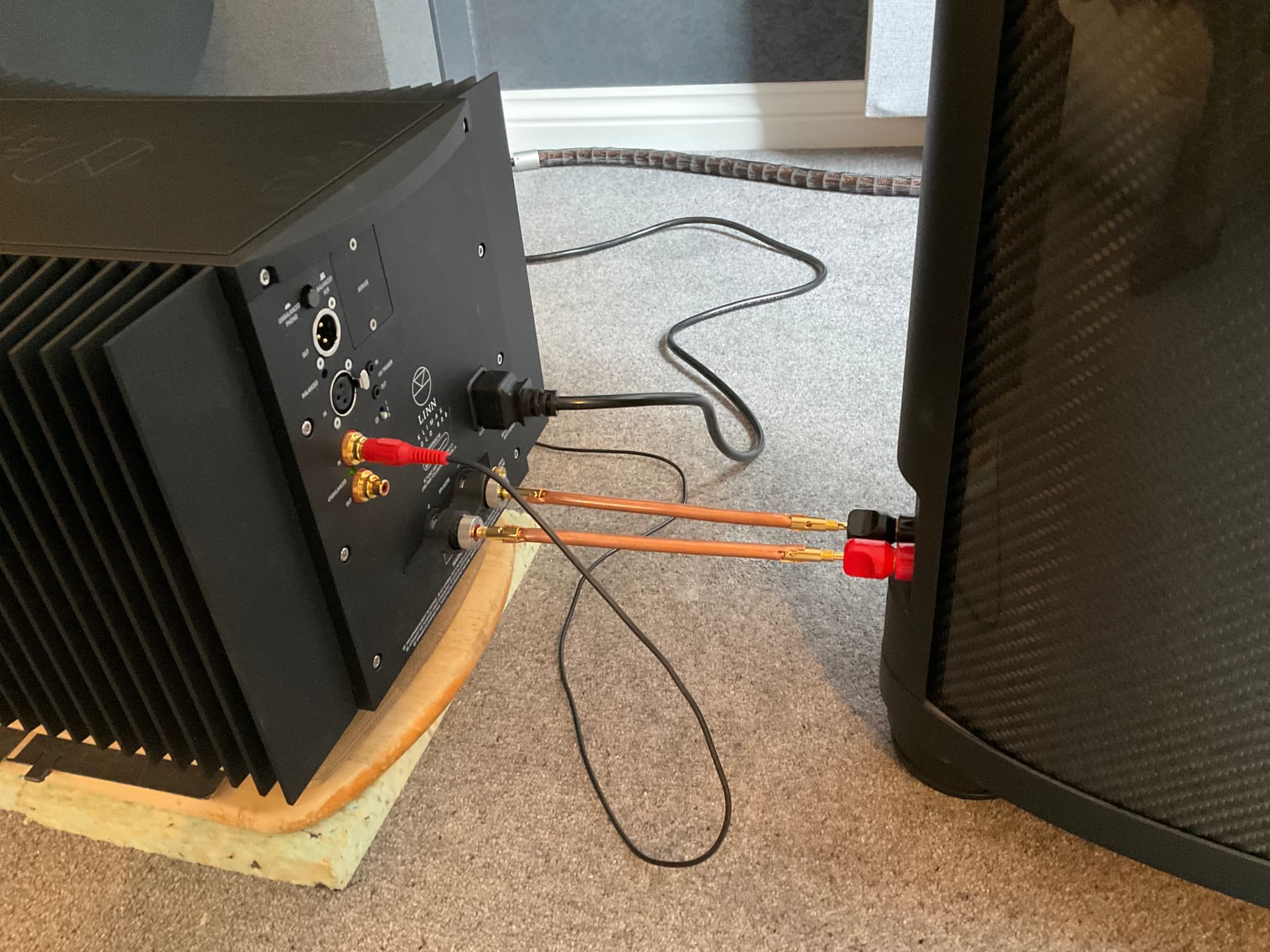
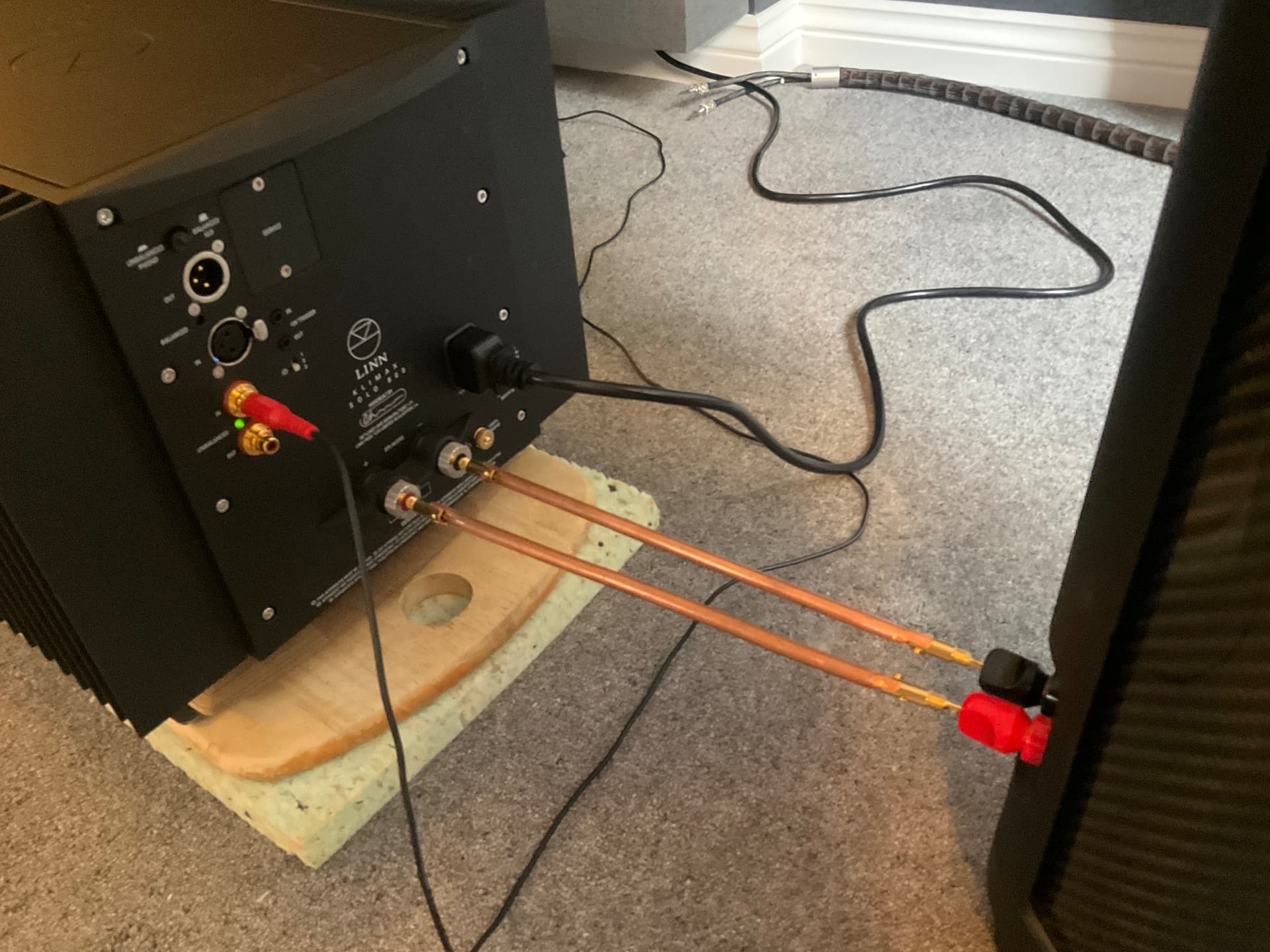
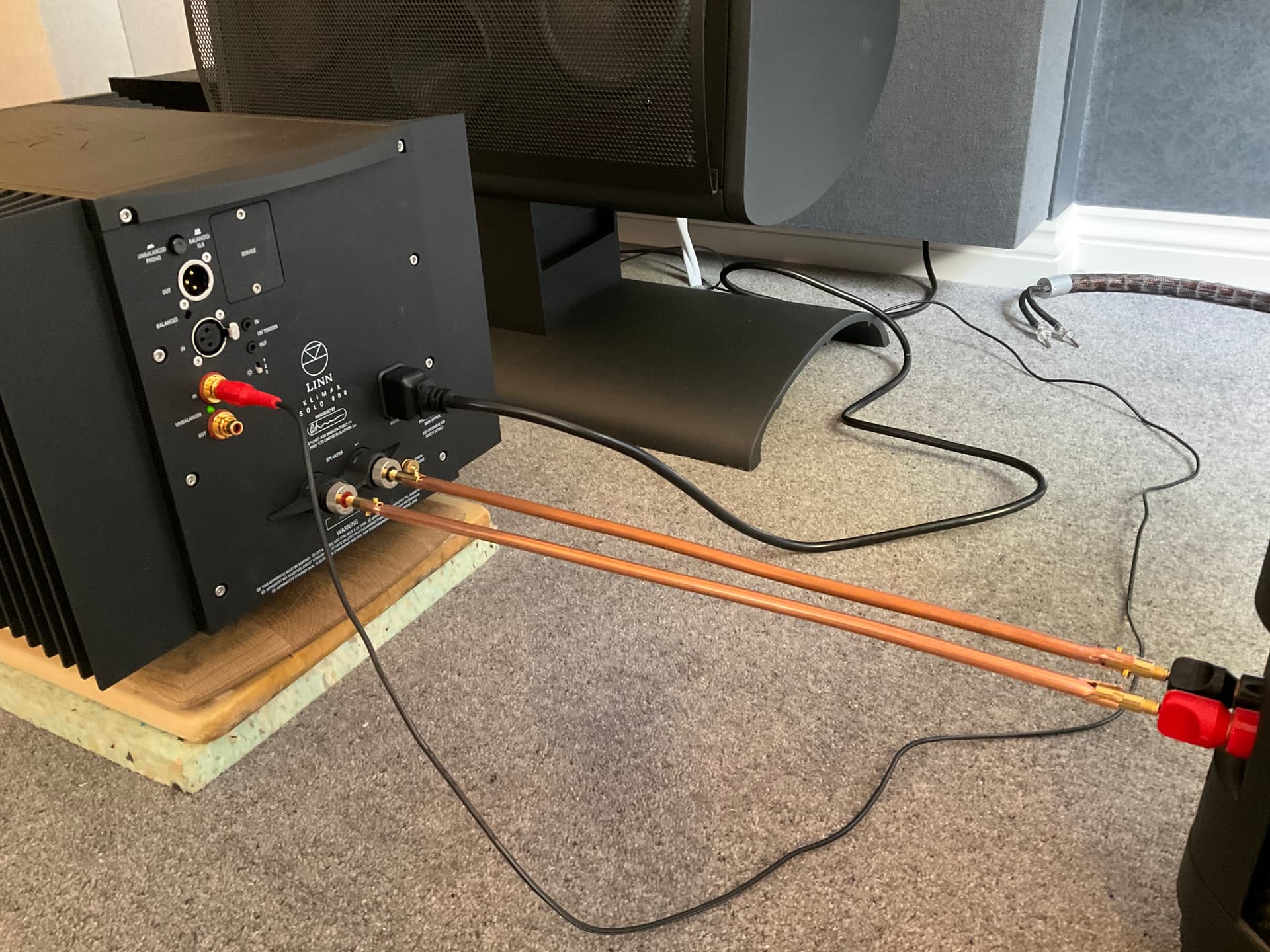
The reason for me undertaking the ‘copper pipe’ loudspeaker cable experiments is to explore the limits of the Linn Klimax Solo 800 when connected to my Magico M2’s. I will need a separate post and explanation as to why this became necessary - but I hope it is informative.
FYI, I have tested three (3) different lengths of copper pipe (15cm, 25cm and 40cm) and one amended geometry of the longest pair. Here are some photos of the different lengths of ‘copper pipe’ being tested.
These 2 are more important first, vs power cords into components. In my view and others. But as always, some say a cheap powerblock is enough and stock cables too.
You are the only one who can choose which powerblock you will enjoy, because some tend to have a sound signature of their own. For instance some reported, with Naim amps, that the Chord M6 is a bit hifi sounding, and tend to exaggerate high frequencies.
Other are very satisfied with it. These things are easy to borrow.
Furutech, different prices of powerblocks, are musical and neutral.
Audioquest Niagara 500 should be tried with your gear also.
Put the best power cord from wall to the powerblock. My opinion.