'Audio Grade Solder' - Final Four LS cables and some surprising discoveries

As always, it is fundamentals first. So power, then signal.
I’d go for optimal rather than best, for whatever equipment you are dealing with there is usually a body of evidence from which to begin the search then narrow it down from there, that is certainly the way I have approached the same process.
I did not criticise Edmund’s approach, in fact I am really enjoying the detailed analysis, discussion and contributions, including your own.

Nevertheless it is worth pointing out that it would make sense to test the cables in the setup that will be used long term, otherwise the result may well change. To your point, select the best in one configuration, then change power or signal and you obtain a completely different result; potentially negating all your hard work. This would seem reasonable given both resolution and dynamic range usually improve with better power supply, never mind tonality.

1 Like

Hi All,

Thanks for the questions and suggestions - ALL of which are Excellent Points!
I will soon begin to address each in turn. However at this juncture, for anybody drifting into this thread, the following image and text may help set the scene:-


Image credit and marketing headline:- Cardas Audio Ltd.

Looking for a little more information?

Well you came to the wrong place because here is a LOT MORE.

1 Like

Hi Protegimus,

My apologies in advance as I may be occasionally very direct - and in a later post I may share a picture that perhaps will give you more confidence in what I am up to?

There is no ‘lashed in’ equipment in my system. It may seem open to improvement in certain areas - but that is not relevant at this time - and I will soon cover the explicit reasons why. Nevertheless ALL of the points you make are completely valid and correct.

Where to start?
POWER: I note that you have Shunyata Sigma cables for your Power Amplifier? Your power amplifier uses 2 x 1,2KVA Encapsulated (ultra-low noise) transformers - with rectification of the mains frequency (60Hz in USA). The explicit granted Patent for Shunyata Sigma technology (a good one - not implicated in my earlier posting!) is designed to provide rapid current delivery into your amplifier (when the rectifiers pass current) and you will definitely get a benefit in dynamic recharge of the reservoir capacitors with lower self-noise generated.

Note: I have carefully chosen all the amplifiers I have (ever) purchased. The Linn Klimax Solo 800 does not use a ‘conventional’ mains transformer(s) and rectifiers. This means that the switching frequency of the power conversion is well beyond the audio frequency and draws its power continuously from the input mains through the 50Hz or 60Hz cycle. The most recent variant of these ‘switched mode power supplies’ employs something called ‘intelligent valley switching’ or ‘resonant switching’ - which basically means the active devices (in the SMPS) are switched between the on-and-off state when zero voltage is across them. This is the lowest noise way of achieving a (very high power) SMPS.

A casual observation (of mine) is that a similar concept of ‘switching when the voltage across the diodes is zero’ is used in the interesting deviation from transformer based PS of the Sanders Magtech amplifier (ref see The Magtech Regulated Power Supply White Paper). That amplifier appeared in the spreadsheet of amplifiers in one of the very early postings on my footballing thread. (FYI the Sanders Magtech amplifier was near the top of my list in 2019).
https://community.naimaudio.com/t/english-premier-or-international-hifi-now-with-team-history/38767/12?u=edmund-of-essex

In Summary: It may be the case that for the Linn Klimax Solo (with Utopik SMPS) a reduction in noise can be achieved by using some other product from Shunyata (or other power improvement supplier), however the specific product you use is not appropriate for SMPS - and the claims in the relevant Patent make that explicit statement. Furthermore (I think I have explained elsewhere on forum) that the mains distribution in my media room has been rewired for high current star connections back to distribution board - so any residual mains borne power amp noise does not get close to any earlier (preamp or source).

Next up: TRANSDUCERS.

PS: I am very happy to take Questions and Comments on any and each of my postings.

1 Like

Only if you let them cost more FR :wink:

1 Like

My point was in general. But yes, sometimes less expensive cables perform better. It’s the case for example with my Kharma matrix power cables that perform better, for me, vs powerlines, even on Naim components.
Then if you have the knowledge to make a very good cable diy, it will cost much less.

1 Like

Hi FR,

Very many thanks for joining in this technical ‘Deep Dive’ - it means a huge amount to me personally that you are contributing. Thanks :blush:.

Before replying I tried to look up ‘Kharma matrix’ power cords - but I could only find links and inforamtion to the 3 (three) current sub-ranges of Kharma product:-
Enigma Veyron
Exquisite
Elegance

Have I missed somthing on the web? or did I not look using the correct search term?

1 Like

The matrix is replaced by the Elegance power cable.


The Elegance Cable Collection follows the tradition of Kharma Cables, which were founded on a Silver or Silver-Gold conductors basis. This tradition has evolved by adding carbon as an additional conductor. This combination of Silver and Nano-Carbon (SNC) conductors form a hybrid conductor construction for the entire Elegance Cable Collection. The outer looks of the cables were designed to match their Loudspeaker Collection, making the Elegance Power Cable match perfectly with the Elegance

1 Like

Is the purpose of that to eliminate noise that is present on the mains upstream of the SMPS. Or to prevent noise being added by the SMPS.

If there are two sources of noise, is the level of the combined noise, the two noises added together or the higher of the two noises.

1 Like

Hi Fatcat,

I cannot quite interpret with certainty what you mean by ‘upstream’. So I will try to answer without knowing exactly the ‘geometry’ your question…

My understanding is that all the new Linn SMPS (Utopik) designs of power supply employ ‘resonance switching’. The design also includes ‘power factor correction’ within - this is something to keep reactive load off the input mains. If you have deeper engineering knowledge of what ‘power factor correction’ means with SMPS then great - my knowledge of ‘power factor correction’ comes from electrical motor and generator studies at university.

Forum members may also know that if a business has poor ‘power factor’ demand (‘reactive’ - out of phase V and I) presented to the incoming mains and through the metering of energy it (may) get charged more for electricity energy than it should!

FYI the Utopik SMPS design also provides very high bandwidth control regulation of the internal Voltage rails under highly dynamic high current load demand - and in the Linn Solo 800 facilitates something special as well. Topic for a much later posting.

However - to answer your question - both sources of noise may be present - ‘upstream’ and ‘downstream’. In my media room, the Star connected mains feeds from the distribution board do the best they can of keeping both mains conducted (self-generated within the equipment and mains incoming noise) away for other equipment which are connected on other ‘limbs’ of the Star (e.g. my source/preamp).

Furthermore, I have various signal level equipment isolation options. For example, within the Linn Klimax DSM I can transformer isolate the RCA outputs on the source - although that can introduce distortions that are worse than the potential LF and ground noise coupling from preamp to power amps. FYI I have acoustic measurement data (and listening experience) of exploring these settings.

I have no plan to prepare an equivalent noise model of my system to simulate and evaluate such ‘mains noise’ concerns. Generally, If listeners feel they can hear some noise - or some distortion - it is very apparent in the acoustic measurements.

The one ‘noise’ situation thus far in my media room was an Acoustic emission from a very small LED wall light being On and Too Close to the microphone during REW measurements. Initially I considered the noise as some ‘mains’ noise in equipment (it was not) - but even this visibly ‘obvious’ noise present in the REW spectrum measurements - still could not be ‘heard’ by human listeners.

Hi FR,

Thanks for the clarification - I was beginning to worry that forum members might start to ‘question my search skills’. What a relief - it seems I am OK!

Those power cables really do have Elegance (within the range) - look very beautiful - and the other Kharma ranges do too.

ATB

E of E

1 Like

Hi @Edmund-of-Essex, no, I don’t use Shunyata Research power cables.

My point was that whatever power supply technology Linn favour (whether for efficiency, PFC, emissions compliance or cost/outright performance) and in spite of the care you’ve taken with mains wiring, the electrical energy still needs to be transmitted to the amplifier and that is where the opportunity lies for clear improvement.

I look forward to reading further of your adventures.

1 Like

Are you saying that in your view the mains cable between socket in wall (or however the wiring from mains entry to home and the hifi location is arranged) and the hifi components is more critical to sound than either interconnects or speaker cabling? And if so is that to source components or preamp or power amp, and if all in which order of significance? And do you consider that it is irrespective of the design of the power supply of each component, e.g. whether SMPS or linear, regulated or unregulated, size of transformer and reservoir capacitors etc?

And if that is the case do you relate that primarily to type of cable itself (e.g. size of conductors, any screening) or quality of cable connecting and plug/socket mating surfaces?

2 Likes

Hi Protegimus,

My sincere apologies - I was wanting to engage fully with you on your very valid observations re power supply - and I rushed looking at your profile, saw Shunyata brand name and scanned the rest of the info looking for power conditioning products and simply, quickly, and incorrectly converted your Shunyata XLRs to Power Leads!

I do hope you forgive me!

However, would it be OK if I continued to use your equipment setup to provide contrasting approaches when discussing the various aspect of system assembly on this thread?

PS: I have just checked my previous posting and I had in fact put a question mark after ‘stating’ that you use a Shunyata power lead product.

1 Like

Hi I_B,

As ever, your summary very well captures the exact problem(s). Thanks for this contribution!

I had not replied earlier to this specific posting of yours, as I had some idea of where the conversations might lead on the forum.

Also (as you might have noticed) I have (in a later post) added a picture of a submarine to the thread.

There is implied Deeper Meaning behind my posting of the picture of the submarine…

Which your words succinctly have given a perfect example of the deeper one goes (in constructing or creating or assembling the ‘perfect’ HiFi system) the more difficult it is to:

  1. Know where you are?
  2. Know where you are heading?
  3. Know whether you ever might get back?

I may pick on this particular post of yours again soon as I want to address some highly technical aspects of signal processing and the means to understand what is going on when considering ‘Sound’ when analysed using the ‘frequency’ domain in contrast to the ‘time’ domain (and its particular relevance to ‘tone controls’).

Hi I_B and anyone else, here -2000ft below sea level.

I had said I would next discuss TRANSDUCERS.
However, instead, I would like to say something else:-

Here are my (forthright and challenging) views on all the various HiFi and forum debates about ‘system balance’, ‘source first’, ‘mullets’, ‘end game systems’, etc. etc.

First off, I do like the approach @Protegimus has taken in building their system - it seems very sensible to me! 'Audio Grade Solder' - and help to complete LS Cable Project - #143 by Protegimus

My particular approach (with high engineering bias) for a HiFi in the Home is that it is the Total System and its Intended Use Case(s) (and Target Specification(s)) that are the first things to consider.

After that, Candidate System Concepts are developed, including candidate Transducers and associated Interfaces considered (these Candidate System Concepts can be assessed WRT the above).

After that the Main Equipment can be thought about, following which Secondary or ‘Ancillary’ Equipment may be considered.

There are formal methods for undertaking ‘System Design’, but for Home HiFi the above Summary is complex enough!

Fortunately, there are many simple established Candidate System Concepts for HiFi in the home to take to ‘Control’ how ones HiFi might evolve over time.

BTW, IMHO there can never be an ‘End Game’ system - it does not exist - one simply has to choose to ‘End the Game’.

We all might be aware of this ‘Game’ - the one that the Marketeers, Retailers and HiFi Industry in general (especially CABLE suppliers!) play to suggest that there is a better ‘thing’ - that beats what you have already got!

The ‘mistake’ we (sometimes) make is that we participate in this GAME by discussing (and sometimes even fighting) but mainly by ‘following’ the what’s ‘better’ line from the promoters and suppliers - without sufficiently challenging the narrative.

This thread is not about that - this thread is about ‘Taking Back Control’.

Thank you (All) for your continued engagement.

2 Likes

Hi I_B,

I have chosen this posting of yours again to reply to and add in some more information.

To introduce it here may be premature, but in the end I have decided that it may stimulate more debate - which I consider a good thing!

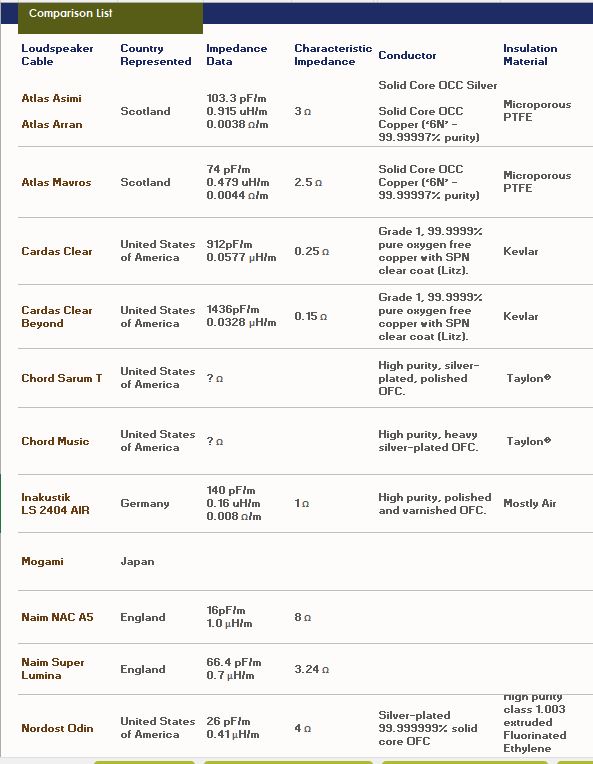
Your mention of characteristic impedance is (I believe) either explicitly or implicitly already undertaken by the OEM cable designers/suppliers. However there is much more to consider with LS cable design than might first appear.

Furthermore (from technical experience at work) there are many more subtleties to subsystem design, interface design and interconnection than selecting a ‘matched impedance’ cable.
(In a later post I will provide a fun story to illustrate this very point).

Originally, I thought it might be fun to run some kind of ‘football competition of LS cables’, where forum members are invited to nominate their ‘favourite’ loudspeaker cable.
Providing certain data are available, these nominated cables get assessed in the LT Spice circuit simulation model that is under construction for my amplifier-cable-loudspeaker.

After the various ‘virtual’ round of competitions (Group A, Group B, Group C, …), the winner of each simulated Group assessment (max 4 Groups?) would be bought or borrowed and secure a place in the Semis and Final of masked randomised human listening tests in my media room.

A World Cup competitor chart (of LS Cables) is already under construction…

What do you think?

I think there is an error : Chord Music is UK, not US.
I have myself Audience an US speakers cable: Audience AU24SX. They are wonderful.

1 Like

Hi FR,

Thanks for spotting this.

Originally I had Chord Co. marked as ‘England’ as nearly all their cables are made in England. The ‘Music’ and ‘Sarum T’ types are also ‘assembled’ here too - so I suppose you are correct?

However, unlike all their other cables, the actual ‘cable’ part of the assembly is manufactured in the USA. Which is why I had changed the ‘country’ to ‘United States’ in the chart. Which introduces an (inaccurate) complexity do you think?

The difficulty I have is that all the technical data I need for the cable assessment is available on the Chord Co. Epic X cable on the Alpha Audio website testing of the 32 interconnect and 32 loudspeaker cables mentioned in an earlier posting.

Chord Co have said they are unable provide the basic data for the ‘Music’ and ‘Sarum T’ LS cables! Why do you think that is? Afterall, it is not data that could be used to ‘copy’ their cable.

PS: Would you like your cables (Audience AU24SX) to be entered in the chart?

Yes Edmund, with pleasure.
I can’t answer to your questions, but you already know that :grin::chicken:. For now I have never encountered a scientist rooster.

1 Like

[ Wasn’t there one, or at least an engineer, in the animation film Chicken run ?

1 Like