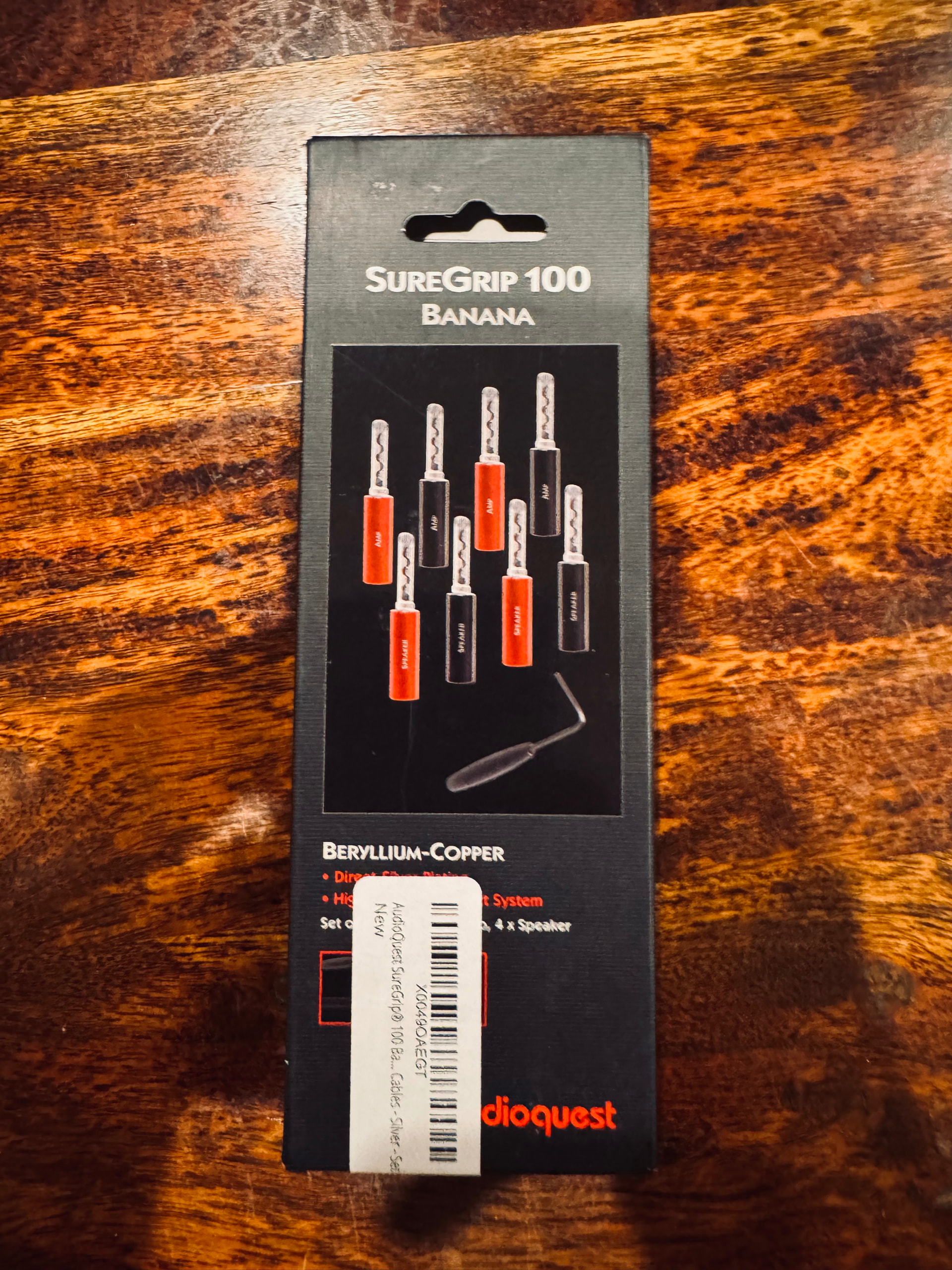
I wanted to change the plugs on my Naim Speaker cables. These are discoloured, com out easily and bent. Dali Opticon 6 speakers from SN3.
I bought these (pic) online and then had the inevitable self doubt and failure of confidence.
There are higher grade plugs available from the same manufacturer. Should I have bought those..
Should I use spades instead (I do move my speakers from time to time)
A further less related Q. Can I halve the length on my speaker cables? Will be much tidier.
Thanks heaps in advance, sage naimian friends.
Ram
These appear to be Audioquest so should be of decent quality. Personally I would have stuck with the Naim plugs or Deltron Bananas. As far as length goes, difficult to say if you could halve since you don’t state the present length.
Use Naim SA8 plugs at any end which is being plugged into Naim kit. Soldering them yourself can be tricky: see FAQs.
If not plugging into Naim kit, match the metal of the plug to that of the speaker sockets.
As far as non-Naim plugs go, Deltron usually gets the support of most people round here, including me. 4mm plugs, well-soldered. I don’t think many on the forum use spades except for jumper cables.
Depends. If banana plugs fit fully into the Opticons, use plugs. If they stick out more than a few mm use spades. A heavy cable and enough time cane case plugs to bend or shere.
My Opticons seems to accept a long banana plug so I think you’ll be fine.
But if you do go down a spade route, the DALI spades on a Dali binding post are serrated so they at least stay tight which you cannot say for most.
Naim plugs tarnishing shouldn’t be an issue either. Just insert them 20 times and scrape some fresh nickel.
Apologies. Each cable is 380cm
My speakers are 2 m apart so lots of heavy cable. I stayed with this length having the impression (right or wrong) that length equals resistance
Don’t worry about cable resistance. It’s not an issue. The Supernait 3 is quite tolerant I believe but I wouldn’t be happy to go shorter than 3.8m of NACA5 if it were me. Yes it will work and the amp won’t suffer but I doubt it will sound as good. If you want a more manageable cable then Kudos KS1 seems very popular here and apparently works very well.
If your speakers have gold plated sockets you should use gold plated plugs. Personally I particularly dislike those BFA plugs, which use hardened (therefore relatively brittle) metal to provide the spring that gives a tight fit. It can also scrape the plating off some sockets when you insert and remove them. My advice would be to get some proper bananas instead. As already mentioned, Deltron are a good choice and they are not expensive.
I would keep your cables longer if you can. Your amp will still work with shorter lengths, but you may find that it doesn’t sound quite as good and then it will be too late to change back!
I suspect that what you really mean is that you wouldn’t hear any difference in a blind test! I’m not really sure I would either TBH and I certainly wouldn’t bother experimenting to find out. So I just use what is recommended as best and leave it at that. Avoids that nagging doubt that otherwise eats away at me continually!
Indeed: But widening this, essentially whatever metal the terminal surfaces are it is best for the connector surface to be the same, whether gold, silver, nickel, copper, rhodium or anything else. The fact that the surface may be a plated coating is of no consequence. Similarly unless soldered the cable connecting surface of the connector is best if that is the same metal as the wire surface. If differing metals are unavoidable then one being gold may be better than most alternatives.
As for bananas, I generally prefer not to use them as the connecting surfaces of most I’ve seen have been poor, and often loose though judicious bending can help. Perhaps there are exceptions, but as a generalisation I prefer soldered spades, or even direct wire connection (wire through hole in binding post), though latter needs several retightenings and then periodic checking yo ensure good connection.
I bought my speaker cables, which are Chord Company Epic X, ready made so it wasn’t an issue for me. I don’t use Naim equipment now but if I did I would just stick to Naim plugs at the amp end and Deltron 4mm plugs (which are basically the same pins as in the Naim plug) at the speaker end. Just because that’s what is generally recommended. I don’t really know if I would hear a difference between different speaker plugs and I really can’t be bothered to find out. It would be extremely tedious and time consuming. As keen as I am to get the best from my system I do have limits as to how far I’m prepared to go and that’s just a step too far for me.
I have seen it opined that this is the best connection. It seems to make sense as it avoids another discontinuity on the signal path. The great problem and disadvantage is that the conductors oxidise relatively quicky and so require constant periodic re-stripping as they can’t successfully be cleaned. So unless you are prepared to do that then it’s not a sensible solution.
I had some NACA5 soldered for me by a dealer, and he made a complete botch. I had to remove all the plugs and start again. They sounded poor until the soldering was sorted despite there still being a fairly good metal to metal contact on the botched ones.
(For what it’s worth D*ck Shahinian, the loudspeaker designer, insisted that unsoldered banana plugs should be used on his speakers. The exact opposite of Naim’s way of doing it.)
Not many people have much control over humidity indoors, albeit normally more limited in range than externally. And I have seen heavily corroded connectors on gear in a house with no abnormally high humidity in the main air in a room, but there was a damp patch in the wall close behind , causing a high humidity micro-climate behind tge equipment.
Bought the gold plated Deltron 4mm plugs (to be shipped from the uk) I will not rush to change my existing plugs although I hope the new ones will have a more secure fit
Thanks to all for your valuable responses
My parents didn’t have central heating and only had single glazed windows. I noticed that all connectors got tarnished very quickly. Since being married we’ve always had central heating and double glazing and no such problems up until now in our current property. This is a 1930’s bungalow and curiously only half a mile from my parents’ old house. I find that despite normal levels of humidity connectors again seem to tarnish very quickly. Nowhere near any damp or windows though. Possibly due to air pollution, being on the edge of the city suburbs and also near a major airport. I have noticed that with a number of properties that have had brand new roofs within about a year or so the roofs look dirty and fundamentally no different to much older ones. So definitely a lot of air pollution.