Agreed at 16.
Hard to explain without a diagram but I created a long rectangle, of which the long straight line of the red area is its diagonal.
Its length is 3sqrt8 + X where X is the length of the large square.
Its width is X - sqrt8.
Its area is half the product of these two. I then subtracted the unwanted white area, which can be isolated into 2 triangles and a small rectangle.
Surprisingly, all references to X cancel out, leaving just 16 remaining.
Yet another counter-intuitive result, as you would think the larger the big square is, the larger the red area must be.
Great puzzle!
1 Like
Nicely explained, Steve.
To simplify things slightly I ignored the 8 until the end to avoid square roots and just treat the small square as a unit square. Then I flipped the diagram to make it easier for me to see as an (x,y) plane as follows:
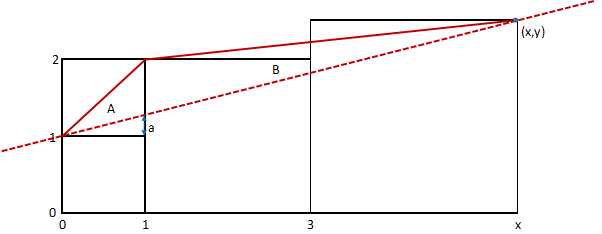
The triangle crosses the small square distance ‘a’ from the corner.
(x,y) is the far corner of the red triangle.
The red dotted line has slope a and y-intercept of 1. Hence: y = ax + 1
The base of the large square is x - 3. Hence: y = x - 3
Eliminating y we arrive at: (1 - a)x = 4 (equation 1)
If A is the area of the red triangle within the small square, then: A = (1 - a)/2
If B is the remaining area of the red triangle, then: B = (1 - a)(x - 1)/2
Hence area A+B = (1 - a)x/2
Using equation 1 eliminates both a and x to give: A+B = 4/2 = 2
Conclusion: The area of the red triangle is twice that of the small square, so 16 units
EDIT: I prefer @SteveD’s solution. I tried but couldn’t spot a visual approach, so I had to revert to using maths.
1 Like
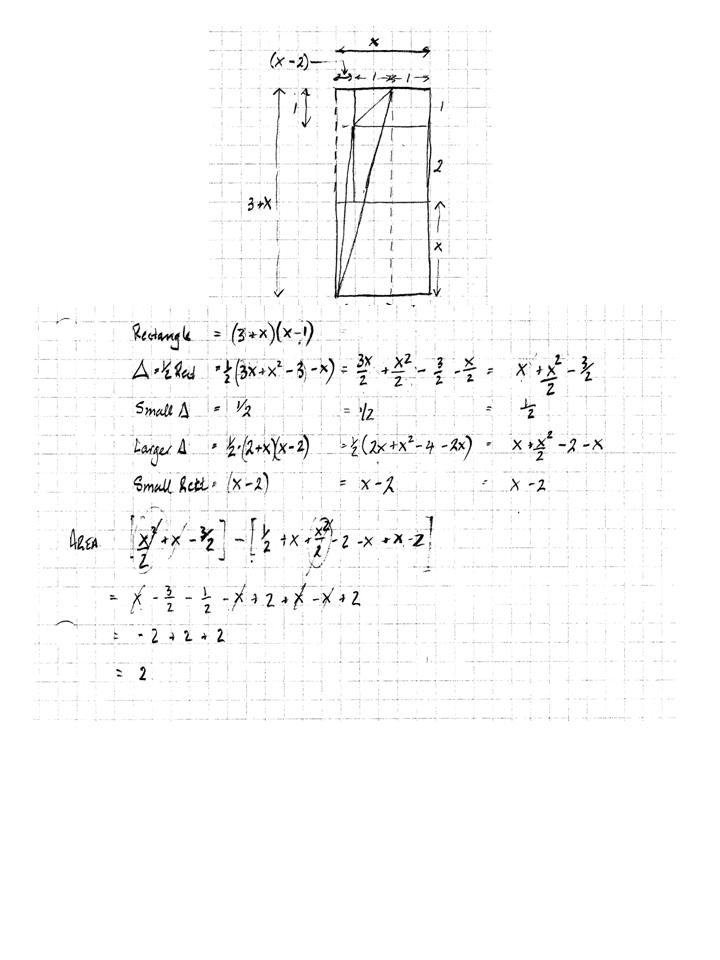
I reduced the area of the given square to unity.
I then used geometry, a bit like Steve, with X as the dimension of the unknown square to show that the area of the red triangle was 2xUnity.
I’ll try to produce a decent PowerPoint picture to post, rather than my initial pencil and paper workings which I’ll scan and post below.
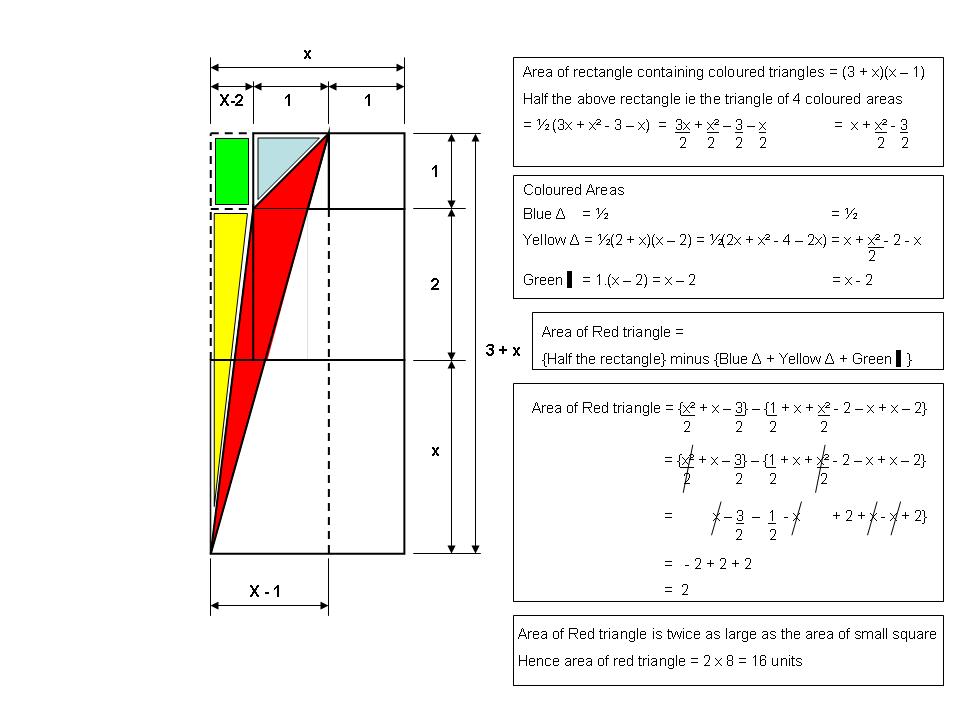
Not my best picture. But I hope it’s readable
The basics are as per Steve (I think, apologies if that’s not the case Steve)
The “Rectangle” is formed by adding the broken lines.
The long side of the red triangle forms the diagonal of that rectangle
The area of the red triangle is (the other half of the rectangle) minus (a small triangle, a larger triangle and a small rectangle)
Thank you. Suffice to say it was way beyond my basic maths skills to work it out.
1 Like
Yes Don, that’s exactly how I did it as well.
1 Like
A very nice teaser. Thank you very much for posting.
Cheers
Don
I thought your solution Ravvie, was pretty neat as well. Nice to have some variety !
I drew my initial diagram and started with 2rt2 for the small square and “x” for the large, unknown square, but thought it was going to get complicated.
Then a “blast from the past” triggered a thought … so I reduced the unknown square to match the large square. Of course, the area of the red triangle dropped out as 16 in an instant. ie, as you pointed out, “X” is irrelevant.
I then thought about using “unity” for the small square … and the arithmetic for a general solution became much easier to manage … well … at least to my mind.
The “blast from the past” was a 6 inch long hole is drilled through a sphere (the hole is 6 inches long). What is the volume of the material remaining in the sphere after the hole has been drilled ?
I posed your “blast from the past” hole in a sphere puzzle to Mrs R. Neither of us had seen it before.
She managed to solve it, with a formal proof from first principles! Something to do with volume of revolution, integrating the formula for a circle. I think I just about followed it.
I had a go using a similar approach that I used for the red triangle puzzle. That is, I worked it out for a trivial case then tried to expand it in general. Trouble is, I ended up with cones and spherical segments, neither of which I could remember the formula for.
1 Like
Yep, it’s a neat little teaser. Well, I think it is !
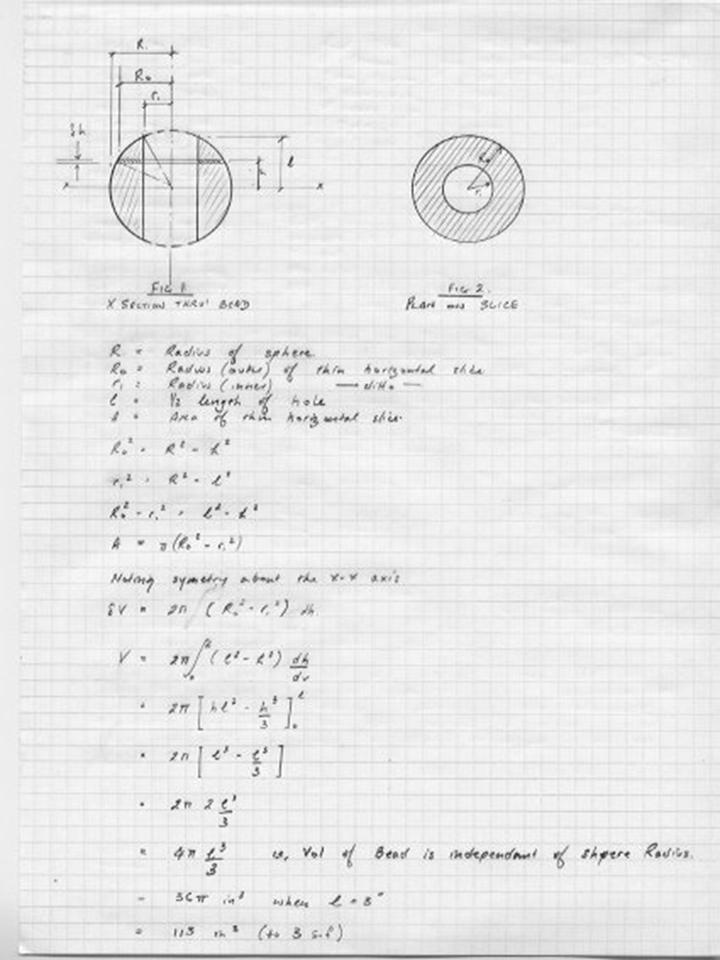
I have posted it before in previous versions of the Naim Forum. (about 20 years ago). My solution is, as per Mrs R, an integration of “thin” polo mints of increasing/decreasing radii from the top of the resultant bead, to the bottom.
Because the remaining volume is independent of the spherical radius, it is the same for the Earth as it would be for a 6 inch globe !
I’ll draft and post BAM’s famous “ladder” teaser in the next day or so. I still have my elegant solution and I also have Ken c’s ultra-elegant solution.
Of course, in this day and age, with Excel on every computer, there is a trial & error solution readily available, making three possible routes to a solution.
Here is a copy of my “Boring Sphere” solution. I noted from the Word Document in which it was stored, that I created it on 4th Dec 2001, for posting on a previous incarnation of the Forum !
1 Like
Some members will no doubt recall this teaser from a few years back, posted by Brian (BAM). Others might find it interesting.
Ladder
………………… in the I-Pad factory not a creature was stirring except for… in an attempt to discover the secrets of Apple’s new i-Pad Streaming App, a team of Naim engineers decided to gain illegal entry to the i-Pad factory. Oh the shame of it!
They arrive at the factory in the dead of night and decide to try to gain entry via the roof. Naturally they aren’t carrying a ladder because this would arouse suspicion among the locals. So they search for one and eventually find an old wooden ladder with a slightly rotten set of rungs. The ladder has length L . The factory roof is hard to access, even with a ladder, and on their first attempt the ladder crackles and threatens to break. They stop climbing and wonder what to do. Scouting for a way in they find a wall against which a large, cubic crate has been left, of side 1m . They reason that if they position the ladder so that it just touches the ground, the wall and the outer top edge of the crate, that this will provide sufficient support to prevent the ladder from breaking. Good.
Being exacting engineers and slaves to mathematics they first decide to calculate the exact distance that they must place the foot of the ladder away from the bottom edge of the crate so that it will just touch both the wall and the edge of the crate. Can they work it out before sunrise?
In terms of the ladder length “L”, what is the horizontal distance “d” the foot of the ladder must be placed away from the bottom edge of the crate?
Assume the ground is horizontal, the wall vertical and the crate a perfect cube.
One point for the value of d if L = 10m
Ten points for a formula where d = (function of) L

Just going for 1 point:-
If L is 10m, d is 5m on your diagram.
I used pythagoras 345 triangle to determine that the floor and wall lengths would be 6m and 8m. for a 10m hypotenuse. The length of d is 6m less 1m, though it could also be 8m less 1m if the ladder was less upright (ie your diagram rotated 90 degrees anticlockwise).
From what I remember, getting 10 points is much more than 10 times harder!
1 Like
Hi Steve,
The drawing is not to scale and therefore might be a bit misleading.
If the crate is 1m x 1m and the ladder is 10m, the ladder will look more upright.
But even so, the 1m crate and the “d” in the diagram, don’t sit too well with the notion that “d” = 5m
But you are right in recalling that getting 10 points was a good bit harder than getting 1 point 
I only have a part solution that doesn’t even score the one point.
A formula for L as a function of d is quite straightforward, but not the other way round!
By Pythagoras, noting that the tangent of the slope is 1/d, so the top is 1/d above the crate:
L² = (1 + d)²+ (1/d + 1)²
As it stands, that will expand out to a quartic equation which is a bit nasty. I can’t envisage there being four solutions. There should be two, as Steve pointed out, a steep angle and a symmetrical shallow angle.
Hence I will have a think about how to turn it into a quadratic, maybe with some substitution of the variable d.
1 Like
Apologies Don, I can see that that my approach was far too simple and incorrect. Nil points!
I’ve now got the same equation as Ravvie, with the same problem of how to simplify.
Where L = 10, the answer for d looks to be somewhere between an eighth and a ninth of a metre, so will work on how to get a more accurate figure.
1 Like
There are only two solutions for a given ladder length L, as Steve has noted.
My reference to three routes to a solution referred to My formula; Ken C’s formula and of course the formula that you and Steve have now generated for L = f(d).
The 1 point is for iteration of your current formula until you find a value of d that generates L = 10m. By hand it’s tedious. But, as I said above, with Excel its pretty straightforward so worth 1 point for the effort !!