I’m fairly sure that at least one of the reviews after the introduction of the Superline mentioned signal coupling capacitors as part of its design. Both location and quality of the Evox would make sense in this regard.
1 Like
Yes. I see what you mean with regards position.
I assumed they are feedback because of the large size.
Naim coupling caps are usually 10uf, which would be smaller than the caps used.
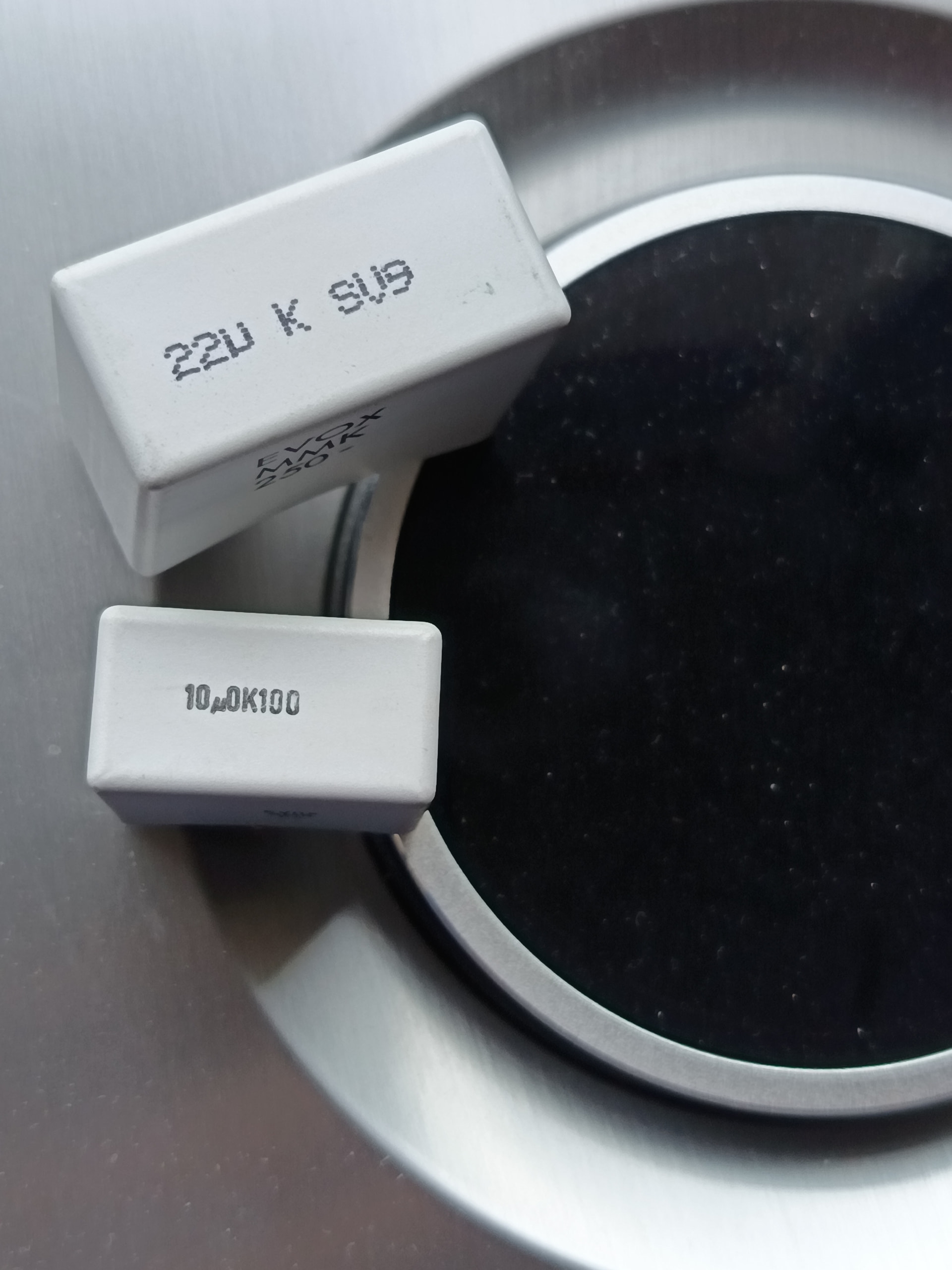
Whatever they are doing, they are doing a great job. 
I’ve had a lot of fun rolling different capacitors in DIY amp builds mostly class A or Tube where the output capacitors have a influence on sonics along with film and choked power supplies
As an observation the majority will work well even big industrial motor run capacitors for audio use.
Personally having tried more than a few combinations from inexpensive industrial to boutique brands you generally get what your paying for as the price increases and you get into the boutique brands.
One of the most successful results I’ve had of changing capacitors was in high spec tube RIAA phono amp where I purchased a couple of dozen Russian military surplus teflon capacitors cherry picking the best to hand match the RIAA stage to under 0.5% tolerance per channel. The effect on the three dimension ability of sound stage was easily noticeable.
Interesting film capacitors I’ve used
High pulse burst made for Russian cold war radar
High spec teflon used in down hole logging in high temperature high pressure oil well drilling.
RTI 10uf Teflon (custom made for Audio Research anniversary amplifier).
The thing to understand is really such capacitors make little sense in commercial offerings costs are too high sizes are to big and audio rated electrolytic capacitors like the Elna Cerafine and Elna Silmic II are really really good compact in size and relatively inexpensive.
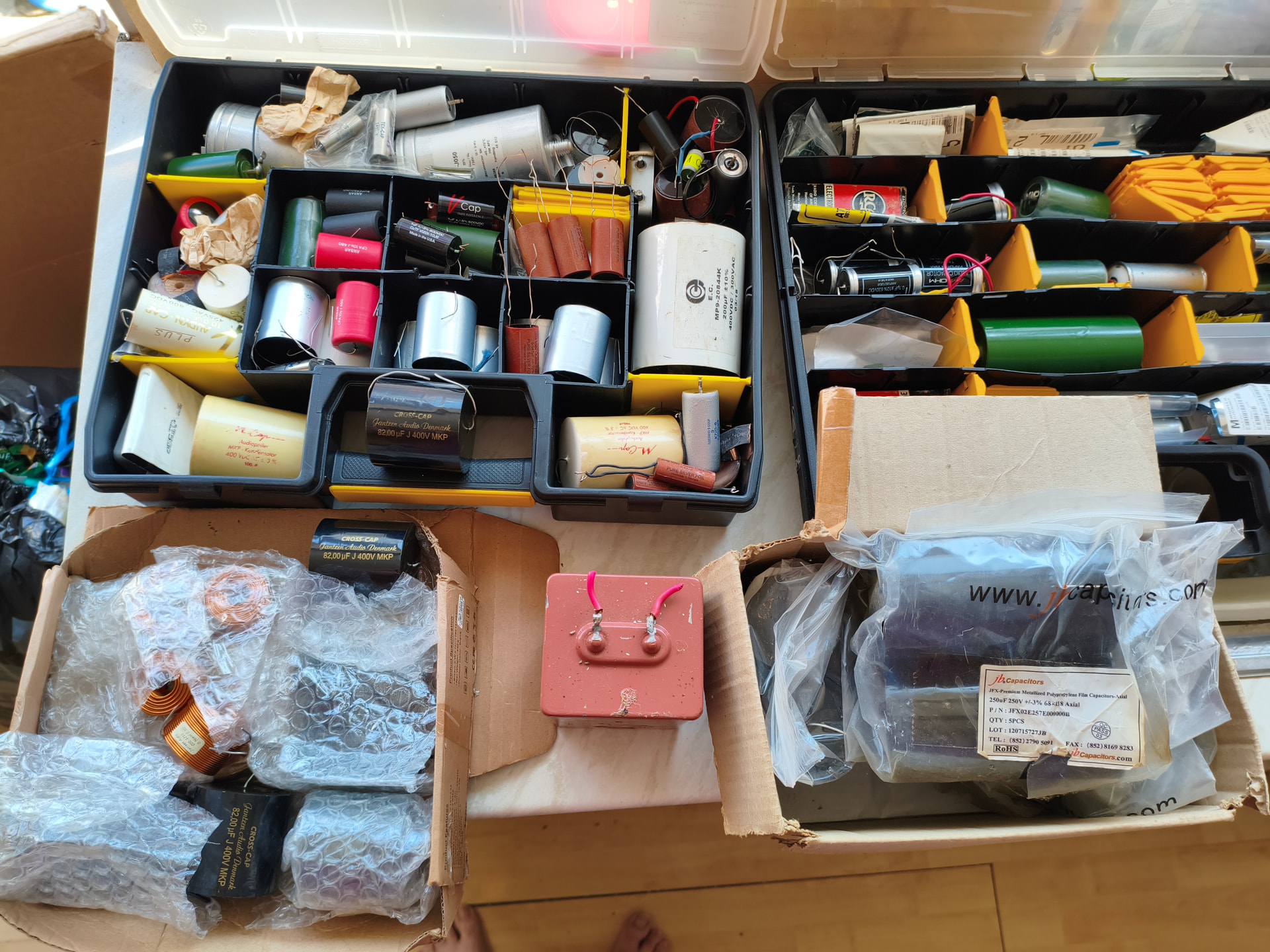
Some of my stash of film capacitors 
1 Like
Sure, but that’s what they are often used for elsewhere which I what I was referring to… they are more performant than aluminium electrolytics.. They are essentially designed as high performance reservoir capacitors/ higher capacity devices where power and efficiency is important. Very effective at handling high ripple current. They can also self heal to some extent mitigatin breakdown and fires in fault conditions.
In audio audiophile land large film are sometimes used in loudspeaker cross over circuits where the low distortion, audio frequencies and high efficiency are useful parameters.
Their thin film and foil variants are often used in high end audio circuits in the industry due to the low distortion, tight tolerance, thermal stability and efficiency.
Premium brands for high quality audio of poly film capacitors include Mundorf, Auricap, and Rel-cap where they specialize on smaller production runs of more specialist designs offering ultra low distortion and parasitic losses for signal path duties.
@JamieMcC you mention repurposed Russian components… I have ‘rolled’ or repurposed some Cold War Russian valves in my headphone amp… they as in the model, was apparently used in ballistic missile guidance systems. I think coupled with appropriate driver valves they sound wonderful into my magnetic planar headphones… and didnt require any modification to the amp.
2 Likes
Ah. I see.
So they are being used in an application they weren’t actually designed for.
I suppose that’s the power of the Internet. Somebody discovers an unusual solution, puts it on the Internet and other people, (including hifi designers) can test if it works in their equipment.
Hi Simon headphones are really the ideal weapon for noticing differences due to component changes head fi has been a passion of mine for many years.
It’s probably down to a mixture of regulations and supply that unusual and vintage components are just not main steam enough and remain on the fringes of the hobby. I suspect there is an astonishing high percentage of folk in this hobby who will have never experienced listening to a really good vintage paper in oil capacitor maybe topped off with a teflon or my favourite a Duelund silver foil bypass for an absolutely beguiling combination with beautiful top end and bags of resolution.
2 Likes
Sure, you can use them for anything if their characteristics suit…. It’s like driving a Ferrari to the super market… probably not the most practical or even possible for most but certainly possible for some. Who would have thought a valve apparently originally designed for a Soviet era missile guidance system from the Cold War would sound good in a headphone amp?
I have no technical understanding of anything being discussed on this thread. And yet the very idea that there might be such a thing as ‘boutique brand’ of capacitors is hugely appealing. It just goes to show that there a many ways to enjoy the forum.
Have a good Sunday everyone.
1 Like
You cannot send electrolytic caps into space! They ‘explode’….(ok, a bit of exaggeration for joke effect). What would happen is that they leak and would contaminate the whole shebang (we called it “outgassing”).
However they really explode if you connect them the wrong way round. As demonstrated many years ago in the lab by my colleague, and later “best man” - yep he survived!
But it made one h3ll of a bang!
2 Likes
Whenever I replace electrolytic capacitors and test before reassembling the equipment, I always kneel on the floor and reach up to switch on. Better safe than sorry.
1 Like
Good thinking! 
I hope Russell from the Meridian repair guys in Godmanchester reads this, cos he’s doing a full recap on our DSP5000C speaker at the moment. 
Oh yes… we spent much fun in the tech block at school in the lunch hour when the teachers weren’t around connecting large electrolytics connected the wrong way round using the HT connections from the lab power supplies… .. we would switch on from a safe distance away… and they would make a spectacular bang and explode showering the class room with electrolyte / filler…
I guess schools now don’t have lab power supplies with HT connections anymore. … but I assume (and hope) such antics carry on today…. It’s all part of growing up and ‘discovery’ 
4 Likes
The chemistry equivalent was a certain compound well known to chemists but not something to mention on a public forum these days, which when dry was extremely touch sensitive, and it only took small traces on, say, a school laboratory doorknob or just lying underfoot to create unexpected loud noises…
With capacitors, decades ago I did do some experiments at home to try and find something I could use for pyrotechnic embellishment to my rock disco, but in the interests of public safety I settled for commercially available theatrical maroons!
The mind boggles!
1 Like
As a physics teacher, I can assure you I empower my pupils to fully appreciate first-hand the importance of observing polarity on electrolytic capacitors.
Precisely how I achieve this is a conversation for another day; though, for the record, it is fully documented and risk-assessed.
3 Likes
My point was ‘learning’ and discovery outside adult supervision and risk assessments… a key part of growing up… not least being caught sometimes meant getting the ‘slipper’.. which I guess was our risk assessment..
Clearly if you are professionally educating children and young adults it’s a different paradigm, and I have no doubt you are motivational, diligent and effective.
Now that takes me back 
1 Like
Well, I try…
And I completely agree about self-motivated learning outside the classroom. Among my current pupils, I’ve been delighted to hear about (and, often, see their videos of) home-made crab robots (including 3D printed legs and programmed motor routines), Lego V8 engine models and more. Although, one of my ‘quirkier’ pupils did start asking me some very specific questions about earthing high voltages last term. I wonder if he’ll return in one piece next month?
1 Like