Given the same parameters what makes one capacitor better than the other?
Marketing
1 Like
Really? I’m surprised but not surprised.
Well there are many different capacitor chemistries and physical constructs to suit different use cases. They are quite diverse components..
For signal path audio the following dielectrics are often preferred
-
Polypropylene (MKP / PP): Widely considered the gold standard for crossovers and audio coupling. They offer ultra-low loss, neutral frequency response, and high linearity. (low distortion)
-
Polystyrene & Teflon (PTFE): Exceptional precision and minimal signal colouration, frequently used in sensitive low-level equalization and boutique audio circuits.
-
Polyester (MKT / PET): A budget-friendly alternative with higher losses than polypropylene, sometimes preferred to smooth out high-frequency harshness.
With regard to construction types - again there variation depending on use cases some better for signal path audio than others.
-
Film and Foil: Constructed with separate layers of plastic film and actual metal foil (like tin or aluminum). They offer superior current handling and are generally regarded as the best-sounding for signal coupling.
-
Metallized Film: Built by evaporating a thin metal layer directly onto the film. They are compact and cost-effective, though slightly less dynamic than foil variants.
-
Ceramic (C0G / NP0): Stable and linear enough for high-frequency RF bypassing or small-value filtering, but Class 2 ceramics should be strictly avoided in audio paths due to microphonics and nonlinearity ie adding distortion.
7 Likes
He did say the same parameters. I may be wrong but the OP is perhaps asking about the difference between brands given the same spec (and I assume he is asking about the usual larger uf power suppply capacitors such as found in amps)? If so I would say stay away from boutique stuff and stick with decent quality big name brands supplied by a reputable seller.
If all parameters are identical, then it might well be that different brands may sound the same. though the chances of precise identicallity is perhaps small given that there are quite a lot of parameters: capacitance, tolerance of capacitance, temperature coefficient, voltage rating (continuous and surge), max current, leakage current, ESR, ESI, dissipation factor, as well as physical dimensions, lead type and dimensions, and life expectancy. Some of these might have no effect in audio terms, though whether the physical composition and construction that causes said differences might be significant in audio terms in another question.
Meanwhile in this hi-fi hobby of hours there is a lot of snake oil pedal, and now I’m an awful lot of people willing themselves to believe there’s a difference when they pay more money for something claims to be better. Where some differences in parameters beyond the most basic might well affect sound with capacitors used in certain parts of audio circuitry, it is by no means a given that other parameter differences, or when used in other parts of audio circuitry will make an audible difference. In my view it is best just to choose hi-fi equipment that is right for uou and assume that the manufacturer has done whatever is necessary to optimise within the design specification which will include product cost. To do otherwise, unless you are building your own of course, is a sure route to unending tweakery. More particularly, unless you do careful testing, including blind comparisons, it could actually lead to s worse sound. Of course it might not be worse to the committed tweaker’s ear though if it is worse then long-term dissatisfaction may be the result…
2 Likes
There is an interesting video on YouTube called An Introduction To Denon Sound Tuning.

Basically all the components that go into a piece of equipment has its own sound signature, the Sound Master knows these sound signatures and mixes them together to produce the best sound along with the manufacturers house sound.
Rather like a chef, creating a meal.
What Naim consider to be an excellent sounding capacitor, Denon might consider a poor sounding capacitors. And vice versa.
The sound is probably down to material used and manufacturing process.
Which will probably be top secret.
8 Likes
Or it could sound better and lead to years of satisfaction. 
1 Like
If capacitors are from the same company they could be graded for accuracy and the better ones selected for particular projects.

3 Likes
yes but there are specialist niche manufacturers that make limited production niche capacitors for specific use cases such as high end audio (so called boutique manufacturers) such as specialist polypropylene dielectric capacitors built as thin film or foil.. the big manufactures would tend to not be interested in these limited markets- and focus likely more on more generalised high volume component markets… which of course may be perfect for certain designs but less optimum for certain niche specialist designs.
I remember from my undergraduate days in Electronic Engineering many years ago now learning how important component design and selection was for certain designs - typically this was learned in labs and student designs and not based just on theory.
In one of my design and build lab groups of three of us we had a what we believed was an innovative design for a quality Audio power amplifier with simplified signal path, it measured and sounded good, it had very low phase distortion - however it suffered from speaker load instability in some scenarios and damaged certain components when it drove into ultra sonic oscillation. we used some specialist niche components - and our professor kindly stopped by the manufacturer/importer on his way to Uni to pick up replacements a few times before he suggested we should change tack! These components were not available from RS or Farnell
2 Likes
A drawback with film capacitors is they are very bulky.
These large film capacitors (polyester I think) used in the superline haven’t been used in any other Naim equipment as far as I know (they are not easy to hide away) and they are really something special.
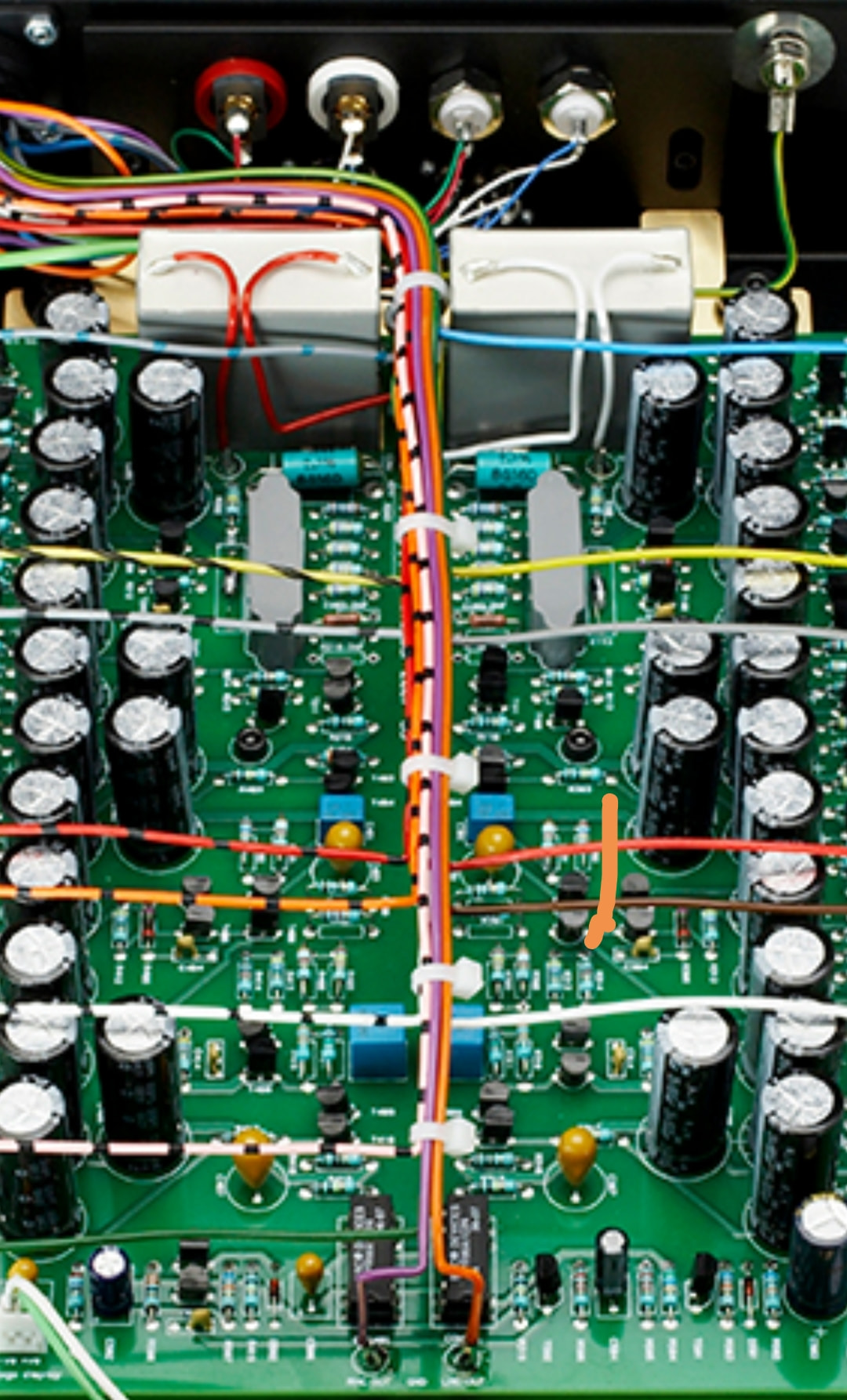
Also I believe they need a high quality power supply to sound their best.
So, not a great idea using them in budget equipment.
1 Like
I don’t know the subject, just read in reviews that high end brands use Mundorph capacitors very often . There must be a reason.
1 Like
Perceived value would be my guess and you usually pay for such jewellery but if it makes a punter feel better, job done.
Personally I’d put reliability and specification adequate for the task higher on the wish list than fancy parts. Not a given.
2 Likes
It’s a long time ago now, and that passage of time may have done things to my memory, but I seem to recall reading an interview with Denis Morecroft, designer of DNM amplifiers regarding capacitors. He designed a prototype slit foil form of capacitor and approached a major (unnamed) manufacturer about the possibility of large scale production, only to be told that ‘it would have no effect on the sound quality’. Needless to say, Denis felt differently, and went elsewhere for manufacture..
2 Likes
Perhaps of more relevance here…

Not sure that is particularly relevant to the thread, Naim dont make thier own componentsl they evaluate and procure them. Naim buy some components like certain bipolar transistors and I believe transformers customised to specific parameters required for thier designs.
Interesting, yes those large film poly capacitors are high quality reservoir capacitors for quality power supplies with very low ESR compared to more traditional cylindrical aluminium electrolytic capacitors… I have only noticed the latter used in Naim power-supplies until your post.
These are industrially available as used in high quality industrial powersupplies where those specific performance parameters (ESR and ESL) is required. Switch mode power supply variants are common such as used in inverters, DC to DC converters etc.
Different brands of Capacitors have had (mythical) reputations as regards sound quality eg Black Gate Capacitors
1 Like
They are not being used in the power supply. The power supply filtering capacitors and transistors at the sides of the PCB are taking care of that.
They will be feedback capacitors, probably something similar to MMK polyester which sound superb for that application. (no idea why).
Below are a couple of 22uf I haven’t found a use for yet.  Although the ones in the superline will probably be 47uf, so even bigger.
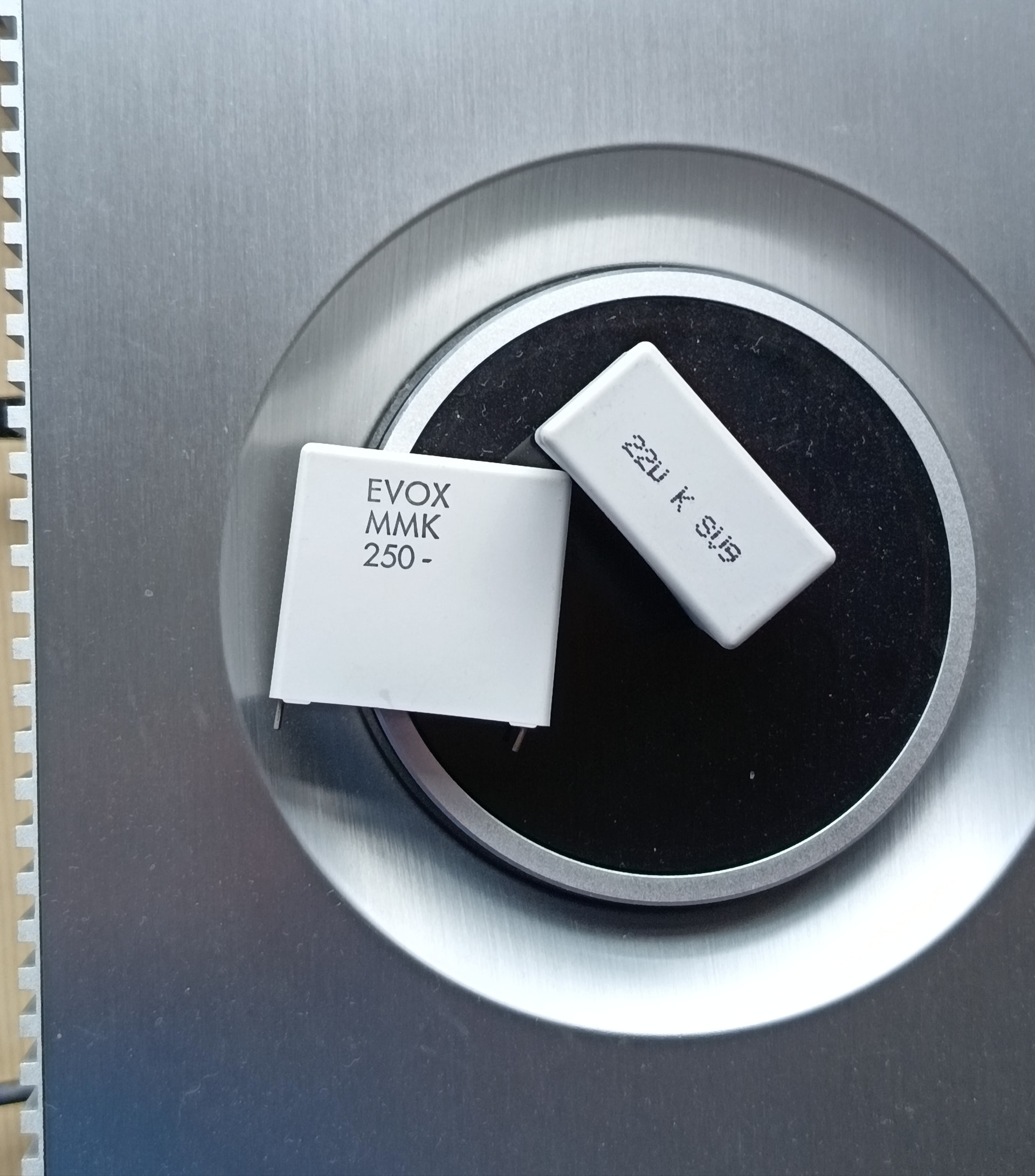
Rotels favorite capacitor.
Apparently they contain graphite dust.