Is that the VW Fifth with a piece by Bax too?
I scurried over there but could only see one secondhand copy.
Oh well, I still have my Boult box.
Yes, ‘Tintagel’ by Bax - also a lovely, evocative piece, conjuring up visions (to me, at least) of King Arthur, Camelot and what have you.
I obviously didn’t look clearly enough - I just saw the CD cover and assumed that it was still in the catalogue. I suppose that you can check the EMI catalogue, then maybe root around other places like other Amazon sites abroad and specialist dealers like Bath Compact Discs. A real pain, but (I hope) worth the effort.
Hello, Stevie, one last try before I turn in.
The German Amazon site (amazon.de) has a new 2CD set of Barbirolli’s RVW’s lovely EMI Second (‘London’) and Fifth Symphonies, with his equally amazing ‘Tallis Fantasia’ and ‘Greensleeves’ as fillers for around €15, so there’s your chance.
As it happens, my own two favourite RVW symphonies in my favourite recordings.
Thanks Graham 
Such a good question to ask!
Lots of people suggest entering via the traditional big names and compositions, and you mention Mozart and Vivaldi, but my experience as a kid was being switched off completely by all this - the romantic and baroque, and the big orchestral pomp. I’m 50 now, and it’s taken me a long time to find classical I like. I listen to prog, electronic, experimental and heavy, noisy, stuff too. If you like technical prog and heavy metal, here’s my quick selection to dip your toe into …
Buxtehude … organ works .
… maybe check Messiaen’s ‘L’Ascension’ too … proto metal/prog!
Lou Harrison … gamelan and eastern inspired
Morton Feldman - quiet beautiful worlds to get lost in …
Glass - Glassworlds … there’s a lot in minimalism you might enjoy … i’m a fan of Terry Riley (try Persian Surgery Dervishes)
Iancu Dumitrescu … dark and heavy! just to get a sense of how outside classical can go
John Dowland … medieval and renaissance period is timeless and definitely worth a listen …
Webern, Berg, Shoenberg … 20th century stuff gets rejected as ‘difficult’ by most classical listeners, but to me it’s spiritual and free, and it has a feeling to it that you might like. .
2 Likes
I know some, but by no means all of that music.
Morton Feldman was a very odd chap. I once heard an amazing piece by him on the radio, but I didn’t make a note of it, and I will probably find it again.
Philip Glass’s 'Glassworks" ia a remarkable piece of music, but I have a bad experience of ithe composer. Philip Glass brought his Philip Glass Ensemble to the Brighton Dome concert hall as part of the Festival about ten years ago (the venue where Abba won Eurovision with ‘Waterloo’, incidentally)… I bought two tickets, invited a friend and I went along full of excited anticipation that I was about to see a world famous composer ‘live’.
But we had to leave after about 20 mins, because the (amplified) music was being played at deafening volume. It was too unpleasant, far louder than any rock concert I had ever been to. So, a great shame.
I still enjoy ‘Glassworks’, though, and will try to track down a copy on vinyl.
1 Like
A slightly harder RVW symphony but still very much in the “non bombastic” mould of the 5th is the “Pastoral” 3rd symphony. Despite the name, it is in reality more of a war requiem based on RVW’s experiences in WW1 in the RAMC and the Royal Artillery together with the loss of many friends.
There is this most marvellous moment just before the end of the symphony and the return of the wordless soprano (usually a soprano anyway); the strings and horns have a descending motif and then suddenly it reverses and the horns, lower strings, harp and clarinet start climbing towards the final fortissimo. In the hands of the right conductor, an incredible moment of acceptance and reconciliation to my mind.
I find it the most moving of all his symphonies.
2 Likes
Yes it’s great. VW suffered from the cow looking over a gate comment on his music. Because his music had calm perhaps even ethereal moments some people didn’t look deeper into his darker and sombre reflections after WW1.
Thanks for the recommendations M
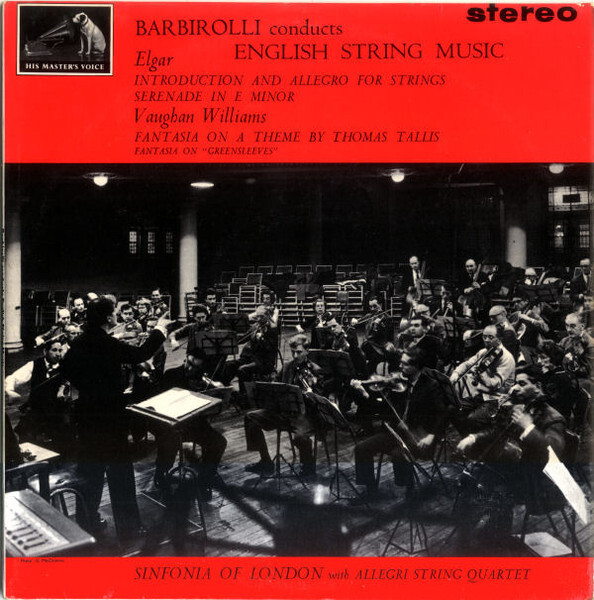
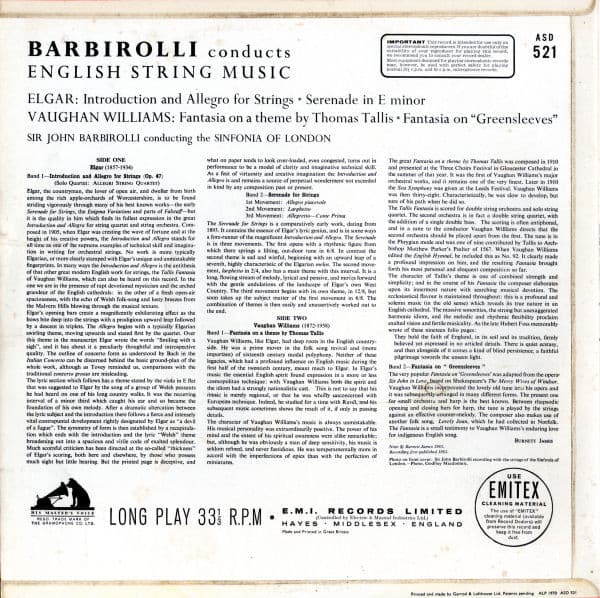
Try and track down Barbirolli conducts English string music on EMI. Also try Barber’s Adagio.
Glass wrote a number of film scores - some for “art films”, some for more commercial films. So you may know some of his music.
I mentioned Feldman in my first post. I listen to his music differently than I listen to other music. (Note - I’m referring to his late works.) These are long works; notoriously, his second string quartet runs 6 hours, but most of these works are more than an hour. And not that much happens. I’ve read that his subject is time, yet my experience is being in the moment. I listen to each phrase on its own, maybe in the context of the prior phrase, but no more. I started with his Piano and String Quartet, which, at a mere 80 minutes, seems to be a popular introduction. I should add that I rarely make it through. I can only maintain that level of concentration for about forty minutes. The rest tends to play out as background music.
It’s been fascinating browsing through this thread. While I wouldn’t argue with most of the suggestions made, I’ll suggest that “Papa Haydn” hasn’t quite been given his due; he often seems to live a bit in the shadow of his successors in the classical tradition, Mozart and Beethoven.
While not chamber works, I think that the Haydn symphonies are in the spirit of what the OP is looking for. Presto Classical currently lists a boxed set of the symphonies on 33 CDs for a paltry £30. These critically acclaimed recordings were made by conductor Adam Fischer and the Austro-Hungarian Haydn Orchestra over about 15 years on the Nimbus label, which unfortunately folded just after the final set in the project was released in 2002. The compete set was reissued by Brilliant Classics.
I’ve also found the web site Classics Today a useful resource when trying to choose among recordings. While an annual subscription is needed to gain full access, what’s available free is also useful. I found the reviewers refreshingly candid in the assessments. A very useful feature is that most reviews will include the writer’s personal reference recording for the work being reviewed. There’s no guarantee that your tastes will align with those of the reviewer, but it’s a useful starting point if you are paralyzed by an excess of choice.
4 Likes
The EMI record of Sir John Barbirolli conducting English String Music is a classic.
The recording session took place overnight in the middle of winter at the Temple Church of the Inns Of Court in London in the 1960s. The venue was chosen for the acoustics, and the timing chosen to reduce as much as possible traffic noise from the busy Fleet Street nearby.
There was no heating in the Church then (or even now), and Barbirolli, the Sinfonia of London players (and Ralph Vaughan Williams and his wife Ursula who attended the session) were all warmly wrapped up, and had sandwiches and flasks of hot coffee. I imagine that some of the players might have had hip flasks to guard against the cold, but I don’t know this for a fact.
Circumstances were perhaps not propitious, but the recordings of the Elgar and Vaughan Williams pieces that emerged were miraculously lovely.
Thankfully, the recording is still available (it is one of those that has rarely, if ever, been out of EMI’s catalogue).
In lrecent years, EMI have added to the CD edition of the album a couple of extra string pieces by Elgar and RVW conducted by Sir John that weren’t recorded on that magical night. Personally I think that this spoils the record, but of course you can programme out those tracks easily on a CD player.
3 Likes
Hi Graham do you mean the 1960’s as RVW died in 1958?
Thank you for that information JS - Pete
Do you know, I really have no idea. I think that the recording was made in the winter of 1962, or thereabouts.
And I thought also that RVW and wife attended the session.
I will check the booklet when I’m back home (which I hope will be soon) but, if I have got anything wrong, please do correct it. I hope that you’ll believe me when I say that I would never knowingly mislead anyone - particularly not on a public forum such as this!
I don’t think that there are any other hostages to fortune in what I wrote, but clearly the old brain misfires occasionally.
1 Like
Thanks for this. Ebay has quite a few LP copies - tempted by a white/gold first press, or a Supercut Hi Q remaster which is said to be excellent. Knowing me, I’ll probably go for the WG first press. Discogs says only Tallis was recorded in Temple Church ( one of my utter favourites though, so worth buying for that alone). Cheers.
No, if we’re talking about the same record, the bulk (other than, I think, ‘Sospiri’ and ‘Introduction and Allegro’, the added tracks), were all recorded on that one night.
RVW was indeed long dead. Having had a think about this, I think that the other ‘guest’ at the session (with RVW’s widow Ursula) was Hitchcock’s favourite film composer Bernard Hermann.
Now I had better shut up, to avoid making other silly gaffes.