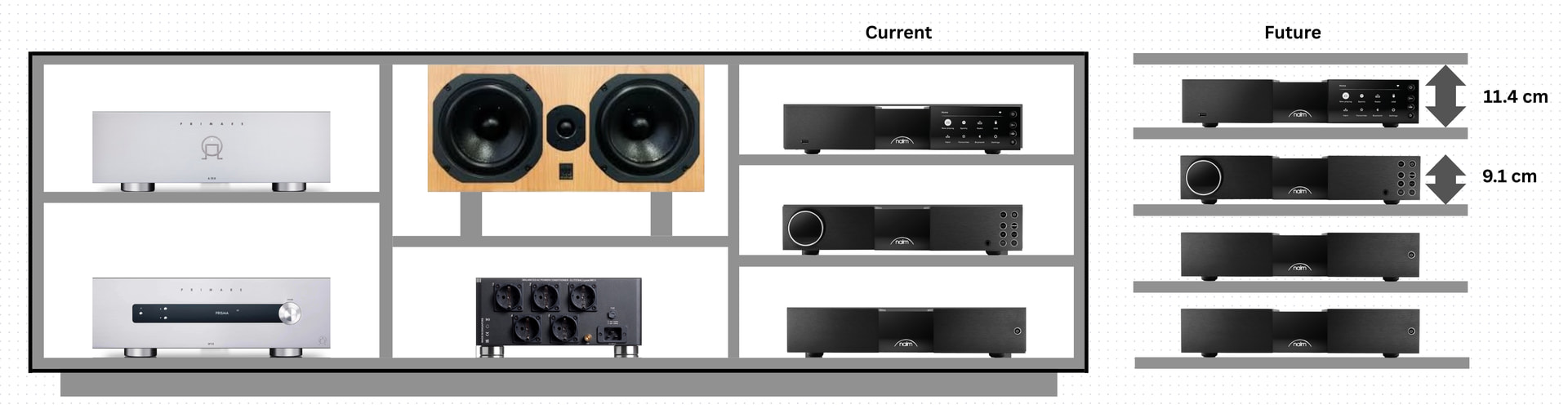
I am currently designing a new TV cabinet which also houses my hifi and AV equipment. At the moment I have a NPX300, NSS 333 and a NAC 332 so they can fit perfectly with enough ventilation space. I do foresee an additional NPX in the future so the cabinet would then house the 4 devices in the space that will first house only 3 devices. Space between the shelves will then be reduced to 11.4cm and each device is 9.1 cm high. Left and right is about 8cm and the back of the cabinet is partly open. The front is fully open. Do you think it would give the equipement enough ventilation to not get hot?
So the net open area for the entire back panel will be equal to the sum total area of each device (e.g. 4 devices’ area worth of open area on the right side)? Or to just a single Naim box?
Why put a back on the shelves if you then have to make big holes in it for the mass of cables, which may well be compromised by being run through the holes. Don’t add a back and it will be easier to make, lighter, cheaper, and better ventilated.
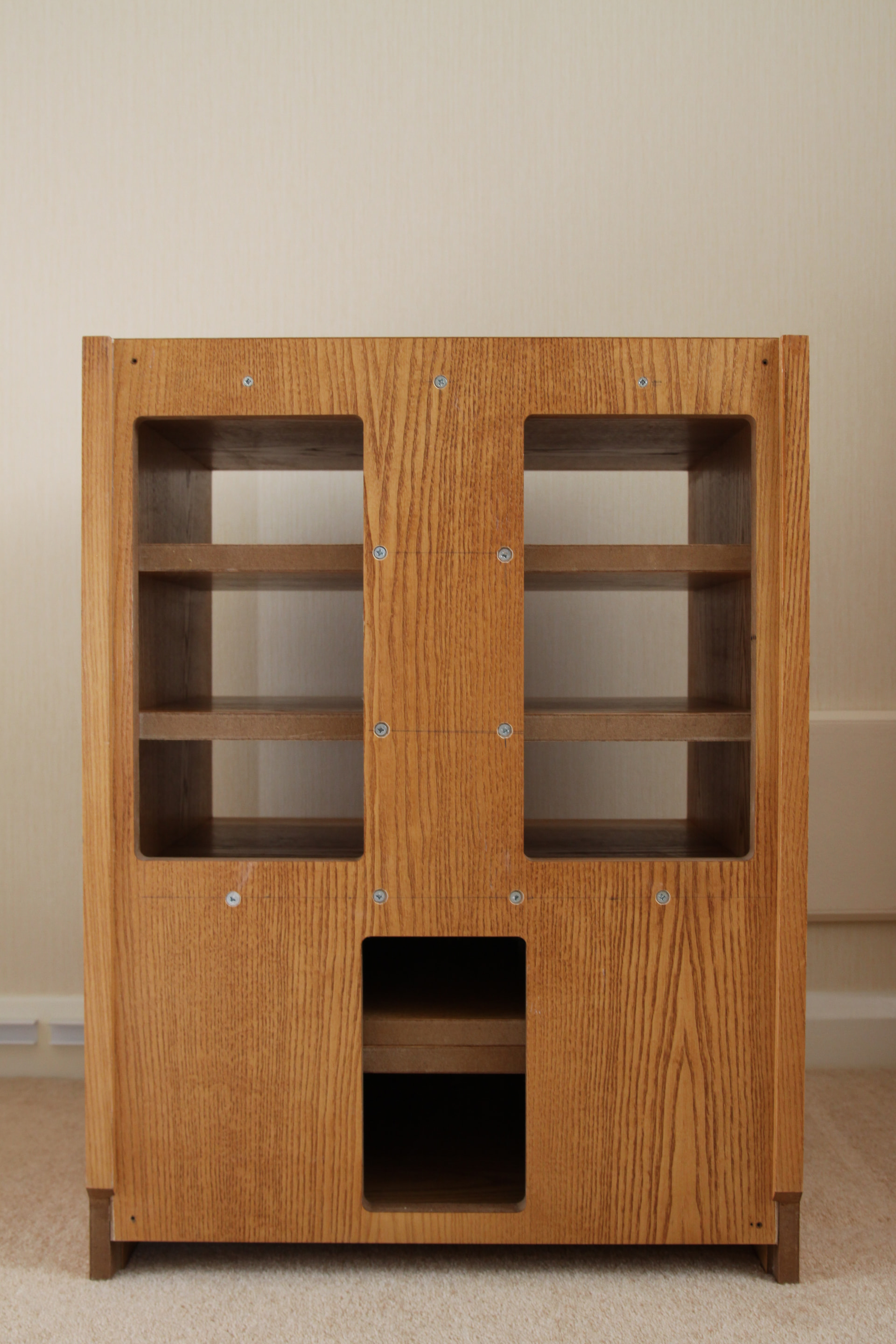
The furniture maker said the back panel is needed for strength of the cabinet. Everything together weighs about 135 kg so I do wanna make sure that everything is strong enough.
They won’t exactly be holes but rectangular openings of 81mm x 400 mm.
The back will be an easy way to make the cabinet rigid, but not the only way. Even a back panel on just one shelf with less critical gear on it would add significantly to the rigidity if necessary. Decent joints such as dovetails should make the cabinet very strong, as would a small, discretely placed diagonal brace or two. I really don’t think a full back panel is necessary.
Maybe but since I’m not making this myself I do trust the furniture maker. On top of that I also like the back panel cause it hides the view to the cables. It just looks tidier.
Your furniture builder is correct to note the need for a back for structural integrity, however, it should be sufficient to have narrow vertical pieces behind each of the uprights, extending 3" or 4" on either side and screwed, jointed or dowelled to both the shelves and the uprights. This would give you ample room for both cable routing, ventilation, and general access.
I consider myself most fortunate to have spotted it on an auction site a few years ago. It had a few faults which took a talented technician ages to find … but once they were fixed, it sounded - sounds - great.
Great, thanks. I have an old STA-50 that, like you, I spotted on an auction site here in the UK and bought, mainly out of curiosity as I had heard about the amp on my trips to NZ. Supposedly they worked nicely with a Sondek front end and Saras…
The hi-fi shop I frequented as a young man probably promoted Roberts amplifiers that way. (Can’t exactly remember; it’s a long time ago). In the late 1970s / early 1980s, I used the Roberts (the one I had back then) with a Rega P3 and a pair of Monitor Audio MA2s.
I agree, when I built my rack, I made the back panel to be a structural part of the whole.
The structure including back panel is all 18mm veneered MDF.
Shelf spacing (space between shelf top/bottom) is 100mm.
I am also thinking of veneered MDF. However, my current cabinet is also made of MDF and when I play music I feel the plates vibrating. ChatGPT gave me the advice to use multiplex for its less resonating character. Solid oak would be even firmer but easier to bend and twist and less easy to work with for furniture. Not even considering the additional costs.
My cabinet including the shelves are either routed or biscuit bonded and with an unbreakable glue.
As a whole it’s very inert (dead) and that is mostly due to the inert qualities of the MDF, something any form of natural wood cannot reproduce.
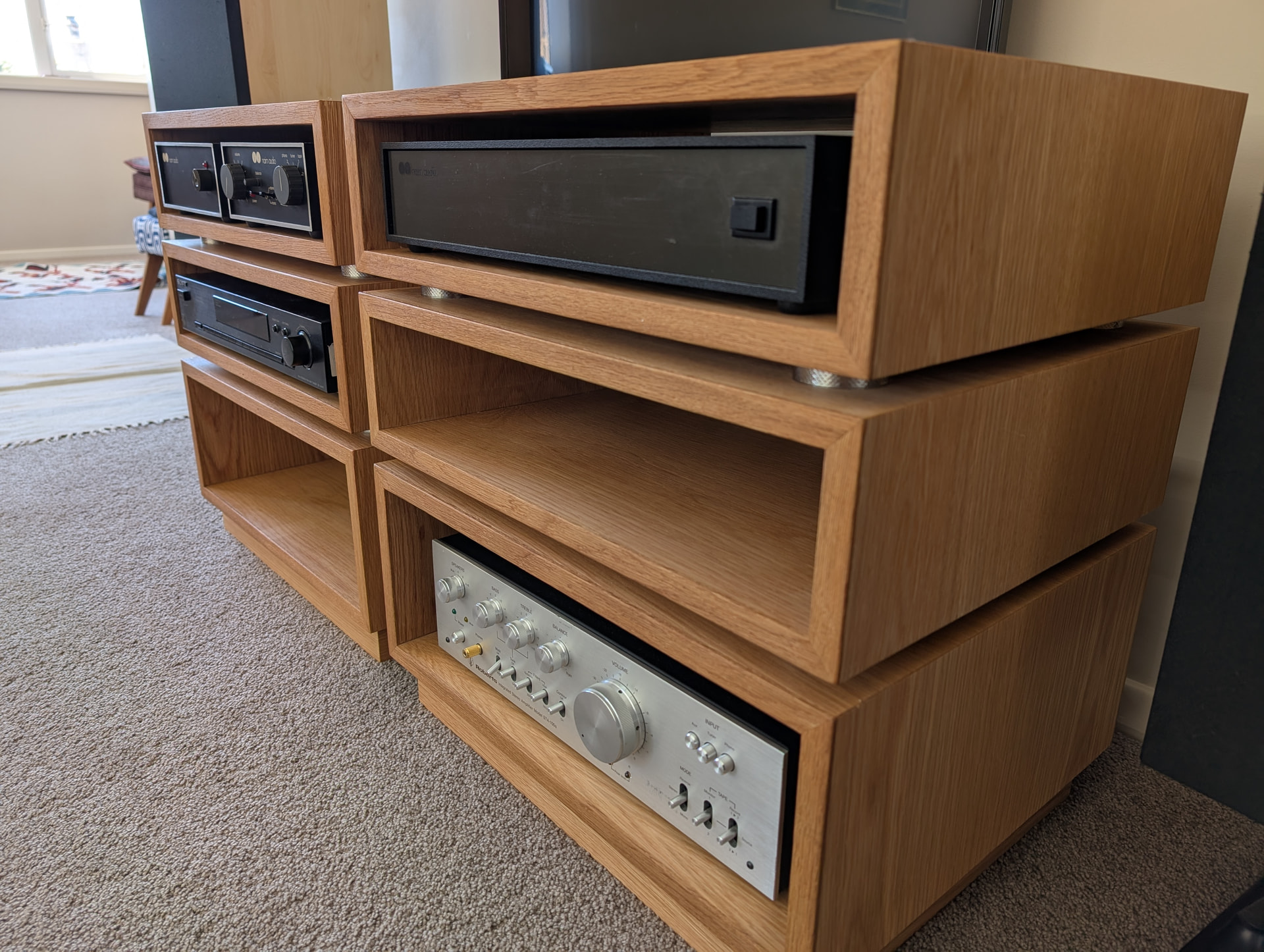
The cabinets I had made last year are constructed of ply pre-veneered with crown-cut American oak. The facings are Japanese (red) oak, cut from an old bedhead. Almost all joins are mitred and glued. The cabinets are really solid.
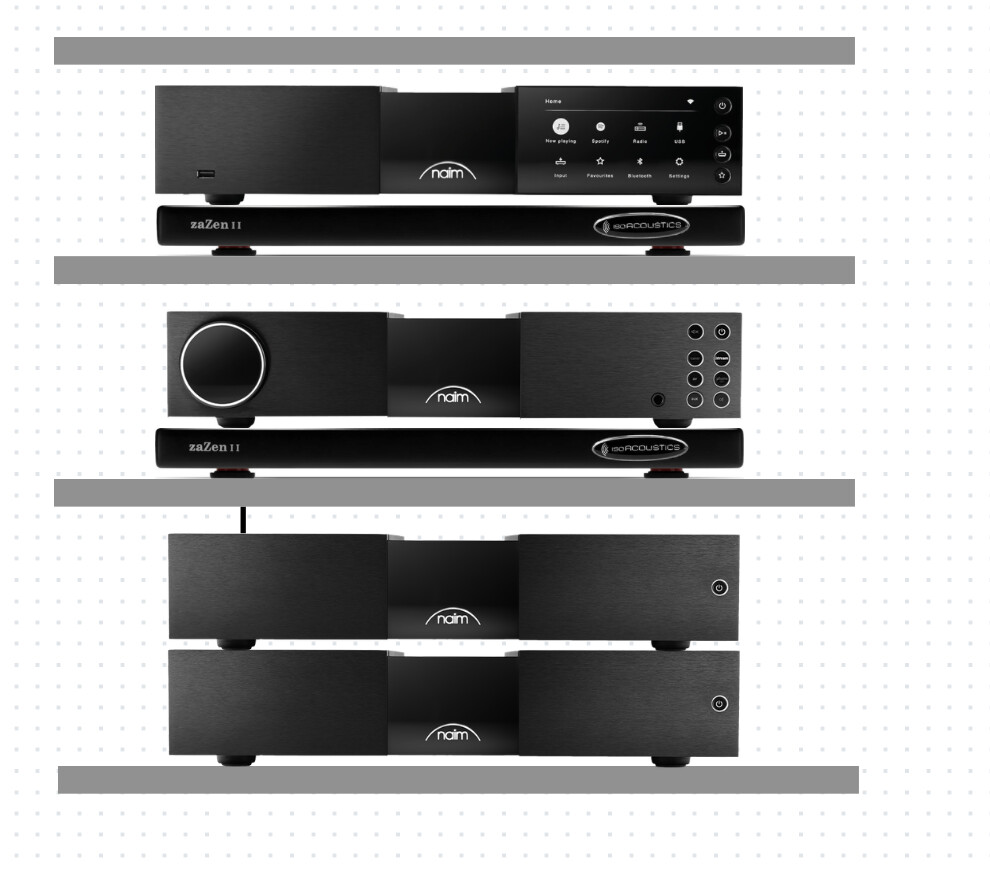
How bad would it be if I stack 2 NPX300 on top of each other in the cabinet while the 333 and 332 each have their own space in the cabinet with an IsoAcoustics ZaZen II Isolation platform under it. Due to space restraints for the height of the cabinet the NPX300’s would then have to be stacked and without an isolation platform like in the picture