Been living with the Diva Utopias for a while now. Sound is amazing, and that ADAPT slider is a stroke of genius for A/B testing from the listening chair.
But I’ve hit a wall: I have a narrow, stubborn room mode at 70Hz. Measured at 2.20m distance / 85dB SPL.
@Stevesky & @110dB : The SHARC DSP and Class AB power are a killer combo. But the current ADAPT filters (I’m using Tone 6) are a bit of a “blunt instrument” for this specific peak. It’s not surgical enough.
Systems like Kii Audio or Genelec (GLM) allow for precise PEQ/Notch filtering. The Diva hardware is clearly superior and the DSP has the headroom—it just needs that “Pro Mode” software precision to really master the room.
Any chance for a granular PEQ on the 2026 roadmap? Would be a dream for us “Plot Analysts.”
Welcome to the forum. Great first post to establish exactly where you are coming from!
Personally I am very pleased to see you here, as I have wondered what the results of using the ‘tuning tools’ in the Focal Diva look like in action in somebody’s listening space.
Great first post, I don’t know if Steve or Steve will reply, let’s hope they do?
@110dB and @Stevesky, just a quick follow-up to my initial post. The main issue is simply that the current filters are way too broad. For example, if I try to boost that 40–45 Hz dip (using Tone 6, for instance), I inevitably end up pulling all the surrounding frequencies up with it and mess up the rest of the sound. And if I cut the 70 Hz peak, I ruin the bass punch below it. No matter how I tweak it: the filters are so broad that they always affect the wrong areas. I’m basically stuck in a dead end.
That being said, what you guys have built with the Adapt system is genuinely brilliant! That 0 to 100% slider to seamlessly adjust the room correction intensity with a real-time before-and-after comparison—honestly, I haven’t seen anything better out there.
But imagine combining this brilliant real-time intensity control with a proper, surgical PEQ or Notch filter to target those stubborn modes. It would make the Diva Utopia the only speaker in the world that truly offers the complete package for high-end playback: integrated streamer, DAC, DSP, and a variable room correction system including precision filtering. That would be a massive unique selling point globally.
Have you played thoroughly with room arrangement, speaker and listening positions? If so maybe room treatment is needed.
I’d be surprised if Naim were to do as you request, though I’m thinking Naim Brand there, whereas you’re talking Naim’s Focal implementation so perhaps I’m wrong. I do believe there would be benefit in having a high quality DSP box with various EQ options available for any/all systems, whether to reduce unwanted peaks where room has been optimised as far as possible/practicable/acceptable, to enable personal preference for sound shaping (whether the “Harman curve” apparently beloved of some headphone manufacturers, or the apparently natural gently rising towards bass end, etc), or to correct excessive roll-off of some recordings),
I am going to give a bit of a cheeky reply to your excellent observation here…..
Naim already have such a unit….……it is the Naim CI-102.
Maybe Naim could enable an ‘engineering mode’ to the settings of the Focal Diva so that those customers who are really into this sort of adjustment (such as the OP) can get the best out of the product.
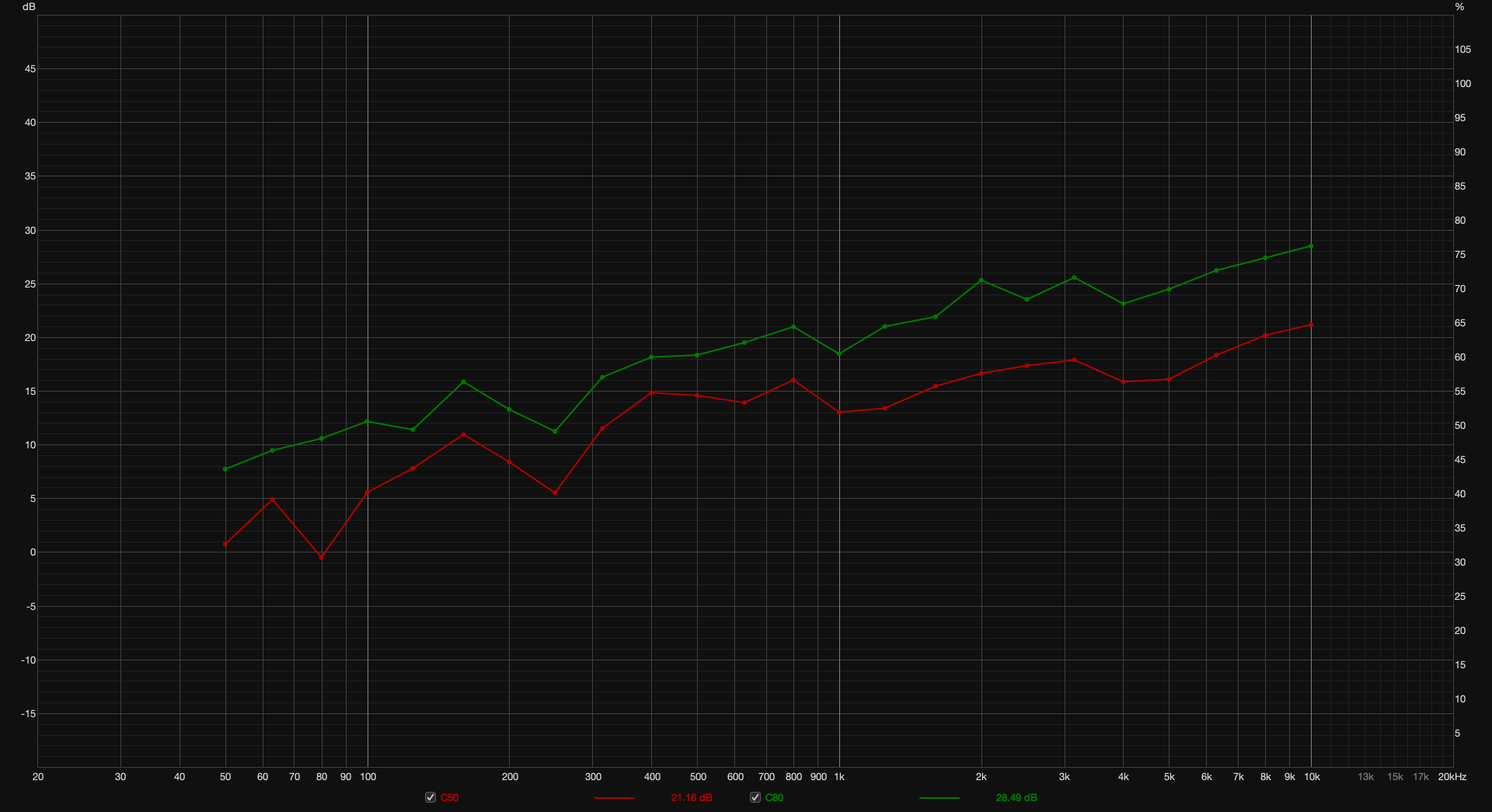
thanks for the input. I’ve actually already put a lot of work into the room acoustics and placement. I’ll upload my measurements here so you can see that the room is already quite extensively optimized.
The Decay Time is stable between 300 and 400 ms, which is studio-standard. The Clarity (C_{50}) in the mids and highs even reaches nearly 30 dB. This shows that the room is already playing at a very high level, effectively mastering grade.
This is exactly why a surgical PEQ for the Diva would be so brilliant: in such a “fast” and transparent room, the remaining narrow-band modes in the bass (45 Hz / 70 Hz) and the 350 Hz resonance from my cabinet doors stand out even more. These issues are almost impossible to solve with passive elements in a living room environment.
Since the Diva already has the DSP power under the hood, a “Pro Mode” PEQ would be the absolute icing on the cake. It would perfect this fantastic system for users with optimized rooms, just as you see with other high-end DSP systems (like Kii Audio), where it’s an option for that final bit of precision.
I’ve been thinking about a potential win-win solution for the PEQ request that wouldn’t require a major app redesign. The idea is a ‘Pro Mode’ via a hidden web interface (IP address). This would allow power users to dial in specific values while keeping the main app as clean and user-friendly as it is now.
The beauty of this is that the intensity slider in the app could still be used. It wouldn’t need to know the specific frequencies; it would just tell the DSP to scale the values from the web interface. For example, if I set -6 dB at 70 Hz in the browser and slide the app to 50%, the DSP simply applies -3 dB in real-time.
All the great app features, like centering the vocals via acoustic signals, would remain fully intact. The web interface handles the acoustic foundation, while the app continues to manage the soundstage and convenience.
I suspect the developers already use a similar direct DSP access for internal testing anyway. Unlocking this for home networks would be a massive upgrade for us enthusiasts uniting both worlds with very little effort
Many thanks for the hint regarding the CI-102, Edmund – I owe you one!
Why is a budget-friendly Custom Install device allowed to do more than the flagship of the active range? It is hard for me to understand why the entry-level segment gets this surgical precision (PEQ), while with the Diva Utopia, we are limited to the acoustic automation and cannot intervene specifically. It feels backwards to me, like a world turned upside down
From reading a recent thread on the CI-102 (complexity of setup, wish for more documentation), I would assume, that the CI-102 is directed as an indirect sale - you buy it as part of a custom install; i.e. always with a service provider included, who does the setup for the user.
The Diva is intended as a not-so-cheap put-it-there-it-works-automagically solution, and has a matching interface. I’m not sure, you - with your expertise and interest - were the primary user the Diva was designed for, when use cases and user interface were specified.
But maybe Naim/Focal can learn about the flexibility of the new platform (CI-102, Diva, Hekla, in variations) - but often offering additional user interfaces for a very diverse range of users creates a lot of effort to design and test; maybe they prioritized so far (only) one target audience per device.
From IT, I know the term for a user “who is competent on technology and domain knowledge, allowing them to manage complex system usage/configuration” - you can offer these people much more configuration options that could be hard to understand, manage, or even dangerous for a “casual user” (=it shall work with minimal investment of time with great convenience) to stumble into.
Say, a person using iPad OS to browse the web, vs. a macOS user who directly jumps to the CLI/console to configure system settings not available in the UI at all.