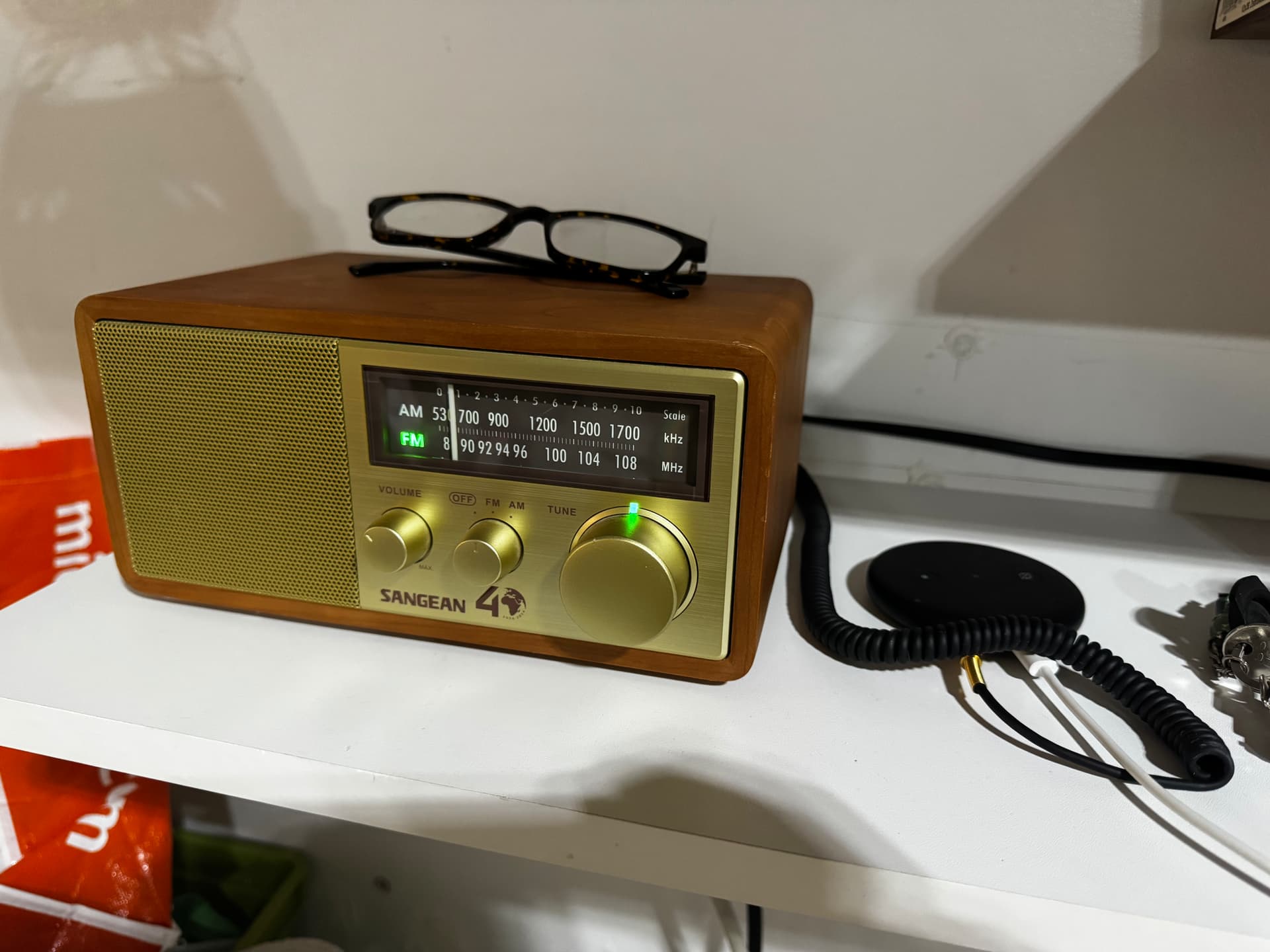
Working out this morning - I’ve got a $35 Amazon Alexa Unit playing into a Sangean Radio - it has an aux in.
The unit is timing impeccably!
Leaves me wondering - whether it’s harder to Time things at higher wattages - hence the 15W Nait1s - and why Julian did not want to do bigger amps initially.
And most HiFi pieces of equipment kill the timing because they’re trying to do other things…
The bass on the tune was coming along at exactly the times I expected - it was neither before or after where it should be. The music was flowing nicely along. Maybe not naim good - but better than Naim when not Properly setup.
I’ve heard a number of systems from B&O, Bose and a fair few others in home hifi and very many bar / restaurant setups where the timing is woeful, with the bass or bass-drum hitting miles away from the actual beat.
Some high-end manufacturers and / or their implementations of them certainly mess up timing.
That particular scenario is hardly surprising, with often multiple speakers rather than normal stereo some much further away than others different times for sound to reach ears, and worst when there’s a sub somewhere, possibly with no attempt at time alignment for anywhere in the venue,
It’s difficult to say if Naim amps are the best when it comes to timing. I used to have that idea previously when I found the Naim (NAC 202 and 282) to be the best match to Harbeth SHL5s. Timing in music is usually or predominantly messed up by bass notes, and bass quality (which affects timing) is mainly influenced by the speakers and room interaction. Some speakers put out clean and defined bass, some produce considerably slow ponderous bass. A good amp may help alleviate bass issues thus improving the ‘timing’ in music but that’s just part of the equation as there are other factors as well. In my experience, it won’t help much when a top amp such as Naim is used if the speakers are inherently bloated in the bass, for example the old Harbeth SHL5 model pre Plus and XD models.
FWIW the current ‘timing’ of the Gryphon amp matched with Marten speakers are currently the best I have experienced, followed closely behind by Luxman and lastly Naim 282/250DR where the bass sounds more ponderous. Timing is not the only aspect of sound reproduction that’s important as there are other considerations of the delivery as well such as tonality, detail and nuance in the music, treble as bass quality etc. but it’s surely one of the most important aspects to get right.
Makes sense - you can look at the radio above - and its speakers. Not much of anything going on in terms of clarity texture etc etc. - but listening to rock - and the bass - one note though it was, was enjoyable….
Guess digital has come a long way… - it’s a $25 dac + Spotify streamer! they don’t make it anymore unfortunately…
and I’m sure the Node Nano will probably sound the same…
I had the harbeth SHL+s too - sold they after about 6 months - they just left me feeling depressed - beautiful as they sounded…
My answer would be some do and some don’t. How each of the units interacts with the others will also have an impact. For me, my system has excellent timing, I can hear when individual instruments are played before and after the beat. That my system does this is down to every component working well together. Others might not like my systems presentation, but that it down to personal choice and not it being better or worse, just different.
If I am understanding this thread, it seems that some amplifiers, (particularly expensive ones) have an ability to take the speeds of different instruments in a recording, which are fixed in the recording, and make them go at different speeds relative to each other?
@Collywobbles - no that would Be silly. Rather some are capable of playing tunes the way they’re recorded and some aren’t. Thinking about this more, here’s an example I can come up with -
Say you’ve for a flute playing and now a drum kicks in and the recording says it kicks in at time N. If the system isn’t fast enough, it’ll try to make that sound start at N but the sound will only come through at N+. Now add on reality that there’s actually tonnes of music playing at the same time..
Thinking about this more then - the reason the cheap system sounds like it was timing right - it can’t even play 1/2 the things that are on the music / or I can’t hear them - the only thing I’m hearing is the drums and they sound like the time well…
Ultimately it’s about relative timing like you eluded too - but most amps find it hard to stay true to the recording.
@Innocent_Bystander - you’re right - I’m guess you’re eluding to the fact that it’s not mighty bass notes that shake the walls / but since there is sound where those true bass notes should be it’s a frequency multiplier of that - and these time well - since it’s way easier …
so yes - doing the real thing is way harder - and looks like I’m Enjoying the fake thing more since it’s times well…
which explains why when I got the Marshall Woburn it sounded slow and bloated - I returned it for the Marshall stanmore and it sounded excellent!
But if the cause of your observed timing discrepancies with bigger systems has been due to bass being slowed (delayed) in some way, something frequency dependent, that might only affect, or become noticeable, at frequencies below the Alexa speaker’s cutoff, not audible on the harmonics but becoming when the fundamental is the dominant note.
As for the real thing vs fake, I would only listen without full bass if I was unfortunate enough for it to be the only source of music - but I got my first decent speakers almost exactly 50 years ago and so have had that luxury continuously except when away from home. But I have to say I’ve never noticed the timing issues you describe: music has managed to be wholly immersive throughout - maybe its the type of music to which I listen. (Or maybe I’ve been fortunate in listening only to musicians playing in time with each other! )
Interesting topic and some nice observations. My own take on it is that amplifiers have different slew rates which basically means the time taken to reproduce a particular sound/note once received. The higher the slew rate the quicker the response time and therefore the more accurate the timing.
Lower frequency notes require more power to reproduce and are therefore the end of the spectrum where slew rate is arguably most important.
‘Lesser’ quality gear may have a reduced frequency response, lower power and sound fine because they do not have to work as hard as equipment with a wider frequency response.
As mentioned elsewhere, the lower fundamental frequencies are not reproduced but only the harmonics for example the 3rd harmonic of 20hz is 60hz and it may only be the 3rd, 4th, 5th etc. a that are being reproduced.
It has been some 40 odd years since I studied electronics so I apologise in advance for any inaccuracies!
 )
)