I often listen to music at night at low volume. At these low volumes, the sound is impacted (e.g. less bass and more emphasis on mid frequencies). The Naim Uniti products do not offer some sort of dynamic loudness compensation, right? I guess it should be possible to detect the volume level and than apply dynamic loudness compensation using DSP. Is anyone aware of an amplifier/streamer (Naim or other) that offers something like that?
Hi,
The Naim CI-102 product has such a feature and one can select the level of loudness compensation between Off, Strong, Medium and Weak selections.
SteveSky provided a brief explanation previously on another thread (link here) and quoting…
ATB
E of E
Oh, I did not know that. The CI-102 is a really interesting product, especially with the new accessory pack. Thanks for the heads up. I have no plans to part with my current Naim system yet, but this is interesting information for the future.
1 Like
If you want to keep your current system, Roon has DSP built in that you could configure and turn on and off depending on your listening level. Obviously there’s a cost to the subscription, as well as hardware to run it if you don’t already have something suitable.
I was aware of that option, but I am not sure I want the extra complication. I will look at it anyway.
Muso QB has Loudness button and a bass-fiddling option to compensate for distance from rear wall. Similar results?
1 Like
I have often suggested that a ‘loudness’ compensation facility would be beneficial, meaning properly compensating not the crude on-off loudness button commonly found on various amps decades ago, and included by Naim on the Muso. To do correctly it would need to be sophisticated, calibrated to the range of average listening levels at the listening position (requiring a microphone for initial setup, calibration thereby taking into account all system and room factors). With modern DSP it should be possible to do it effectively, and to be of such quality that any negative impact is more than outweighed by the benefit. I don’t know what/how the C102 does its version, but I don’t think it calibrates with reference to actual sound levels, so won’t be accurate except possibly at one sound level setting, different for different systems and rooms.
1 Like
Indeed. That would be the best solution. For the best result, it would require measurements using a microphone. I don’t think I have ever seen HiFi equipment having such functionality. Maybe it would be too complicated for the average customer. You could even say that for the CI 102. I haven’t seen or used the software, but I read posts here that suggest it is complex and really only usable for professionals.
Maybe I should buy a new house without neighbors  Living in an apartment building has downsides such as playing music at low volume to keep the neighbors happy.
Yes, I would hate to live in an apartment unless so well soundproofed that I could hear nothing of the neighbours, nor they me. Music was never intended to be played at lower volume than produced by the musicians when they played, which includes non-acoustic music recordings.
Take a look at the BK subwoofer site. They sell Antimode, which includes microphone.
I’m sure @Xanthe used to refer to this.
Whether it dan be used wigh Naim, I do not know
You could use that sort of sub-only DSP in any system: it connects the preamp to the low level sub input.
I was unaware of that device (thanks for identifying it here), and have just had s quick look. Forclarity its not a BK device, but made by DSpeaker of Finland.
It doesn’t do loudness compensation as such, however it appears that it may be possible to manually design a a crude loudness compensation curve using the adjustable tone control feature, perhaps two to suit a couple of different typical listening levels in one’s own system, which can be saved and selected when wanted. From my brief look I note that as a DSP box, digital in and out, the X2D version looks as if it could be inserted in the digital signal path before the DAC, so not changing the DAC used, and irrespective of whether a sub is in the system. (Unlike the X2, which only has analog out, both to main amp and sub, so you would be using its DAC not your one of choice.) It can also take analog inputs. On optical it input it can handle 192/24, but USB input sadly is limited to 96/24). Price seems pretty good, too. My interest would be its room correction if needed after I’ve done what I can acoustically, plus tone controls to correct poor recordings. I wonder what its like…
Another option is a MiniDSP product. I note their miniDSP Flex now can handle up to 216KHz sample rate, but oddly if using Dirac Live room correction facility it appears to limit to 96kHz. This product appears to offer wider DSP capability, thus possibly more accurate loudness compensation could be set up, but I’m not sure if it can be set for quick selection as the DSpeaker X2D can.
(Edited after further reading)
That’s an interesting statement, and something I’ve long pondered on. Certainly in terms of sheer realism that’s really convincing I believe that this can only be achieved by playing at realistic volume levels. Of course not really realistic, but giving that impression. I found with my previous big Klipsch speakers that to me they only sounded realy ‘right’ when played at such levels. They did perform very well at low levels but lost the element of reality.
In many domestic circumstances though it isn’t really possible to play at realistic levels. Nor I believe should it be necessary to in order to achieve complete musical satisfaction. One of the benefits of my new system is that I can play at far more modest levels without any lack at all of immediacy, apparent impact or musical coherence. I no longer feel any need to listen at loud volumes. I get complete musical satisfaction listening at ‘normal’ levels.
In my view in perhaps most domestic situations the most appropriate systems are those that scale down the performance to domestic proportions whilst still absolutely conveying the musical message. It’s a different experience to live music, and doesn’t seek to emulate that experience realistically in terms of scale, dynamics, bass depth etc. Rather you get a domesticated version, one that is more appropriate to most people’s homes. Very few people I imagine have detached properties with no nearby neighbours which would permit the realistic recreation of reality. We have a semi detached bungalow but got away with it for so long with the Klipsch’s as our neighbour is young and is out almost all the time working. With someone next door who was retired and at home, as we are, almost all the time I would never subject them to such an ordeal. This is just one of the considerations that prompted the system change.
1 Like
I don’t mean to be facetious, but it sounds like a decent pair of headphones wouldn’t go amiss in this situation.
1 Like
In my case I often listen to classical at realistic levels (as when I am in a good seat in an auditorium) though of course sometimes I do play quieter. With rock music, whilst I do very much enjoy playing at at least fairly close to realistic levels, out of consideration for my ears I restrict the time I’m doing that, and most of the time play quite a bit lower level (though my wife still calls it loud). I can of course play quieter if I wish and sometimes do. It still sounds good, but and this is the significant factor, inevitably as the level reduce the extremities of the audio spectrum sound relatively quieter than they should in proportion to the rest of the music, increasingly so as sound level decreases, with bass much more than the top end. That is simply the natural physiological behaviour of our ears, and absolutely nothing to do with the system. If you want music to have the same frequency balance as when played at or close to the musics natural level, then you actually need to boost the spectrum extremities, bass being the particular area that most people notice has diminished (of course assuming the system is reproducing low enough in the first place!). What’s needed is to boost frequencies to emulate the Fletcher-Mundon curve:
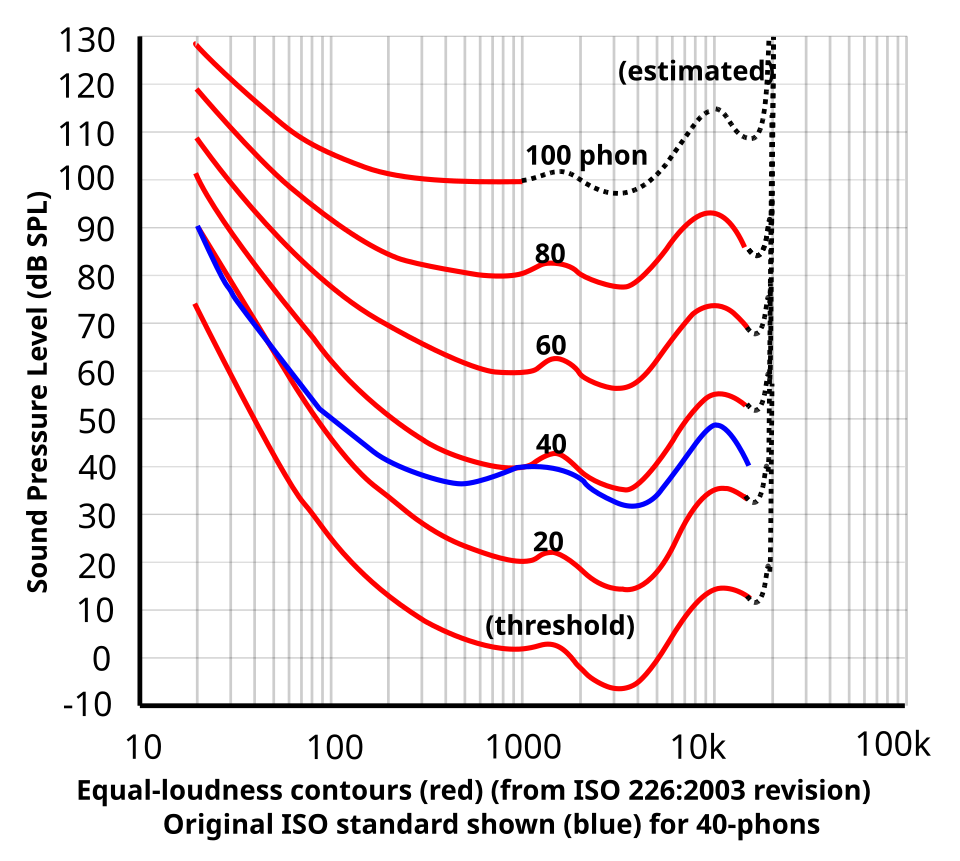
Other variants are available, notably ISO 226:2023, but the above (dating back to the 1930s!) is already in the public domain and I believe out of copyright, and serves well to ollustrate.
1 Like
I also have a separate headphone system and some higher end headphones. But it is very different (not better or worse, just different) from speakers. Headphones become uncomfortable after a certain period of time.
1 Like
Of course yes - the very reason for the common loudness buttons on many 70’s amps in particular, which were very crude in their operation but did at least make music at very low levels more balanced sounding.
More serious for me than the loss of bass though is that I have often found that music played at lower levels loses impact and immediacy. It can tend to recede into the speaker boxes and become distant and unengaging. I discovered when I got the Klipsch that horns are extraordinarily good at avoiding this pitfall, which is one of the reasons I wanted to continue to have horn loading.
Like you I also was becoming concerned about possible hearing damage from long term exposure to high sound levels. I don’t think I could achieve what I would call realistic levels with the Nait 50 and JBL 4309’s even if I wanted to. Curiously though I don’t feel any compulsion to try. The system sounds sublimely musical at much more modest levels. It doesn’t have that live concert feel of the Moon / Klipsch, here we’re talking a 100W amp into large 99bB efficient very dynamic sounding horns. That was extremely impressive played very loud. Where it easily beats that system though is for sheer musical engagement. That’s what was missing for me from the previous set up. A big Naim amp like a 552/500 into a big pair of JBL horns would I’m sure be about as close an experience to being at a live concert as it would be possible to get at home - in all ways sonically and musically. But very expensive, very heavy components and not practical unless you have a detached home without nearby neighbours. If I had the money and the home to do it then I’m sure I would. I’m pretty sure I would eventually move back to a smaller system though as impressive a spectacle as these systems are they can just be too full on for regular listening iMO.
I could liken it to when we had a projector. It was extremely impressive watching movies on a large screen with proper full range surround sound. The closest it’s possible to get to being in a commercial cinema at home. As a regular way of watching films though it was just too much. Like going to the cinema every night. Sometimes it was much nicer to just watch on the small screen on TV. Bigger isn’t always more enjoyable.
With hifi, as I have mentioned in the past, I rationalised the size and weight of speakers and amps as being ignorable as once set up they need never move, though my unexpected house move forced a temporary solution (which may remain permanently) of castors on speakers making them easily moveable despite their weight. And I hope never to live in a non-detached home again (should I one day have to move into a care home, I think the only thing that makes sense is headphones, which I can just plug into my DAC which has a headphone output - assuming I still know how yo use it snd can still hear- but that would be a sad day.) As for affordability, it isn’t difficult if you accept secondhand, thou I know that for whatever reason you bar yourself from that. But where there is a will there is a way!
The way I have done home cinema , with a big screen (12’ wide, at about 11’ eye distance) is watch certain, more special, movies on it, perhaps about once a week on average, otherwise TV suffices. But then with TV I will often do something else while watching, whereas I don’t in big screen darkened room surround sound home cinema mode. I plan to set up home cinema again once my house mods are finished and music room properly optimised again.
1 Like
If I had the room then I would probably at one time have set up a home cinema in one room complete with curtains across the screen etc. and a concert room with a big system to emulate the effect of being at a live concert. I may even go so far as to make a stage area with lighting to add to the effect. It sounds frivolous perhaps but IMO would add considerably to the sense of realism and occaison. For more regular everyday listening/viewing I would just have a TV in the lounge and my current system.
Many years ago when we were still working we had the opportunity to acquire a larger property and I did have plans to implement just such a venture had we proceeded. One thing and another happened though and it wasn’t to be. Nothing like that would be possible in our current (and hopefully final) property even if we had the money. But priorities change anyway and I wouldn’t really want to bother with all that now.
As for moving into a care home I think what I was going to listen to music on would probably be the very least of my concerns if I ever found myself in such a sad situation. I’ve seen it happen to a family member who prior to this had a very comfortable life which was very sadly effectively destroyed by events beyond his control.
My music room doubled as occasional cinema room in last house, and will here. TV is in another room, this time an open plan kitchen dining room with lounge area. We have to have two lounges as music and TV aren’t compatible, and my wife doesn’t like most of my music, and prefers to sit in the quiet with a book, or watch TV.
But this has strayed a long way from loudness compensation!
1 Like