Hi Simon,
Thanks for contributing. I have used this term ‘pre echo’ previously in post number 324 when we were in discussion about system filter passband roll-off characteristics, the corresponding system impulse responses and the listener perceived effect on sound reproduction…
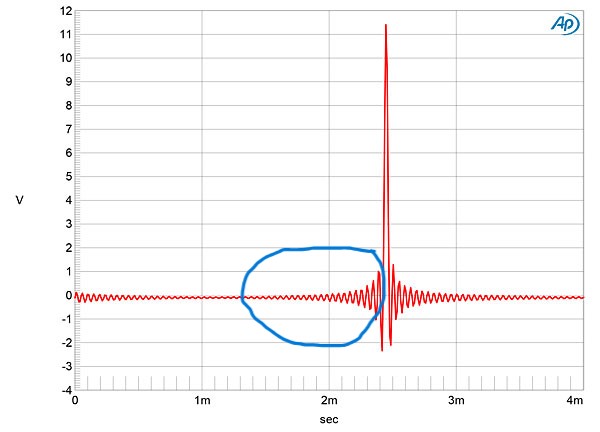
Regarding my use of the term ‘pre-echo’. It is NOT the delay to which I refer, it is the presence of output (from the filter) before the main peak of the ‘pulse’ arrives. This is a fundamental characteristic of Linear Phase Finite Impulse Response (FIR) filters. One can choose to have FIR filters that are NOT linear phase, CHORD have NOT done that the DAVE DAC - they have implemented linear phase.
My specific point is that the ear-brain system works to make sense of the sound pressure variations and these pre-echoes represent a distortion of what normally would occur in many ‘natural’ (low order) systems in real life. I.e. the ear-brain system does not expect (and is not evolved to ‘expect’) such pre-echo pressure variations.
Of course (as you have mentioned elsewhere on the forum) much recorded music is ‘processed’ in some way. My additional point is that in the replay chain in the home one does not wish to excessively add such ‘unnatural’ linear phase high stopband attenuation - c.f. long impulse response - signal processing.
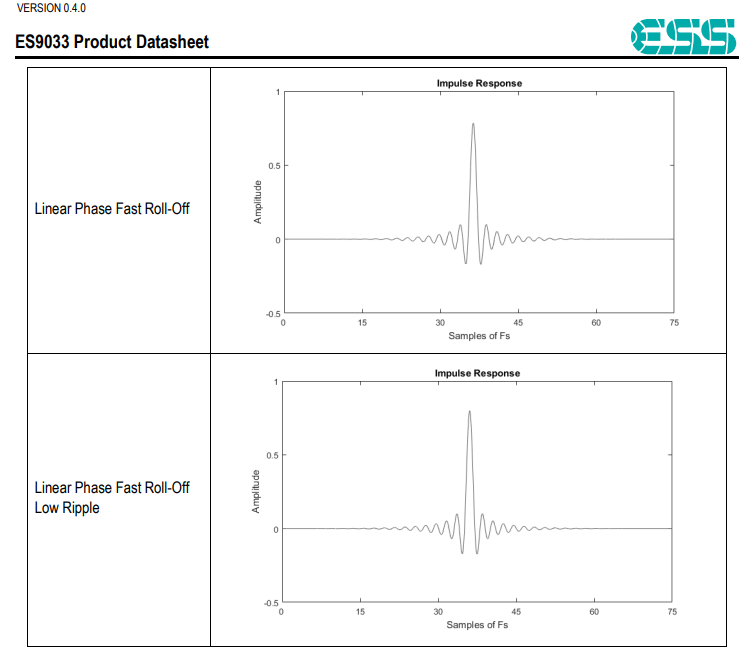
By way of illustration, I have chosen to include impulse response examples of just two of the eight available filter type options from the specification sheet of the DAC devices that NAIM have selected to be used in the NAIM CI-102 product. Note: I am not suggesting that either one of these is the filter chosen to be used by NAIM in the CI-102 - that has not been confirmed.
Image Credit: ESS Technology Inc.
As can be seen these are Linear Phase (symmetrical) impulse response with what I refer to as ‘pre-echo’. For comparison, included below is the Stereophile review and measurement image of the impulse response of the Chord DAVE DAC. The blue circle (added by me) identifies the region I call the ‘pre-echo’.
Image Credit: Stereophile Magazine (May, 2017).
The great news is that the ESS DAC family give designers eight filters to choose, some linear phase some not. What is involved for the designer using such DACs is the trade-offs involved between desired anti-alias protection (of the repeating spectral images of the wanted audio in the Z domain), degree of ripple in the desired passband, sufficient clean initial transient response of the DAC (little or no pre-echo in overall impulse response), and ultimate differential nonlinearity performance if also incorporating other features such as implementing digital volume control.
By way of final illustration, here are impulse response examples of two more of the eight available filter type options from the specification sheet of the DAC devices that NAIM have selected to be used in the NAIM CI-102 product. Note as mentioned previously, I am not suggesting that either one of these is the filter chosen to be used by NAIM in the CI-102 - that has not been confirmed, but I hope readers can clearly see the lack of pre-echo in the first example and very small pre-echo - with a bias towards post-echo in the second example below.
Image Credit: ESS Technology Inc.
FYI I am still seeking evidence of the impulse response of the Linn Organik DAC. My expectation is that it will NOT be a linear phase FIR type, and my understanding is that Linn have implemented an Analogue Transversal Filter (Analogue FIR) in the Organik DAC.
ATB
E of E