Surely a cubic foot is less volume than a cubic metre?
Or is a unit many cubic feet not one?
Different pressure supplies?
I fear the answer may be too obvious.
Surely a cubic foot is less volume than a cubic metre?
Or is a unit many cubic feet not one?
Different pressure supplies?
I fear the answer may be too obvious.
BTU perhaps?
There used to be some multiplier to take account of slight temperature/pressure differences, but it’s always been rather confusing.
Modern electronic bills don’t seem to have all the details you used to get on paper ones.
That sounds plausible I just got a bit excited that 0.7 gas units on an imperial meter was tens of kWh so wondered if the company might have registered the meter as metric instead!
It’s correct.
Imperial to metric is approx 1:2.83
100 cubic feet = 2.83 cubic metres.
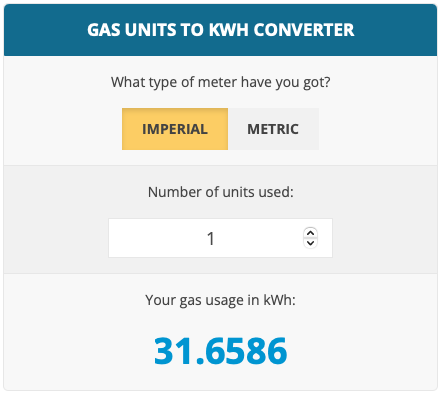
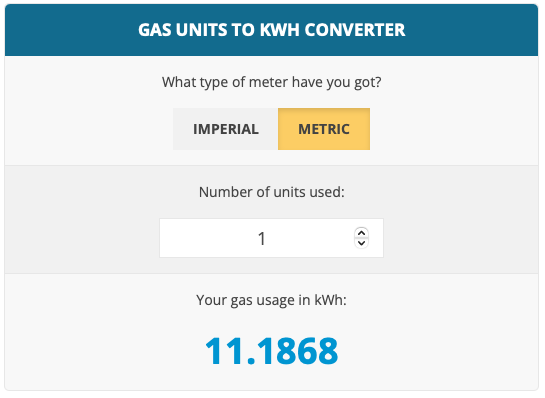
Divide your 31.6 by 11.18 = 2.83
So for imperial the unit isn’t 1 cubic foot but multiple cubic feet - presumably needed to reduce the number of digits recorded for meter reading to a simpler value?
In imperial it’s 100 cubic foot. 
Details are all here; scroll to “calculation of gas bill”
Thanks for that - the key image which confirms what @Skeptikal said:
Just seemed odd the actual meter fascia doesn’t explicitly say that the reading is in hundreds of cubic feet - suspect no one ever really wonders about such things in this day and age.
What about the calorific value.
Is that not taken into account anymore?
Good question.
Calorific value is part of the equation, see step number 3 as linked above.
Get meter reading change
If imperial, convert to cubic metres
Multiply by calorific value
Apply temperature and pressure correction by multiplying by 1.02264
Convert to kWh by dividing by 3.6
Finally multiply by price per unit
This topic was automatically closed 60 days after the last reply. New replies are no longer allowed.

