Are these HD versions that you have made yourself from a vinyl record?
I do have some Steely Dan cds and they are without exception very very good. It’s not my kind of music and that’s why I noticed that the recordings and the way they are put on cd are so good. Improving on something done well is much harder than something not done well.
No. They are screen grabs of the waveform of the four variants of Doctor Wu on Tidal as shown in (early access - I don’t think it’s in production yet) Roon.
The three ‘quieter’ grabs are all identified as ‘2025 remaster’, which I understand to be from a dsd transfer of the analogue master. The other is not identified.
If you go to Tidal, you will see the distributor publisher and date of publish for the track/album. It’s often a little footnote at the bottom of the album or EP tracks.
That will tell you who provided the distribution master to Tidal, and they can be contacted if you have a genuine query. For example
Odd question. No. 
Not really. You said they were analogue originals that you saved.
Ah, yes. My bad. The comparisons are between different digital formats via my Qobuz playlist. '“CD” (or 16/44.1) and “HiRes” (or 24/90-24/192).
Sorry for the confusion.
1 Like
Audirvana has a nice audio analysis capability which is pretty good at detecting upsampled tracks sold as high res and also albums upsampled from MP3 or equivalent lossy formats. Quite helpful. Whether HD tracks are better sound quality than 16/44.1 all depends on how they were recorded and mastered. I have high res purchases in my local library which are great. Some not so much.
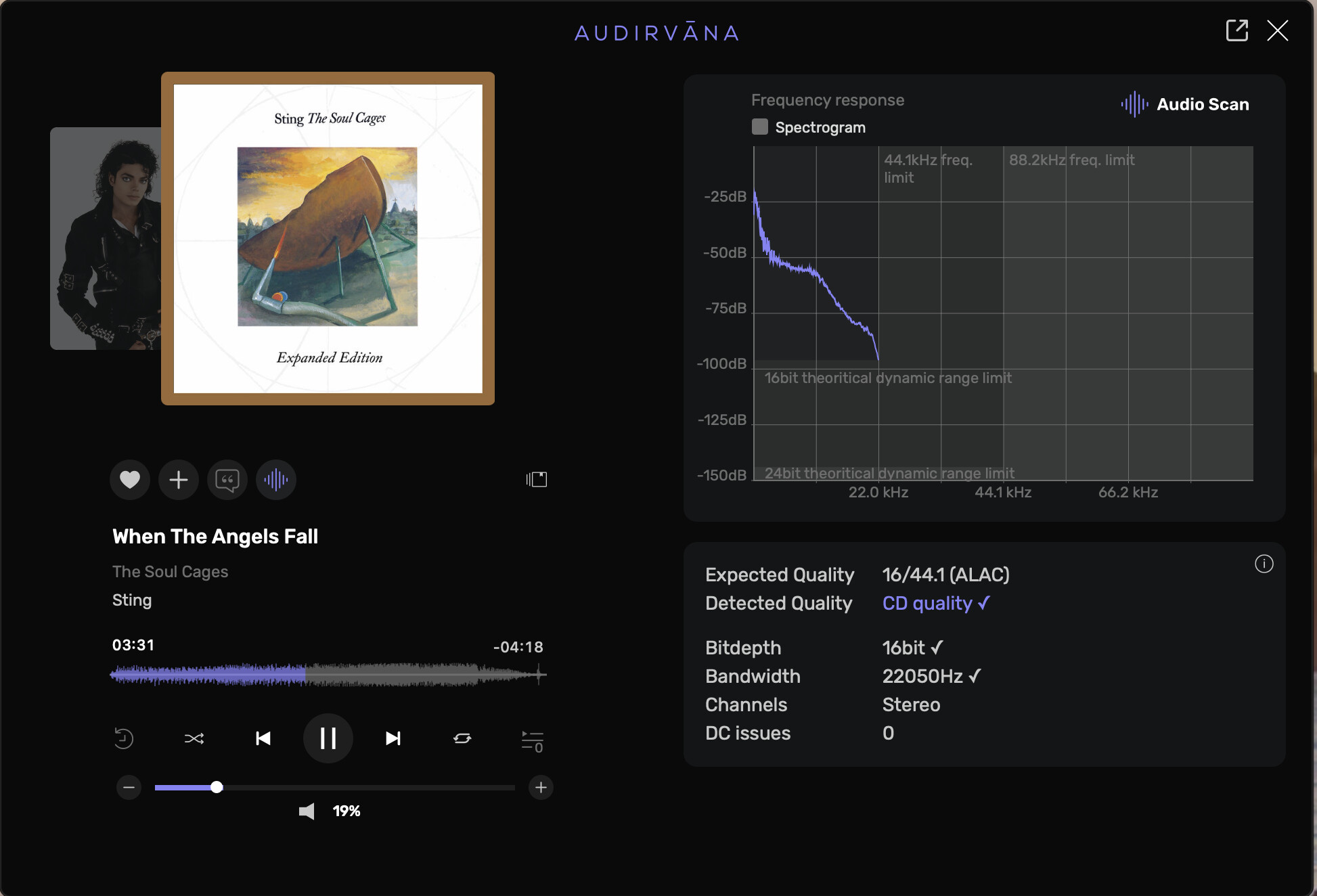
A good choice of example - I see that album has an interesting mastering (and release) history too!
1 Like
Glad I started the thread. It’s been a learning experience. 
when i first started listening to hi-res streams from qobuz i found them very disconcerting - your term “etched” describes it well. at that time the difference between hi-res and cd was very clear.
over time my brain adjusted to the difference and so now i think i would have difficulty telling them apart
On the Sound Liason website they offer free downloads in different formats of one track of a recording done in DXD. The idea is to play the different formats through your audio system and see if you have any preferences- in a sense, evaluating your setup. If interested you can type ‘Compare formats’ in their search box
They claim that they are derived from the same source recording done at 352.8 Khz. There is a description of the process and software used for the conversions. They also suggest how you could carry out the listening comparison.
The lowest resolution offered is 24/96. If you want to make the 16/44.1 comparison you can make a down sampled file from the 32/352.8 file using your own app. (e.g. I use J River MC).
1 Like
I have just watched John Darko’s item about “aptX lossless”.
Apart from the nause-up about the indicators of whether a phone has it or not, which I managed to get my head around, I’m plunged back into a state of confusion about what “lossless” means in this context.
Darko says that “lossless” means “lossless CD quality”. So I’m back at the 16/44.1 thing again. Does this mean that if aptX lossless is transmitting a 24/96 file, it’s doing it in 16/44.1? If so, then it’s not lossless at all, surely?
And if that’s the case, then the only way to get a real “lossless” transmission into my ears is by attaching my wireless headphones to my smartphone with a, er, wire.
It means the only format that AptX lossless can actually deliver in lossless audio is 16/44.1. Whilst it can do 24/96 (all bits of the chain supporting that) it has to use lossy compression to fit it in the available bandwidth. It uses lossless compression for 16/44.1 which keeps it within the doable on bluetooth. Interference though can make it resort to lossy compression on all formats to keep going.
So if you want absolute 100% guaranteed lossless audio, or want any resolution beyond CD in lossless for ‘wireless’ headphones, then you need to add a wire.
That’s what I thought. Calling it “lossless” is a bit of a con. It should be called “CD” or “1471kb”.
I was contemplating updating from my Xperia 10 VII/ML5909 setup to Xperia 1 V/Noble Fokus Artemis.
I think I’ll stick with cabling for now and see if the technology catches up.
Depends on whether you feel you’d notice the difference on the same track from the same master between 16/44.1 and 24/96.
Lossless 24/96 is more than double the data rate of CD, and CD only really works with a bit of compression over bluetooth. So even if you could achieve best case on the fly compression of 2:1 with 24/96 it’s still beyond real world capability of Bluetooth. So we could be in for a long wait before bluetooth is good enough for lossless 24/96.
And us Apple people will probably have to wait for hell to freeze over to get even lossless CD quality without a dongle 
If you’re able to, I’d be tempted to try comparing a CD vs 24/96 lossless FLAC file on the new hardware with Aptx lossless to see if the CD one sounded better. I would personally expect lossless to give a bigger gain that more bits/resolution. Whether that’s significantly better or not than what you have today would also be interesting.
“And us Apple people will probably have to wait for hell to freeze over”
Honestly! I suppose using the dongle option instead of dumping it for Android must be because you love everything else that Apple does.
What is that, BTW? 
Can only speak for myself, but working in IT, and a lot with various flavours of Unix, I just can’t be bothered to faff around with finding the best way out of many options on Android to do what I want to. I just like the fact that generally on Apple stuff works and you can move between devices quite seamlessly.
My Px8’s with my iPhone sound pretty good in general, and I use CD rips on my phone so am quite happy with how that sounds. They also get used in the car where I do get lossless wireless audio over CarPlay, but that uses WiFi not bluetooth.
1 Like
Indeed AptX can only support 44.1/16 lossless .. so if your media is is 48/24, 44.1/24 or higher it will need resampling by your device
It’s an interesting question as to whether the software will know that AptX can only do lossless at 16/44.1 and therefore downsample a lossless 24/96 (or anything else) into 16/44.1 first, or whether it will simply pass on the high-res stream to AptX which will then throw away more information in order to transmit it.
Hence it would be interesting to compare a CD and high-res stream (both from a lossless source) to see which sounded better.