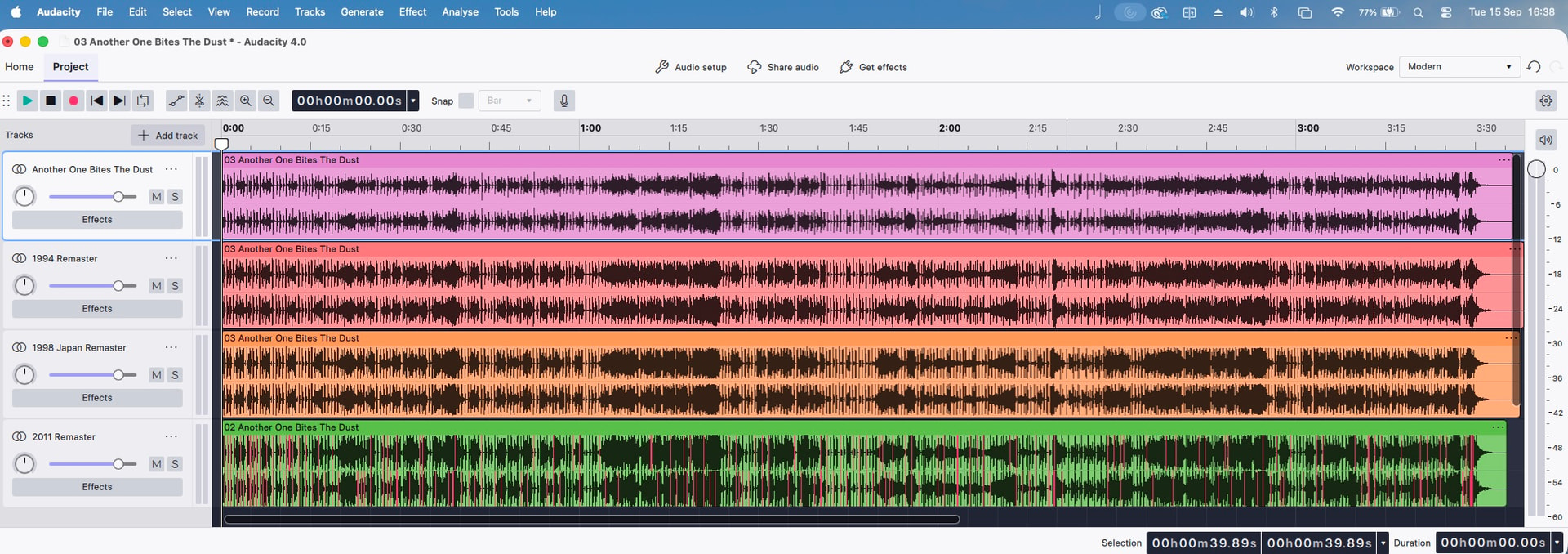
Out of curiosity, I compared a “HD” 24/96 repro of Steely Dan to a “CD” 16/41.1 version.
To my surprise, the 16/41.1 sounded better. It had more detail and dynamic life. In the “HD” quality version, the voice and instruments sounded kind of “etched” and artificial, lacking breath and resonance.
I assume that a good deal of this is due to an original analogue recording being run through the HD digital process. The implication being that the CD process retained the musicality and SQ of the original, perhaps because it had used “dither" where the HD process hasn’t.
Of course, anything recorded in HD is going to be what it is, but now I might have to go through the rest of my library and see if I get the same effect with any other analogue original that I’ve saved in a “HD” format.
PS: I also noticed that Qobuz, if you search on the band or performer’s name, defaults to the HD versions. You only find the full range of albums if you search on the album name.
The CD is probably not the very latest, has it been remastered? The 24/96 will I suspect be from a later master which these days still have the habit of being made too loud which ruins dynamics.
In my view, the only advantage 24/96 holds over 16/44.1 is that if you mastered to maximise the dynamic range of both, then you may be able to get better dynamics from the HD version, but that assumes that a) the source has that headroom and b) so does your kit. If it has been mastered well, then I doubt you’d be able to tell 16/44.1 and 24/96 apart.
One of the difficult parts with online streaming is there is virtually no information on what master you’re listening to, or possibly even what other processing is applied by the streaming service. So getting a like for like comparison is tricky.
On stuff I download from Qobuz in both 24/96 and 16/44.1 it’s very difficult to hear a difference. The main reason I buy at 24/96 is simply because it’s cheaper. I download the CD version too for Sonos and use on my iPhone in the car.
Reputedly there are a lot of falsely described high res files out there, upsampled from lower resolutions, so containing no more information, selling as HD when in fact they are not. (I believe can get free software that examines files to verify if genuinely higher resolutions.)
Otherwise, in any comparison, it is of course critical that the mastering is the same - many hi res recordings are differently mastered, in which event what you are listening difficulty is primarily the mastering difference (when hi res equally may sound better than or worse than the 16/44 version.
As for actual differences in sound, some years ago there was an American PhD study with people invited to score music at different resolutions, blind through the files being disguised in some way. The outcome IIRC was that people could not reliably tell which was which - however there was no standardisation of replay equipment so results were across the board.
I did some comparisons myself from definitely the same masterings, released for just this purpose by the Norwegian label 2L (multiple resolutions available right up to 24/352 IIRC). I did feel I that in several cases I could hear a difference between 16/44 and higher resolutions, but in reality only very slight. Best description I’ve heard others describe it as was “like more air around the instruments” - somehow slightly greater ambience, and I felt that fitted my feeling. But it was subtle, and I can’t be certain that if I compared on a different day I’d necessarily think the same.
(That was through Chord Dave DAC, Bryston amps (active tri-amped), PMC EB1i speakers on bass with ATC’s 3" soft dome SM75-150 mid and Scanspeak tweeter.)
In many cases the 16 bit CD version of an album sounds much better than the Hi Res.
But there are exceptions and I have been keeping a list of albums in Hi Res that knock the socks off the CD version.
Carly Simon - No Secrets
The Allman Brothers Band - Idlewild South
Heart - Dreamboat Annie
Prefab Sprout - Swoon
The Clash - London’s Calling
Steve Miller Band - The Joker
Crowded House - Crowded House
The Tubes - The Tubes
Bachman-Turner Overdrive - Not Fragile
Elvis Costello-My Aim Is True
Alison Moyet - Alf
I guess it’s possible that all the “Hi Res” albums I’ve been listening to have been “false".
Example: on Billy Cobham’s “Spectrum” from the album of the same name, the CD version clearly highlights Lee Sklar’s fumbling of the bass part in the early part of the song. On the Hi Res version, it is barely detectable, as if the process has “smoothed” it out.
However, the CD recording, despite having more detail has an unpleasant harsh sound quality overall which after awhile makes it hard to listen to, so I guess with any recording bumped up from 16/44.1 it’s lose on the one hand, gain with the other.
Although whichever Led Zeppelin version you listen to, they all sound crap.
Ah, Steely Dan. Well the high sample rates on the Steely Dan are real. However, to my ears, they sound rather flat and rather dull. They are made from 50 year old tapes. The 16/44.1 versions are derived from digital copies made in 1981 by the original engineer. He did it then as he thought the tapes were degrading. I also prefer them.
I think preference (sometimes) is influenced by the master (and medium) which you first heard, and are most used to to. Most of my Dan ‘collection’ is vinyl bought fairly close to release excepting a 1993 cd compilation. Most of what I listen to is Tidal… but I’d completly missed the 2025 transfers/masters.
2nd one looks like your typical LOUD master… Bottom two are very close, the first looks to be different again. So I’d say possibly the bottom two are hi-res from the same master and the top one is a better CD master than the second one… probably all wrong!
That will be done to the mastering. Having recorded mixed and mastered, I know one will set a native rate like 96/24 to mix at these level. This will include the stems (the modern digital version of the mix tape) .. one will then likely produce the mix master… this is still part of the creative process and can set a feel or vibe, or energy for a track. This typically is at the same rate as the mix and the stems are mastered down to two channels.
From this mix master you can then have a myriad of distribution masters that are optimised for different media like vinyl, CD, streaming, video etc.
Sometimes the artistes can have influence these distribution masters.. but I believe not common.. unlike the mix master where almost certainly the are involved with.
The distribution masters can be and would often be at different sample rates to the mix master.
The distribution master are created for the media type and then distributed by the distributor/publisher to the various outlets such as streaming service providers.. the streaming service provider may well additionally res ample and process (LUFS) the distribution master for thier service.
So there are several hops in the chain… it surprises me it ends up still sounding as good as it does.. and it also brings a wry smile to me when he hear people stressing over being ‘bit perfect’