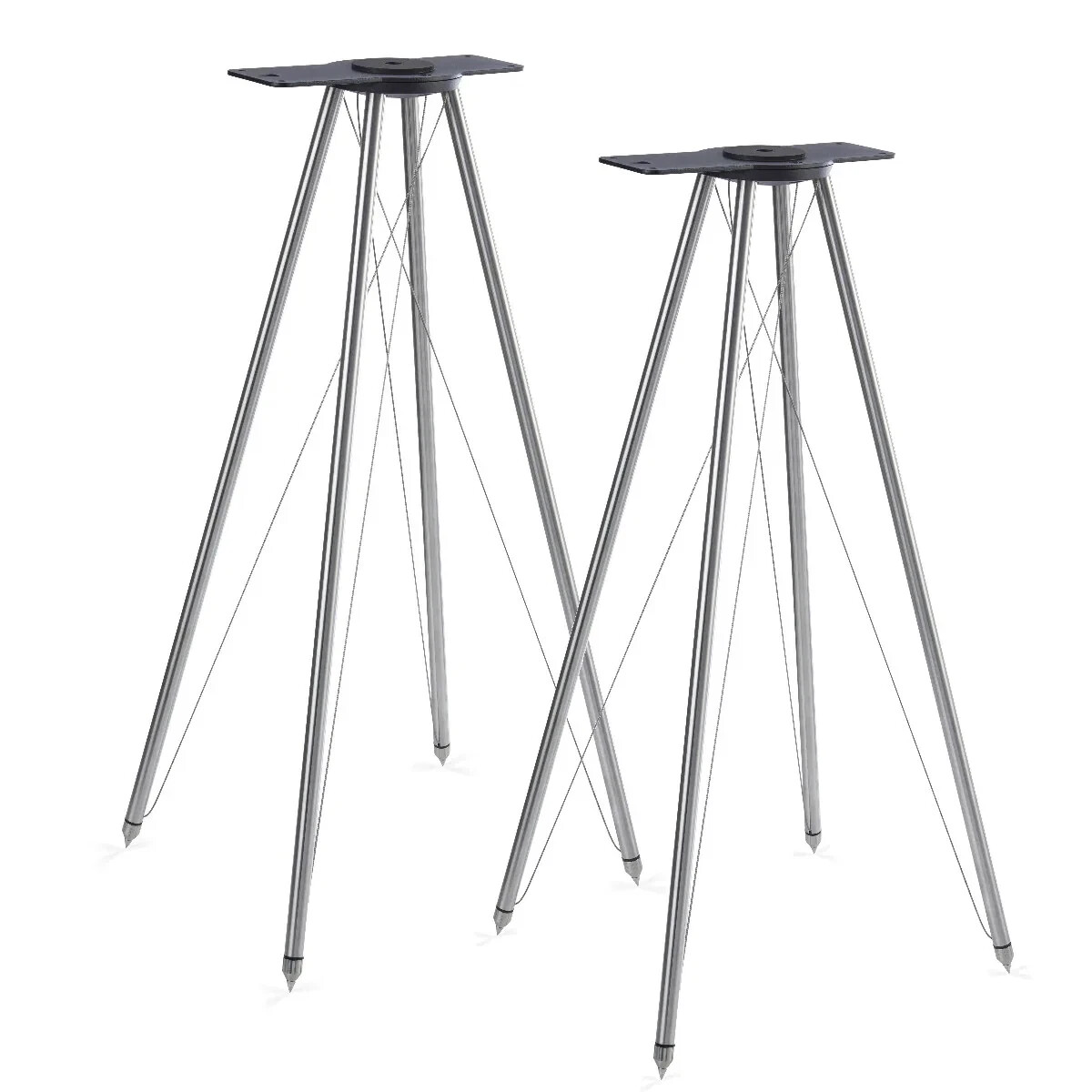
They are important. I think the coupling or decoupling to floor is as important as to the coupling to the speaker itself. This changes resonance and damping frequencies of the speaker cabinet and baffle.. and also micro cabinet and baffle movement which can have a profound response to the performance of the speaker into free space, and allows you to match your listening environment.
This is one downside of floor standers, this is usually fixed… so like it or lump it for a given room. I believed some of the early Naim speakers focussed on decoupling and coupling within driver stages in the stand to perhaps address this. I am sure others can comment.
When I had Falcon 3/5a GB I bought pair of Foundation Designer stand – sanded and like 25kg-30kg each – I was like what on earth?
Coupled the Falcon to the stands with blutack, and found the stands worked like bass unit which is amazing – without that the Falcon had absolutely no bass. A 40cm distance from the wall, toe-in and it formed a 3D soundstage.
I’d never thought of it like that. One reason I’ve always been more comfortable with floorstanders is that (in my mind) it totally removes the stand issue. Also saves a few quid, though I appreciate that floorstanders are usually more expensive full stop.
Is it therefore possible to change stands to adjust the sound; not necessarily for better or worse, just different to fit a room?
Not had the M40 but other than these, I do think that the P3ESRs are the best (and only really good) speakers that Harbeth makes.
However, the P3ESR generations do not sound the same and the earlier ones are a bit slower. I now have the XD which I find to have a very good balance of keeping excellent pace and strumming rather sweetly, great natural sound. I’ve had several small monitors before, including Falcons and (here finally coming back on topic!) I kept their excellent dedicated Falcon stands, which I now use with the P3ESRs, cannot recommend the combination high enough!
Fun fact - the P3s are a bit of a cheat as they are slightly larger than the standard LS3/5a box size and, just possibly, this may also be contributing for a fuller sound, while on the other hand the Falcons remain a bit more direct as a presence?
I’ve never tried but quite possibly both of these might sound very ok on a bookshelf with quieter music or BBC4 on. You just won’t get the space around instruments and those voices that just hang in the air, in the middle, in front of you - something very few speakers, at any price, can quite do in such a realistic way.
I took the advice of the MD at Neat for mine, and followed his advice on placement and filling of my Custom Design FS104 Sigs. All I am really saying is please don’t spoil the ship for a ha’porth of tar.
Important as everyone else has said but it can be slightly complicated; Without wanting to teach anyone how to suck eggs; Open or solid stands? What height is optimal for your seating position, filling or partially/not filling, how is the speaker secured to the top plate (or not) … and what is the stand connection to the floor … . Manufacturer recommendations are certainly worthwhile following but not always a guarantee for success. Some speakers are really sensitive to positioning, others less so.
Typical audiophile, confusing dilemma and it is possible to enjoy music even if sitting in a non-optimal position or having speakers sitting on shelfs or similar. I have some bookshelf speakers sitting in a Kallax next to main speakers and it is not an issue.
Have you tried the different Falcon crossover builds? The Gold build is faster and fuller… the LS3/5a subtle bass hump is more effectively be fitted from. It is quite incredible, or at least it is for me, how such a full, expansive, detailed, punchy three dimensional sound can come from such a small cabinet… but yes they took several months of run in.. in which sometimes I doubted they were right for me in the ups and downs.
I do find stands even more sensitive for the LS3/5a including top plate coupling… no doubt as a product of the very specific cabinet design. I have found the SS60 stands with appropriate top plated coupling provide a full and naturally balanced sound on the Gold Build. The Silver Build crossover was slightly slower, and a little cuddly and more forgiving of sub-optimum setup, but had less bass punch, speed and transparency… all in my opinion of course.
Test 1: place your speakers on 3 coins or washers or nuts (threaded metal, not organic!). Notice any difference?
Test 2: raise speakers so that tweeters are at ear height. As a student I used bricks with my Index mk1. Worked a treat, and the bricks added rumble for the bass!
Test 3: dedicated stands, filled, unfilled, upward/downward pointing spikes/cones, blutack, ball bearings and nuts etc etc.
Hi Simon, As an aside to this thread, and very much in the hypothetical almost not worth asking camp, I’ve often wondered what you would have made of my one time Chartwell LS3/5as compared with yours. (Their serial numbers were four figures.)
I’ve owned the Falcon Q7 gold and had the Falcon silver (well run in I believe) at home on a couple of longer demos, so not exactly the same cabinets and, of course, neither of them exactly your model too.
The Gold crossover is very good I thought too.
In relation to speakers with a relation to BBC thinwall design, despite old pictures of them sat simply on a desk, my recollection of conversations when I bought my LS5/9s was, that for the cabinet to function as designed, it should only be supported at the corners.
I have the original Something Solid stands, open frame with small carbon fibre inserts. Sadly, with spikes onto a concrete floor, these ring noticeably. The problem is solved by Chord Silent Mounts, not cheap.
The Tontrager stands are made all timber with a small wooden pip making connection in a similar way.
Very important, in my opinion. They focus the sound much more, as the energy they want to produce doesn’t need to go into moving whatever they are sitting on.
My speakers had the B&W Originals at first, filled with very fine sand to deaden them. After a while, I switched to the current Partington Heavi-2s they are currently on and the difference was staggering. They have much better staging, control and are a bit more ‘invisible’.
You don’t need to go overboard, but getting them on something dedicated will be worth your while.
It is an alternative, but the sometimes compromise with floor standers can get in the way.. as discussed earlier in this thread. Standmounts can often offer better speakers/room tuning.. but yes floor standers are easier to setup.
In my experience there is a big difference between stands and no stands (just standing on a shelf). However there is less difference between different stands.
I have N-Sats and needed to raise them higher than the original Naim stands were. I bought some cheap <£100 stands on Amazon, expecting a sound quality hit as the speakers were sat on a plate rather than suspended as per the Naim system. I was pleasantly surprised to find they sounded better if anything - in my room to my ears of course.
Stands are just lumps of metal welded together, different types will sound different but some are just ridiculously expensive - trust your ears.
I know that is a relative statement, but in absolute terms there is a huge difference between stands… Weight, degree of lossyness of materials/damping and resonances, top plate materials and coupling, floor coupling, open or closed frame.. all typically affect the radiations from a speaker cab and baffle, some markedly so.
It is why some stand mount speaker manufacturers make specific stands than can be tuned for the room they are in…
I have collected far too many stands over the years, all cluttering up space in the garage… or I get rid of them.. all have distinct characteristics… and in particular the characteristics can vary with speaker … typically driven by speaker weight, and degree of cabinet inertness or not based on speaker design.
This is does move into the area of mechanical and materials engineering and as such you can find much engineering descriptions of the principles if so interested… it’s certainly not a case of a lump of wood or metal is all you need for optimum results.
Over the years my favourite have been SomethingSolid and SolidSteel….. both are SS.
This might be a topic I can assist with. I also enjoy female voices, and my Celestion Speaker Stands are designed for their SL6si range of speakers, so the tweeter sits at approximately ear level when one is seated for best performance. I would think that this would be a design guide for all modern speakers in this category. If you wish the quote from the instruction manual, I am sure I can find it. I did say think, and I know Mission are an exception.
One thing about these speaker stands is that they are extruded from aluminium and make up for their lack of weight by being supplied with two tubular plastic bags where the owner is to fill with the smallest lead shot available and clean fine beach sand. In Australia, we have loads of the latter or from a pet shop. Insert the bag inside the stand and slowly fill it with tea spoons of lead shot and sprinkle sand in the gaps. Until full.
To summarise, I would think manufacturers’ speaker stands are integral to bookshelf speakers designed to use them.
If you would like a small list of female artists I listen to, I am happy to provide you with one. But that would be another topic.
 and it is possible to enjoy music even if sitting in a non-optimal position or having speakers sitting on shelfs or similar. I have some bookshelf speakers sitting in a Kallax next to main speakers and it is not an issue.