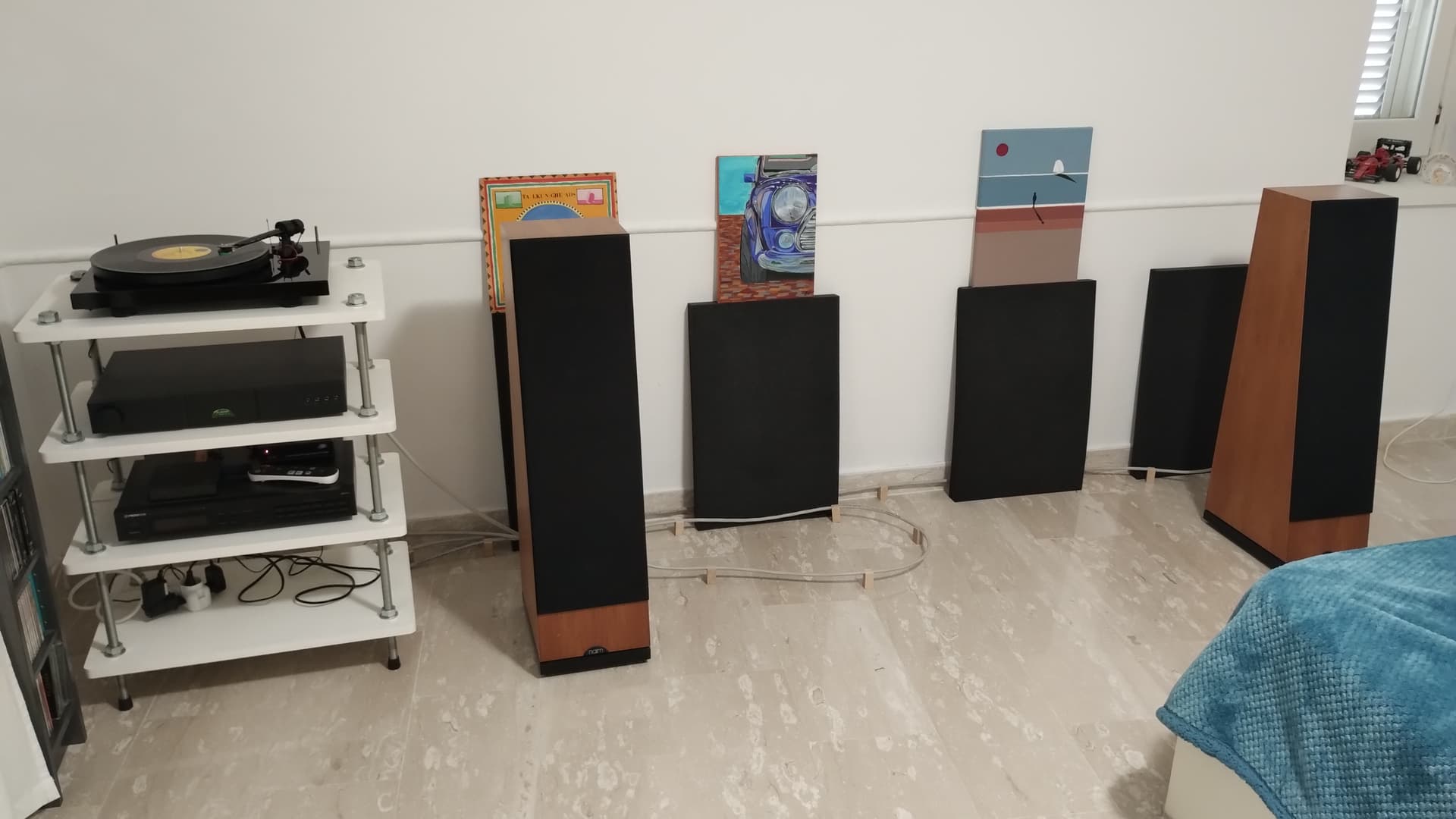
So I should remove my polystyrene panels and egg boxes then? 
1 Like
I just tried this track and she sounds beautiful 
True but the building codes in most countries stipulate that if you have fully sealed doors and windows that you must have active air exchange system installed and they sadly make some noise. The concern being asphyxiation in a nearly airtight room.
I had to have two installed for the volume of room to pass inspection. Though I’m naughty and only run one of them.
They are not sealed up …would never go that far but ,making sure fit and finish is optimal with good tolerances . Have you seen some of the window fitting ,joinery work that exists out there .
If well designed they can be so quiet as to be imperceptible on normal backround flow, only audible (and then only just) in the dead of night. But it requires large diameter smooth bore ducting for low air speed and aorflow noise, with attenuators between rooms and between fan unit and rooms. Unfortunately it is uncommon for commercial system installers ti give a thought to noise. (I’ve now installed MVHR systems in 4 houses, all with multiple attenuators, so I know it is possible and works well.)
Re your diy art approach @ Innocent_Bystander….
I sourced my own Camira Lucia fabric from EQ Acoustics at a very good price.
It’s not cheap stuff but has a premium, close weave finish that should take a DIY art solution.
If you contact Camira directly they will send you some small samples which you could use to trial your artwork…..of course finding a solution that not only takes your art medium but doesn’t clog up the pores of the acoustically transparent material is another rabbit hole of research to disappear down!
There’s no question sensibly implemented room treatment can have a significant impact on sound, the challenge for most is integrating it into a communal family living space as few wives wish to live in a recording studio!
I’ve also heard rooms where absorbtion is taken too far and the system lacks life because everything is so heavily damped.
It is however something I do want to investigate next. Over the past few months though I have been implementing Townshend Seismic products and they make a massive difference to detail and articulation, so one can approach optimising a system through several angles. The Townshend supports are very easy on the eye - in fact they make my ATC SCM40’s look better as well as sound better. The Gyro has never sounded as good as it does now on a Seismic platform with the entire rack suspended and floating on Townshend Seismic bars - it made a massive difference, it really did… Naim themselves fit their rear sockets deliberately loosely because they acknowledge the effect of decoupling from vibration, so it makes perfect sense that the system sounds much better fully decoupled from ground vibration.
I think a couple of well chosen GIK panels are in my future though, but domestic harmony is important too.
JonathanG
2 Likes
By art I didn’t mean anything I’d paint (no chance!), rather I meant printed with images of my choice - photographs and/or royalty free copies of paintings. (As GIK offer as an option for their supplied panels.)
This single male wouldn’t want to live in one either. A recording studio is not a relaxing place, it is a place of work. I listen to music for pleasure, and doing so in nice surroundings contributes to the enjoyment. Some here are happy to go with the studio look, and good for them if that is what they want.
To me, most room treatment looks horrendous. And whilst some treatments look pretty good, they wouldn’t fit in with my decor, so I won’t go down that route. Also, I think with soft furnishings you can improve a room a lot. Could my system sound better with acoustic treatment, probably? Do I feel that the system is lacking something? Not really, sure it could be better, but I don’t have the ready cash or inclination to take my system up the next step.
7 Likes
The dedicated listening room is a horror…music is to be shared, a communal joy - not a cloistered lockaway.
Yes, I’ve had a few whiskies…but…it’s still true.
Mancave…pah!
6 Likes
Only possible when you have the opportunity to get together with friends having similar musical tastes. For some of us such opportunities are rare - but that is fine, as music can be equally well appreciated completely on one’s own: it is absolutely not necessary to share/enjoy with others!
As for appearance and “studio look”, absorbers can be well disguised, some appearing as works pf art, others blended into decor so they look like part of the room itself - the fact that people with treated rooms seem often not to bother doing that is purely their choice, just as many choose to have stacks of black boxes etc on display creating an industrial or studio-like appearance. If a purely lounge-like appearance is the goal, even speakers could be positioned behind curtains so that the only things on show are items of common lounge furniture like armchairs, bookcases and other cupboards, occasional tables, and family pictures or works of art.
2 Likes
I think there are few people here who have made it clear that they don’t want any room treatments in the living space, wives or singles. There isn’t any doubt that room treatments will have a huge impact to any hifi system, and I have had a dedicated room fully treated except for the ceiling, solely for the hifi/home theatre in my old house many years ago. My system(s) today are in the living room and room treatments are not an option anymore. As harsh as it may sound, I’d pick costly cables to room treatments any day.
A system can sound good with proper placement of speakers and careful arrangement of furniture in the living space, and the use of thick carpet, curtains etc.
If I have the privilege of having a dedicated room for the hifi in the future, I may reconsider room treatments but these days I prefer the hifi to be placed in the living room than a dedicated room. I don’t like the feeling of listening to the hifi in an enclosed room, just looking at the system in front of me and surrounded by walls all by myself. In a living room, the feel is different. To each his own I guess.
This is true. Which is where a new build (if the opportunity presents - or a renovation) provides the chance for a dedicated constructed room from a major vendor like Daiken or Yamaha. When the treatment is baked into the room, it’s truly invisible. Then you can do what you likee in the room, including change layout if you like, because it looks just like a normal room.
Some of these room treatments are pretty ugly imo. They are either dedicated man caves or the posters have very understanding wives! My philosophy would be to spend the money finding speakers sympathetic to the room rather than treat the room to suit the speakers.
4 Likes
[quote=“JonathanG, post:107, topic:40192”]
the entire rack suspended and floating on Townshend Seismic bars
hi jonathan
is your entire equipment rack sitting on seismic bars - townsend site seems to suggest they are just for speakers?
Hi All,
Many thanks to @JonP for starting this thread. I can see many views expressed, and the negative aspects seem to be regarding the visual impact of adding treatment as well as the cost and perhaps effort/ disruption.
Well, I too had the same view, at the start (2019) I was adamant that I DID NOT WANT TO SEE acoustic treatment in the room.
Luckily there is a zero financial cost way (not time cost unfortunately) of exploring the art of the possible.
Let me reinforce the points made many times already by others, sure select the right loudspeakers and put them in the best place in the room and you have sufficiently good sound?
Well, for the avoidance of doubt, when you have heard what a correctly treated room can do for any HiFi you have already purchased, you will not want to go back to the ‘old sound’ (I.e. pre treatment).
You may wish for the old visual appearance, but you for sure won’t want to ‘hear’ the old room again!
In my own circumstance I had a room with very poor dimensions for music playback (refer to my AMROC post no 53 above). I had tried to solve some problems with basic thin panels. It needed decorating and looked like this (apologies for trial equipment in foreground- that was temporary)….
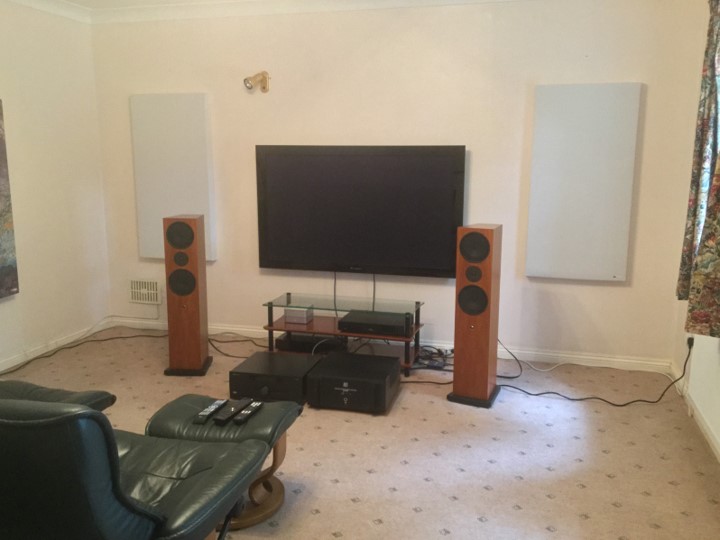
Then I started to contact various companies who could do room design for music playback. I and others have given examples elsewhere on this thread. Some wanted to charge a lot of money for consultation. Others not. Some provided a design tool accessible through the web. I used one such example. Here is the starting point of the above room, entered in the design tool……..
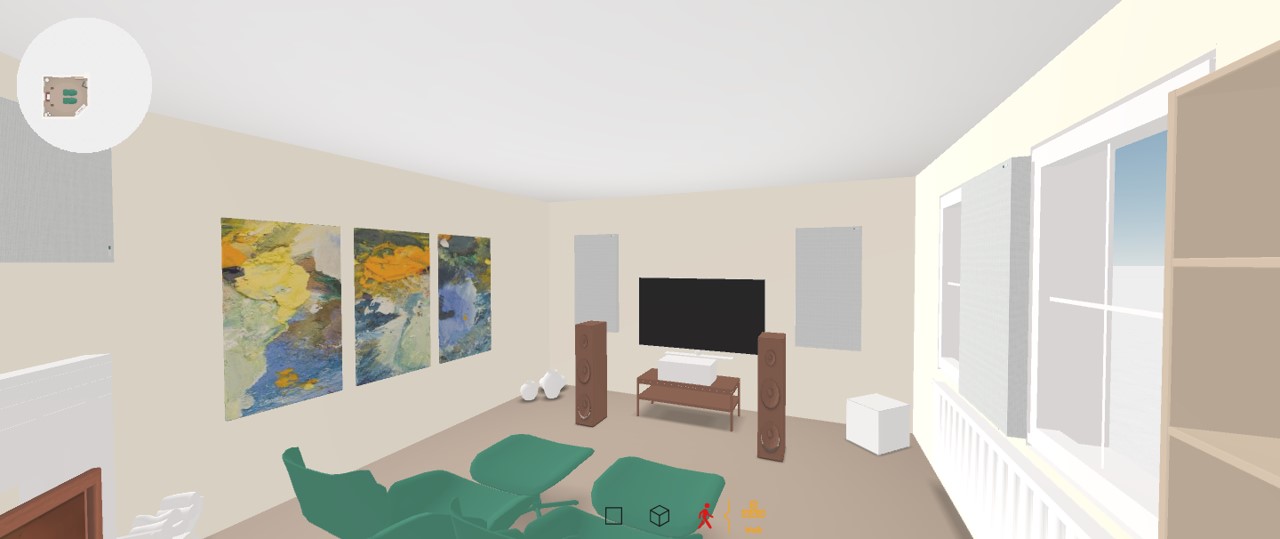
The benefit of putting the work in yourself via such a tool is that you can do ‘what if’ exploration for the VISUAL impact, without buying anything!
Here is a sequence where I am comparing Tri Traps in the corners with some Diffusion and contrasting with Soffitt Traps and 15cm Monster Base Traps……
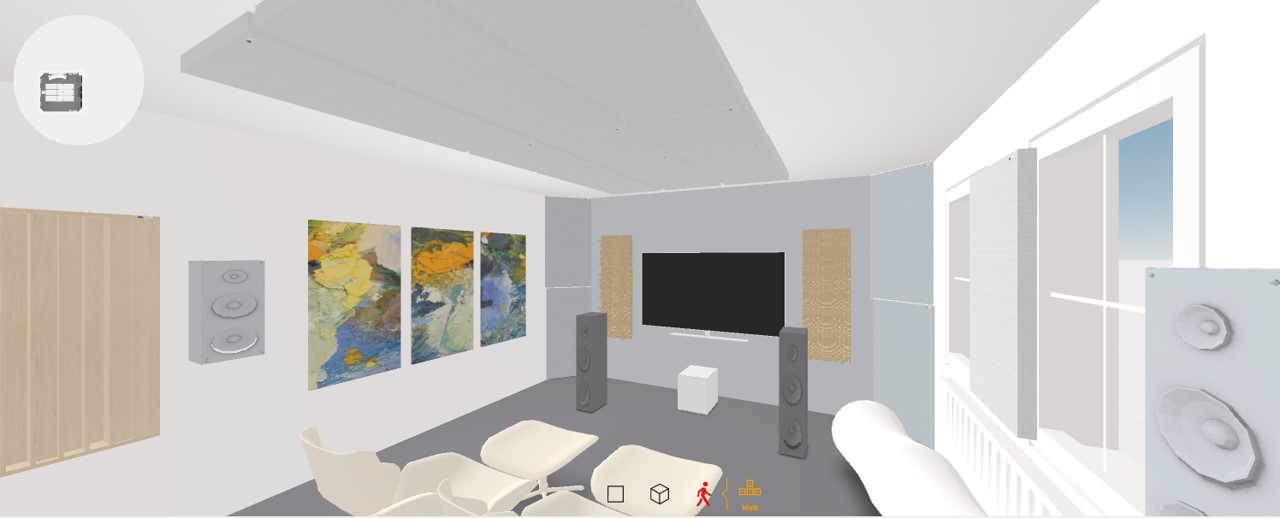
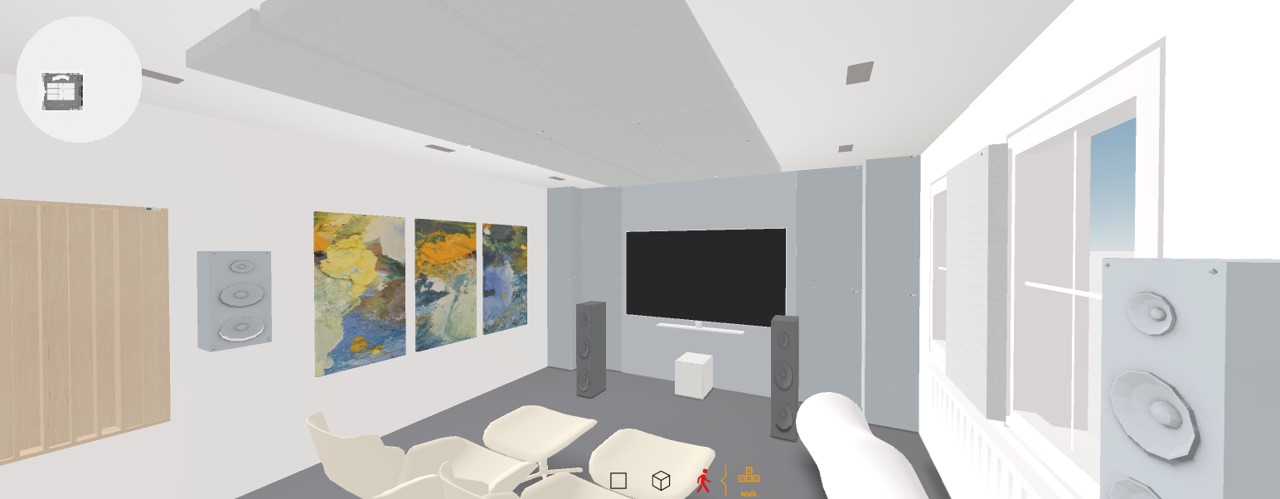
Here is a sequence where I explored adding some 15cm Monster Bass traps on the front wall either side of the TV, and cover the TV with sliding moving art panels for the transition between movie watching and music only modes of the room…….
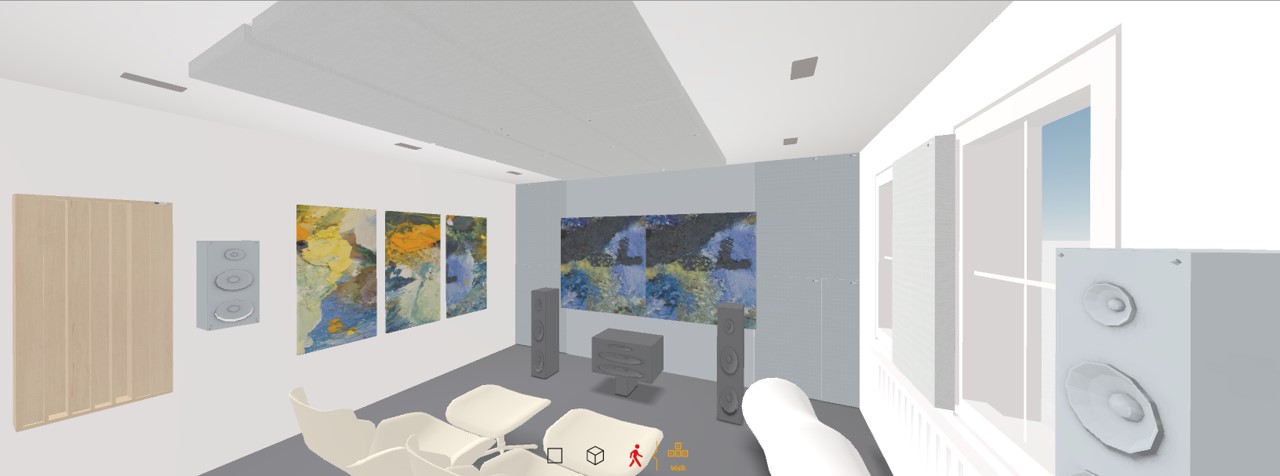
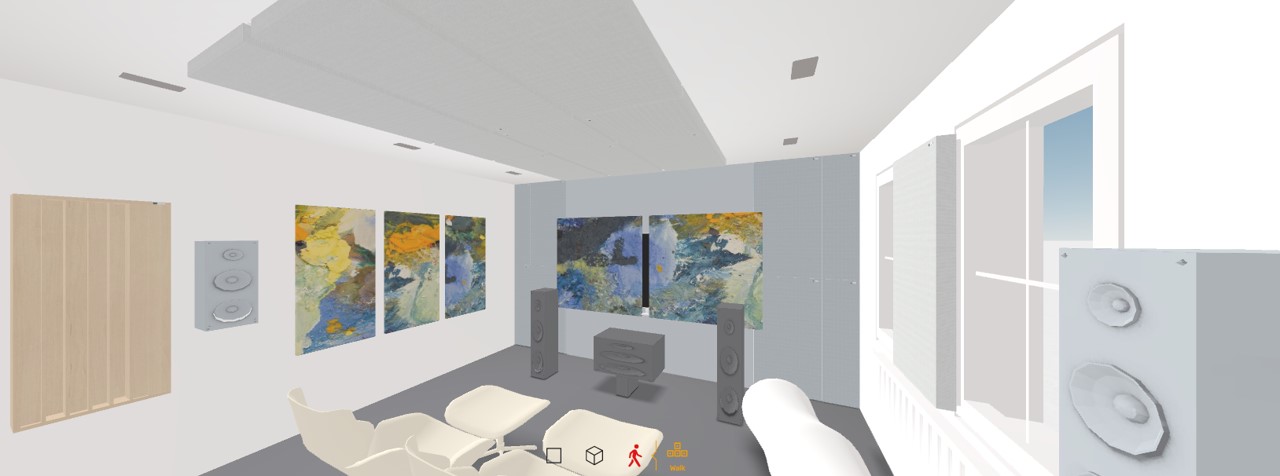
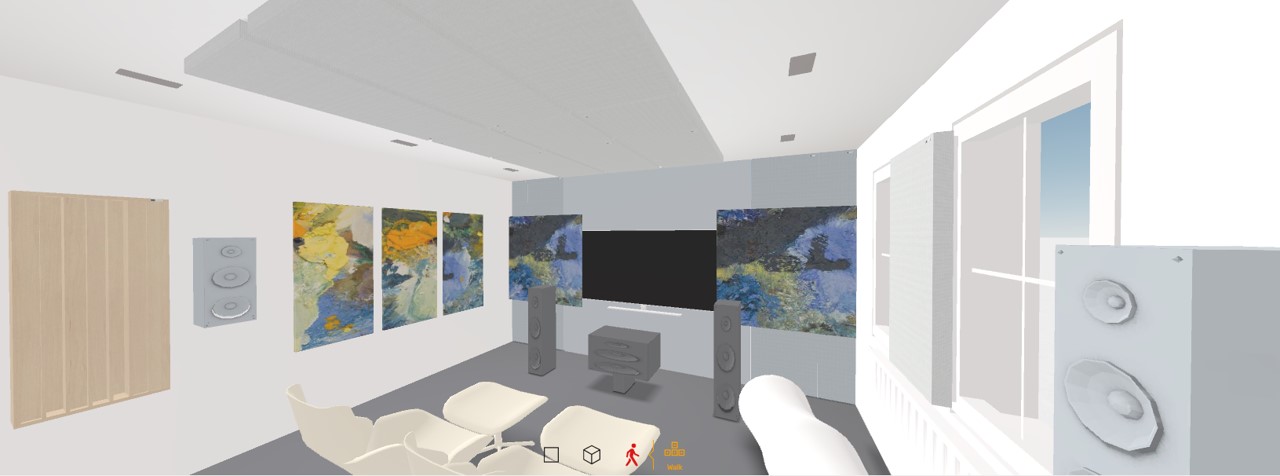
The above sliding panel solution to cover the TV was what I decided to proceed with. Here is the front view in the simulation.
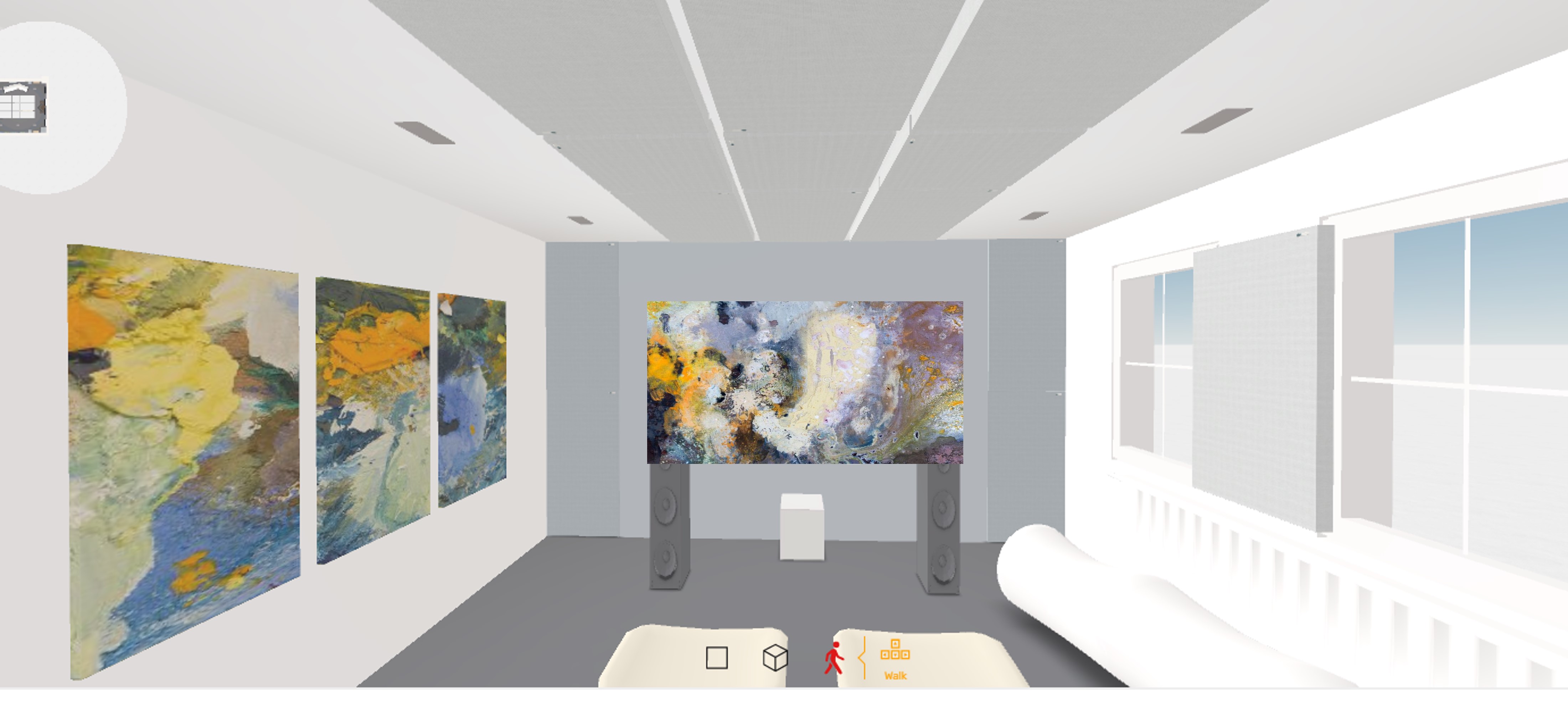
I bought the panels and fitted most myself.
Something happened though…… finally, when I wanted to upgrade the TV, moving art panel concept did not quite have sufficient space left and right to clear this new and bigger TV.
I had to amend the concept….. went into the visualisation design tool again (2 or 3 years later) and amended the concept this time to have Soffit traps rather than 15cm thick Monster Traps in the corners (more visible, but better acoustics), and a moving/ retractable TV mount, again better acoustic, covers with art panels that need to be manually removed.
This is it in progress in the 3D view of the design tool……

Any questions, just ask.
E of E
PS: All designs above are my own. The design tool is Roomle. There are quite a few other design tools. The one I used was facilitated via the acoustic treatment company I used.
7 Likes
I can think of a few scenarios when room treatment can make perfect sense, particularly if you live in a very modern, minimalist setting, with no carpets, have timber or steel furniture, lots of windows with no curtains / drapes etc. which can lead to sounding horrendous.
However, adding “room treatment” to those kind of settings can ruin the aesthetic of the room; a minimalist room with bass traps / absorbent panels and surfaces etc. possibly doesn’t exactly suit a minimalist look.
I guess it’s all about balancing things - the “perfect” sound Vs. the look and your comfort.
I suspect most people don’t post their room treatment on here as they’re happy with their own compromise.
Or feel (like me) that they don’t need to do anything.
‘Beauty is in the eye of the beholder’
1 Like
I would love a dedicated music room and if I had one then after carefully selecting the right speakers I would look at possible room treatments and accept the ‘look’ that they imposed if necessary. My problem is twofold. I don’t have the space or budget for an additional dedicated room ( and am a little envious of those that do), but more importantly it would be a waste of time as Mrs Bruss would still insist in bursting in with hoover in hand just as Tosca prepares to throw herself over the parapet. Meanwhile care in mitigating the furniture placement in the usual rooms suffices for me.
3 Likes