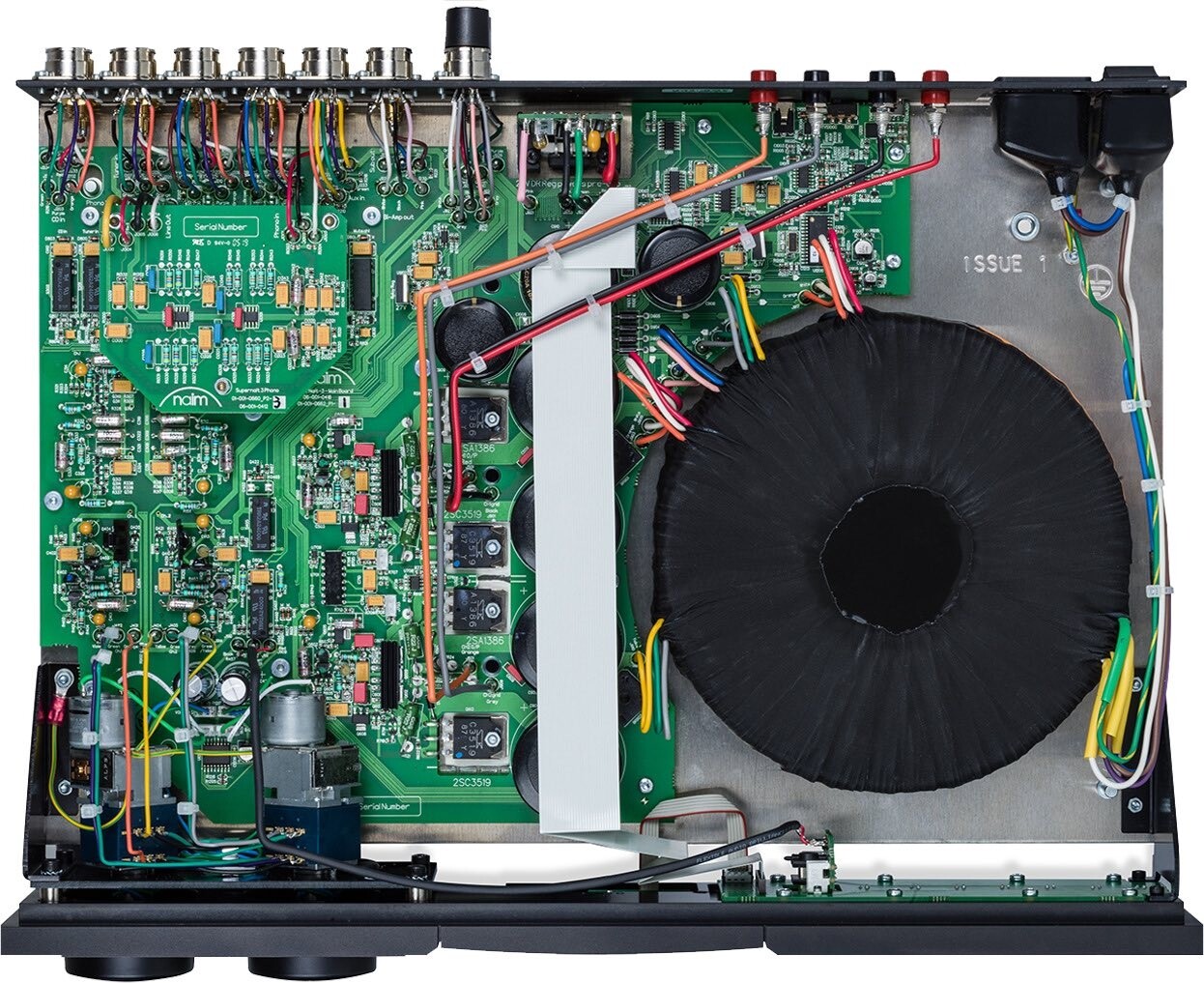
This is a question that pops up every now and then. If If (electric) isolation is so important in HIFI audio, and much time, effort and money can be spent it why, then, this entanglement on the inside of many devices? The wires are even tie wrapped together (see example). The effect of this wrapping together is obviously negligible.
1 Like
Naim have apparently been known to obsess over minute details of internal layout, even down to the position of a single cable tie holding a wire or two in place, so wouldn’t assume that the “entanglement” you see is just random.
5 Likes
I believe there are cases where certain cables are better tied together to cancel each other out.
I’d have thought the transformer would be screened off in some way as seen on many streamers, maybe not needed with this one?
Hi ChrisSU, yes, that is also my assumption, that is to say, I wouldn’t assume that the “entanglement” is just random. It is just that this bundling seems contrary to the efforts to have no electrical interference in/on/between/over elctrical connections. Especially when those connections carry fragile electrical signals.
What you have shown is a a Supernait integrated amp, which is in many respects a “worst case” example. Having so much in one box is always going to be something of a compromise over having it in a number of similar sized separate boxes. Of course, you could just make the one box a lot larger…
A lot of time and effort is spent during a product’s development in getting the details right with regard to the wiring, and even down to the position and number of any cable ties. It has been known for Naim to spend many weeks over just this, and even in the case of the NAC552, to spend longer, eventually removing a cable tie that tidied all the cabling up close to the Burndy socket, as it sounded best without it. Once the cabling is nailed down, wiring copies are made, which show exactly how that unit should be wired. That means that every unit made by Naim of that model should look identical inside, with cable bends in exactly the same places, and also cable ties in the same places. That (amongst other things that Naim do in the process) helps to achieve consistency, which has long been one of the biggest problems in audio at a certain level.
18 Likes
Toroid type transformers are a lot better in terms of EMI emissions than a traditional square frame transformer, so don’t need the same degree of screening.
3 Likes
Please clarify what in that picture you consider to be entangled? I don’t see any that are tangled, rather most wires are routed direct, or as direct as might be practicable having regard for necessary flexibility for assembly, while some follow straight lines that change direction at some point, possibly at some part to follow a path of minimum interference likelihood. As for cable ties, I assume that is to assist in the bundles being self-supporting and remaining along the intended path.
It is a very full case, which of course means that there is not much spare space which is likely to limit wire routing options: depending on type and model some are fuller/emptier than others (and interestingly relatively empty cases sometimes garner negative comments along the lines of “why am I paying for an empty box?”).
1 Like
Yesno.
The flux is confined to the core of a toroid under normal operating conditions so shielding isn’t required, nor distance from other components. An EI core requires distance, shielding, or both. On the other hand, a toroidal transformer behaves much worse than an EI core if the conditions are not optimal. If the core saturates (which tends to reveal itself by humming noticeably) then the flux is not confined to the core and now you have a badly behaving transformer with no shielding close to sensitive components. An EI core is pretty constant with both good and bad conditions.
There is no magic solution here. Which is why some high end manufacturers still prefer EI core and others choose to shield toroids anyway.
IIRC, the early Naim power amps used twin EI cores before they moved to toroids.
WRT cables, I believe even that example of a SuperNait is very tidy. Earth is gathered together. Speaker outputs for left and right are consistently separated by the same distance all the way to the output with hot and signal grounds bound together. Leaving only the output windings from the transformer to the rectifiers which all look fine to me.
I honestly don’t see what the issue is. It looks properly done for the space constraints.
1 Like
Made me laugh.
A SUPERSIZED Supernait 
Hello Innocent_Bystander,
Good question! Perhaps even better: ‘why have you used the word ‘entangled’’? Because from your response I gather I have used the wrong term. So thank you for bringing that light. The point I was trying to make is that by placing electrical/copper wires carrying signals close together (no matter how carefully, and Naim certainly does that very carefully), they surely begin to influence each other electromagnetically— in other words crosstalk or electromagnetic coupling may occur. And my curiosity lies in trying to understand when that is, and when that isn’t a problem with sound quality. Richard Dane gives a good example about the commendable lenghts Naim go through to get it right. (@Richard, the SuperNait3 was to a certain extent a random example on my part, could have used other examples)
1 Like
It turned out to be a good example to use as an Integrated amp presents so many potential problems having the sensitive pre-amp circuitry right next to the power amp and power supply. While you could use shielding, Naim have generally tried to avoid this (except in a few cases where it was unavoidable - somewhat ironically in the original Supernait) as it can come with a SQ penalty.
As for the risk of electromagnetic coupling and crosstalk, that’s probably something best commented on by someone like Steve @110dB
3 Likes
@LammertvanRaan you have tagged me into this thread instead of @Richard.Dane
apologies.
Would that be a Naitment or Snaitment?
1 Like
Hi @LammertvanRaan , all and @Richard.Dane
There are some insightful observations mentioned here.
Naim uses a variety of methods to connect signals and power. The SuperNait shown at the top is a good example of many of these. Using a PCB for connection is easy, cost-effective, and repeatable; ideal for short distances and lower currents. It’s mandatory for high-speed digital, but not ideal for speaker signals. Wires can offer sound quality improvements over and above using a PCB only. They do so by moving high currents and their magnetic fields away from sensitive circuits and offering mechanical decoupling. A wire can carry significantly more current than PCB traces. PCB-mounted solid copper buzz bars can be used where the magnetic fields can be managed.
Here are a few examples of how and why Naim uses wires and zip-ties:
Mains wires to transformers
These are zip-tied together. They carry high voltage, and the zip-tie secures the double-insulated live and neutral wires together. In the unlikely event that one wire were to come loose from the floating IEC socket, the zip-tie helps prevent it from contacting the earthed chassis.
Secondly, mains wires carry high current due to peak rectification and supply all the power for the amplifier. Holding the live and neutral together minimises the loop area of the current path, which in turn reduces their electromagnetic field.
The wires from the transformer are intentionally kept longer than they need to be and are curved. This helps reduce magnetostriction-induced vibration from the transformer core exciting the PCB. The wires are also squeezed together within their respective windings to minimise loop area.
Input wires
These are not zip-tied. They carry near-zero current and do not radiate. Using wires instead of PCB-mounted sockets allows the DIN socket contacts to float within their shell. Sound pressure in the room vibrates the amplifier chassis, and allowing some compliance helps decouple this.
They could be zip-tied, but we find that doing so reduces the compliance of the decoupling. Ground and signal wires are kept close together to minimise the pick-up loop area.
Speaker wires
Speaker outputs carry high currents, and each current pulse, whether positive or negative, causes the two wires to repel each other. We find that maintaining tight coupling and a small loop area improves sound quality.
The zip-tie also holds the speaker wire in 3D space, exactly where the engineer wants it. Wires perform better than PCB traces here, helping keep speaker currents and their associated magnetic fields away from other sensitive signals. These electromagnetic effects can be a dominant source of distortion.
Volume control
Potentiometers are microphonic. They consist of a moving copper wiper on a circular carbon track. Any movement of the wiper — whether from deliberate adjustment or vibration — causes a change in amplitude (volume).
Using a PCB to connect to the potentiometer would act like a diaphragm to the carbon tracks. Wires help minimise and decouple these vibrations. Some wires are kept apart to reduce capacitive crosstalk between left and right channels. There’s also input-to-output crosstalk to consider; high frequencies can bleed across the potentiometer and become detectable at low volume.
31 Likes
Oh man, I love the attention for detail. I had no idea about the thought that goes into designing every aspect of these units. Even up to the zip-ties and their location  Lovely!
4 Likes
Hello @110dB , thank you. Once again I’m so happy to have chosen Naim all those years ago. What an excellent explanation of the the points we discussed. At every point you try to minimize unwanted/negative effects of crosstalk and/or electromagnetic interference. And you do that with great care and insight. And take the time to explain. Kind regrads, Lammert
5 Likes
I see no entanglement. Neither does Heimdall.
One thing that struck me with the Supernait picture, there is a hell of allot to disconnect from that board to make it accessible to service then reassemble, must take quite a time .
2 Likes