I’ve looked - they are small G4 bulbs so the LED replacements are a bit of tight squeeze. Got a few ideas to try. Agree about the grid efficiency as with the changes in energy usage, more micro generation schemes and less of the traditional base load stations provide stability into the grid, it needs to get smarter.
LEDs seem to be getting better, and smaller, all the time. We are using a lot of Osram classic bulbs that look just like traditional bulbs, but use only 6W instead of 60. The light quality is lovely too.
1 Like
Nearly all our lights are now LED. Their efficiency is great, but if anything I find it hard to find any that aren’t too bright. The opposite of those dreadful CFL things, which were always much less bright than they claimed.
I did reject some LEDs for being very electrically noisy, but perhaps I’m just paranoid.
1 Like
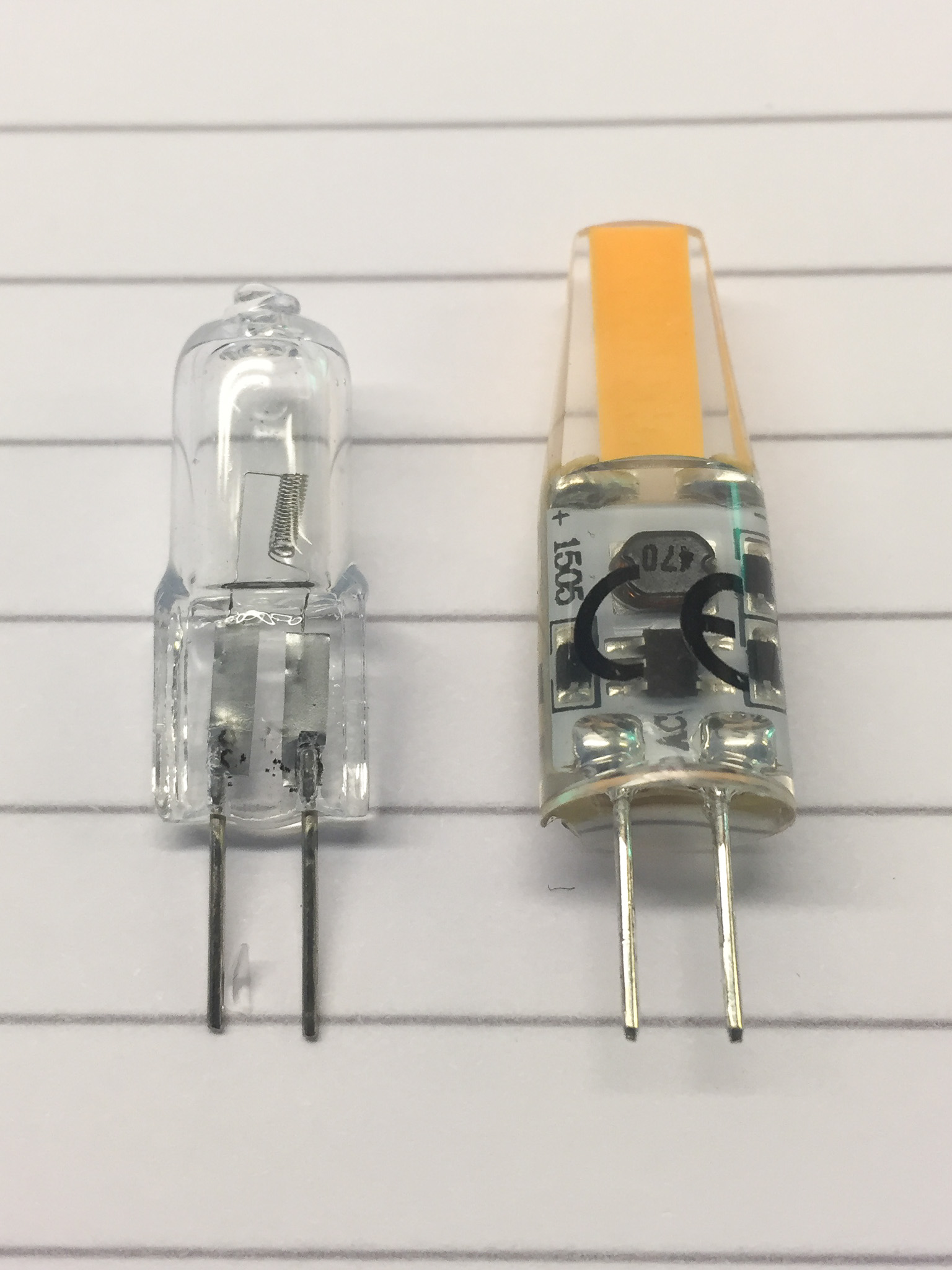
Funnily enough i looked at the LED bulbs in Sainsburys this morning. They have these G4 LED replacements at £2.19 each so i bought a couple to try. They are slightly longer than the Halogen equivalent but have a tapered section where the LED segment is located and fit perfectly.
After a few weeks of working well and after a very cold night at the end of November, we stopped getting readings on the IHD. No signal at all was coming from the electric meter. After trying various things, I called EON, got a chap on the phone who got me to try the obvious then told me the DCC were issuing software updates and connectivity would come back. I was a bit doubtful as the comms module on top of the electric meter (A Toshiba SKU1) was not showing any sign of life - when it was working ok, all 5 LED lights would flash every few seconds but now there is no activity showing at all. Left it a few weeks with no change and rung again this evening. This time i got someone a bit sharper who seemed to understand the problem. checked to see if readings were actually being received, they weren’t (not surprisingly) and took notes about the fact that the meters themselves were working, but no signals were being received at the IHD or indeed out to the DCC. Hopefully now they will put 2+2 together, realise the comms module is actually faulty and just come out and replace it…
Not very encouraging for the customer that despite they had not received the readings they did not react, and you are doing all the leg work! Hope it gets sorted.
Yes, but that isn’t a positive effect of Smart Meter installation per se. If your wiring connections haven’t been checked for donkeys years get a sparky to check and reconnect them, doesnt require a SM installation to do that.

Have a browse through this folks. Plenty to freak you out and get paranoid about!
https://stopsmartmeters.org.uk/

Why are they simply not pushing Economy 7 type tariffs and being transparent about when the times change for the different tariffs?
When I looked some time ago the cheaper tariff time period was never clearly specified.
I think a key point is that no-one knows what the quiet times are on any particular day, the smart meter system allows them to vary the times to respond to real-time change in demand.
Once the home energy control systems take off, the home controller will be able to respond to lower tariffs and turn things on and off according to the rules you set.
Best
David
2 Likes
I may be wrong, but I suspect there’s a limit to the number of devices/appliances we would want to come on at defined times for energy savings.
Dishwashers, tumble dryers, washing machines are perhaps obvious candidates, however I suspect the vast majority of machines currently out there would not be capable of starting up automatically perhaps overnight during periods of lower usage - so yet more expense to replace existing appliances with smart appliances in the short term.
If we assume the tide of Smart devices and appliances continues unabated, then we’ll undoubtedly see ‘connected versions’ of those above that could be controlled remotely, by a central control system or even by low power circuits inside them monitoring for a change in tariff. Why not have those ‘connected devices’ monitor electricity cost continually updated by the supplier and decide themselves when to turn on without the electricity company knowing?
Most other appliances need to be always on - say fridge/freezer, cordless phones for example, or are only in a significant comsumption state when you actually need them to be.
If I want a cup of tea, food, electric heating (storage heaters aside perhaps), lighting, a clothes iron, lawnmower/strimmer/hedge cutter etc which may use large amounts of power I am highly likely to use them when I need them and would not wait for a cheaper tariff.
If we all suddenly have smart tumble dryers or other high consumption devices that switch on at 2am when electricity is cheaper, then I’d have to wonder if energy usage might not become fairly similar throughout the day and the energy companies would then I assume determine there’s no ‘low use cheaper’ period and simply charge the higher tariff around the clock.
Pardon my cynicism but I don’t think any of this is being done for the benefit of consumers.
2 Likes
Do you still see a meter reading with these devices or do we have to trust the smart device ?
I’ve often wondered how we know conventional meters are still accurate if they’ve not been changed for decades, but there is something reassuring about a number updating due to an analogue display mechanism.
This could be quite hard to do if you get down to the question of demand in your street.
The smart meter infrastructure will do this and your controller just reads it from the meter through the read-only “consumer access device”.
I couldn’t give a toss about someone in the data centre knowing what my energy demand is from moment to moment and I don’t understand why it would bother you? Paranoia on the one hand versus complacency on the other maybe. But I’ll take complacency personally.
Best
David
The main concern I have is one of privacy in the event that the monitoring network and/or meters were compromised - patterns of usage could be monitored by criminal gangs to determine if you’re likely to be away from home for example to plan burglary - chances are I’m not a high profile individual of any interest to big gangs but as we’ve seen with many aspects of the internet if there was a compromise the groups doing so could I suspect quite easily offer such information for a small fee to smaller criminal outfits.
I accept probably paranoia, but criminals do their best to use technology to hoodwink, scam or target us maliciously.
I understand re burglars etc but I also know (as I’m involved professionally in the programme) how much effort went into the security of the system. That’s the main reason the SMETS2 programme is so delayed. I don’t think you need to worry. I’m not worrying myself.
I think spotting whether both cars are in our drive and whether either has moved recently is probably a better guide to whether we are at home, especially as I tend to leave the heating on whether we are there or not (although a couple of degrees or so cooler if we are away for more than a day or two.)
Best
David
1 Like
A question that just occurred to me is given so many suppliers in the market these days is whether tariffs will be based nationwide or locally - for example if suppliers base their real time tariff on energy they are selling, could we be in a position where price comparison becomes very difficult?
If a supplier has 90% of the customers in an area then their ‘supply’ would likely be around 90% - so might their tariffs be higher than other suppliers with 1-2% who would see comparatively less regional use?
Not sure if that makes sense.
I think no, because it’s not actually about the cost of energy principally, it’s about the cost of distribution (ie what the local energy network can carry). You can get an insight into this if you look at Bulb’s smart electricity tariffs, to mention a company I know a bit about as I am a customer. If you can find the right page on their website then you can see the difference between peak and off-peak tariffs. In the South East, it’s a very large difference. Whereas in the North or even London, it’s a much smaller difference. Or to put it another way the cost of distributing (electricity in particular) to me here at peak time is about two or three times higher than delivering to a London customer at the same time.
Best
David
1 Like
Not sure if this link is allowed but shows what you suggest:
Looks as though the newer meters they are installing are not currently compatible with this beta.
I suppose the next question would be whether or not the supply costs are consistent for each supplier - you would hope so and then it’s down to the suppliers to compete, however as different companies may use more or fewer renewables it probably isn’t the case, and a cheap region to supply might become expensive if perhaps a regional power station closed meaning a new supply route.
All very complex!
Perhaps we should re-nationalise!
The meters they are installing are compatible actually. But some people joining them may already have SMETS1 meters that aren’t compatible, although that situation is quickly resolving as more types of SMETS1 meters get enrolled to the data system.
The delivery costs are the same for each supplier as they are buying them from the DNO, but how they package them in a smart tariff may be different. That’s called competition!
Best
David
The smart meters have digital displays, but how do we know if they are a really acccurate display of the fuel used…