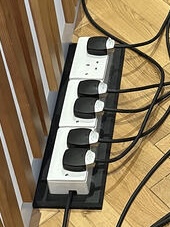
Sure, I’ll try to explain the best I can but just remember these things can be quite subtle! Firstly, my experience with the Wireworld Matrix is similar, in many respects, to Darkebear when he had his. Even down to the plug order he recommended. I still say (despite some of the comments on build quality) that it’s one of the best sockets I’ve tried so far.
With regard to the Chord products, I’ve always found their ‘Array’ stuff to be a little bit questionable on Naim kit. Both the S6 and M6 seemed to demonstrate this effect when I listened to them. I actually thought the S6 sounded marginally better than the M6. With the M6 I found that it definitely calmed the sound down. At first I thought you could hear more, like it had reduced the ‘noise’ but after a while I found it less nuanced than the Wireworld and lacking the little dynamic pushes that make you want to tap your feet. By contrast the Wireworld/Powerline combo gave guitar strings a real edge that made you want to pick up the ‘air’ guitar!
When I finally returned the Chord trailing leads to my dealer he also mentioned that it could be a bit of a love/hate relationship and that many Linn product owners loved what they did, whilst some Naim owners were the opposite. As always, these things are often about balancing the system out. What works for one person doesn’t necessarily work for another, so I fully get why we don’t always agree. If you ever have the chance to listen to a Wireworld Matrix 2 with a Powerline I’d be interested to hear what you think?
If ever anything went wrong (God forbid) I think I’d rather be explaining to my insurance company that the problem was with a commercially purchased plug socket than something I’d made myself - even if I was a qualified electrician!
I am qualified and the components used are all manufactured to regulations
And industry standard.
Much safer than any of these cobble together devices that are aimed at unknowing punters.
Naim use exactly the same materials as me on their “ home made “ blocks I wonder why they did that.
Thanks for taking the time to explain. I think you’re probably right in that these things are system and listener dependant. It’s curious that you prefer the Wireworld block in that there doesn’t appear to be anything very special about it on the face of it. But then the Musicworks blocks don’t appear to be anything special either. The high price of those is due it seems largely to the extensive use of Peek plastic in the construction which is a very expensive engineering grade plastic. But then superficial appearances don’t necessarily correlate with performance and this is what makes the whole mains block thing fascinating to me.
I’m tempted to start experimenting but TBH I don’t feel like going down a rabbit hole from which I may not emerge for a good many months! Too much else to concentrate on.
@Skeptikal …. I’m tempted to agree with you with the Wireworld block re a visual assessment of quality. (Twist Nuts etc)
But my negative is mostly with SQ. I had one when I lived in USA and bought it back to UK and improved the SQ from my then Audiolab system significantly when I replaced it with my own DIY strip.
Re the twist nuts … I’ve repaired a friends UK 13A verion in the past when one of the twist-on wire connectors came loose.
But that asside I’ve looked into the build stardards and what they do or do not comply with.
Wireworld is a USA owned company and HQ is in Florida, various mnftrg locations.
The Matrix-2 block does not follow a singular “manufacturing standard” like an ISO number in its public specifications. But it is component engineered with the following …..
All the outlet components used are specific to regional standards … USA NEMA 5-15, UK 13A, EU Schuko and the inlet plug/socket is IEC320
Internal wiring is 13AWG (2.6mm/2) solid copper (OFC).
Circuit configuration is radial wired (they call it “Star-Wired”) meaning each outlet is directly connected to the inlet power source to reduce interference between components.
The contentious twist-on wire connectors do comply with several electrical standards provided they are properly rated and installed.
USA under standard UL 486C & UL 94V-2.
IEC (International): comply with IEC 60998.
BS 7671 (UK): BS EN 60998 and are acceptable under BS 7671, provided they are installed in an accessible enclosure.
.
It’s my understanding that any electrical device sold in the UK must by law comply with all relevant electrical standards and must be CE marked. Any that are not (and I’m not syaing that there aren’t any - I’m sure there are, though not necessarily hi-fi related) are by definition unsafe and illegal.
@Geko raises an interesting point re insurance claims. This is something that has somewhat troubled me in the past when I’ve made my own blocks. I’m 100% sure that my blocks were safe or else I would never have used them. As I’m sure that both @Skeptikal ‘s and yours are. Safety isn’t the issue. It’s the question of making a device that’s non-standard. And I’m talking here from the likely perspective of an insurance company. Even given that all the components are certified legal and appropriate doesn’t help. You have made something that is not what these sockets are really intended for and which has not undergone any appropriate testing or certifications from the appropriate bodies. Once again I’m looking at what an insurance company is likely to say in the event of a claim over an electrical fire or such like. They will be unfamiliar with home made mains blocks as I’m sure anyone outside of hi-fi circles is. We accept it as the norm, but how many non hi-fi types would ever make something like this? This is how an insurance company would likely view it.
I’m not saying it’s a reason not to do it, and I would still be happy to make one and use it if I needed to, but it’s perhaps a consideration and something to be aware of.
That’s correct, but CE marking is only a manufacturers self certification system whereby they confirm the product is mnft to whatever list of standards apply to the product.
The IEC and BS standards however test to establish the criteria and set the finite details of all aspects of actual safety range and limits.
Some of us saw Naim’s ‘DIY’ block on Thursday at the factory visit and photos have already reached this forum. It is interesting that Naim don’t offer a block of their own design and manufacture for sale, as they do with Power-Lines. One imagines that it would be easy money for them as, if it were built to Naim’s standards, worked well and carried their imprimatur then folk would rush to buy it, rather than all this anxiety about which one to buy, or make. I guess the reason they steer clear is that they recommend a dedicated mains feed. But not all of can have that without major upheaval. I wish I had asked about this when I could have on Thursday.
Not necessarily easy money for them and not so simple to design and market such a thing commercially. As it stands I strongly suspect that this ‘home made’ design wouldn’t pass the relevant electrical safety standards. Not because it isn’t safe , but becuase the standards are very involved and demanding about what will pass muster and what will not. Same with any home made block. Done competently they are an excellent way to go and completely safe but they would be very unlikely to meet the standards required to sell commercially.
Anyone can put a CE sticker on their products all it means is that “I the manufacturer believe it complies with the rules and regulations of the intended country of use.”
I could put a CE sticker on mine.
People see it and think it carries weight.
That’s why the market is flooded with dodgy phone chargers and exploding iffy lithium batteries everyone sees the CE sticker and think it’s a bargain.
They are being used exactly what they are intended for and indeed uprated from what the standard use is.
My mate is an insurance fire scene investigator so between that and being electrically qualified I’ve no problem sleeping at night.
Others unqualified trusting snake oil salesmen should think hard.
These well surpass all regulations and I wouldn’t do it otherwise.
Some of the crap I’ve seen online I don’t believe but nobody knows until the house warming party.
By the way I can Pat test and done my own this too is bogus box ticking I’ve Pat tested mains leads with the plug like a Brillo pad inside and it passes until it stops working or worse.
I’ve been round the factory quite a few times and I know that Naim have tendency not to verbally or visually recommend any other manufactures products. They try to keep the supporting kit quite bland in the dem room. No fancy ethernet cables, plug sockets or switches. Linn do very much the same and they even went to Ikea rather than demonstrate a Sound Organisation table with an LP12 at shows. I can understand why. The trick is to ask the guys at the factory what they use at home on their own systems. I bet you then get a different story!
Doubt it
The only reason for not promoting is they don’t sell build or distribute said products.
So keep it real to what’s generally domestically consistent.
Yes. But unless it’s backed up by the relevant documentation regarding the required conformaties then it’s illegal. Of course unscrupulous people/companies do break the law so I take your point that CE marking - or for that matter any kind of marking, such as a BS standard, can simply be fake and is no guarantee of anything unless from a known reputable manufacturer.
Not quite. They are intended primarily for wall mounting. I did read in the package insert on an MK socket that I once had that “it must not be used as a trailing socket”. Exactly what that means is of course open to interpretation. I’m not saying that using them in such a confiiguration is in any way unsafe and as I say I would be happy to do it myself. I’m just saying that from the point of view of an insurance company facing a payout it could possibly, though not definitely, be problematic.
It depends on exactly what you mean by that. If you attempted to market your block commercially I suspect you would face problems in getting it past the required standards for doing that and achieving CE marking. What’s safe in terms of folllowing electrical regulations for building a home made mains block doesn’t automatiically translate into it being acceptable and legal as a commercial product. That’s the point I was making in relation to Naim selling their ‘home made’ blocks. But anyway really not an issue as it’s only for your own use.
I think a lot of companies have this approach. From talking to the guys at the Chord Co. they will not recommend or even comment other manufacturer’s products (such as racks or power supplies) . However if you ask them what they use themselves at home then it’s a different story.
Facia only for wall mounting but having an insulated surface mounting back box means they can placed in any orientation that’s required.
I am fully qualified don’t you understand I’m not going to do anything in my house or anyone else’s that fails my very stringent qualified standards.
Some people will argue over anything.