Thanks @simon.pepper
I’m using RooUPnP on a Raspberry Pi for the same functionality as the 'SonoreUPnP Bridge appliance’ into my NDS but I omitted to mention that it would still need a Roon core/server which you have within your unit. Mine is on a NUC but could also be on a PC or Mac or some NAS drives.
Hi, It is the SonicTransporter units that offer Roon Server plus SonoreUPnP bridge in the same box.
I have an UltraRendu, which is just a NAA. Roon Server runs, like you, on an Intel NUC using ROCK.
I have a NUC7i7DNKE, the same board/quad-core CPU used in the Nucleus+ Rev B, but with 16GB RAM and a fast NVMe SSD.
2 Likes
If you’re referring to the image I posted, my apologies, though sometimes it does become difficult to have a meaningful discussion without. Again, you might counter that by saying That the discussion would be superfluous if I just stayed with NAIM products, but here I was trying to extend the life of an undoubtedly superb but discontinued NAIM product. If it wasn’t the photo but the discussion that followed, then my apologies for ‘kind of’ hijacking the OP.
1 Like
No, the image was fine, and discussion of other brands is also fine here. It was the link to the commercial website that was problematic - no unauthorised commercial links are permitted in the audio rooms here.
Pardon me but I can’t seem to spot a link, is it that the image shows up as a link to others, and perhaps myself if I were to log out?
You won’t see it now as I edited it out. It was link to a sales page of a seller of item pictured in your post.
Sometimes you can intend only to copy an image or perhaps some text, which you don’t realise has a link embedded. I’ve been been caught by that on occasion.
3 Likes
Hi Simon
I’m planning to give a Sonore product another try to attempt to replicate your success with the Ultrarendu. Thanks again for your detailed help previously. Because I’m also attempting to implement Lan to Fibre optical “cleaning” I’m looking at the Optical Rendu and in particular the lite version which understand does Roon and DLNA modes only. There’s one available i might try after my ultrarendu attempt wasn’t successful. To your understanding, would this slimmed down version accept Roon or alternatively Tidal/Qobuz streaming apps and deliver its output via UPnP?
My setup is Roon Core on a Lan based NUC with NDS - Ethernet connected. I’m hoping to avoid using the digital input which I’ve found to be at a lower sound quality. Mconnect over UPnP provides better sound quality, but it pauses, especially on Max resolution files often repeatedly.
Hi, It is the SonoreUPnP Bridge application you need on the UltraRendu.
This runs here
Not sure if the ‘Lite’ model allows for this app - I would check with Jesus @ Sonore
Yes, this solution does not use any Digitial output from the Roon Server, or any device, and therefore no S/PDIF input to the NDS - it is all on the Ethernet input, which the NDS was designed for, and optimized for. Plus S/PDIF is a comprised protocol anyway.
Confirmed that the Lite version of the optical Rendu does not run the bridge application. Full version now in hand ..the trial awaits:)
Interesting, good to know.
So the ‘Lite’ model is the same hardware platform, just with a restricted set of Apps.
I have been thinking about trying a 2nd hand OpticalRendu and using a fibre connection between it and EtherREGEN ‘A’ ports instead of the Chord Anthem streaming cable.
Won’t be adding any additional boxes for media conversion or power supplies into the configuration, just swapping out the Rendu with a wired connection for one with an optical one.
However, not sure of the impact this would have - will wait to see how you get on.
In the commercial world this information is always provided by manufacturers and is a contractual certainty.
Alas in the consumer world it is quite rare to be formally stated.
However for internet connected devices (like streamers) there are legal requirements (in the UK) to defining EOL/EOSL as this becomes the point no further software vulnerabilities (ie cyber vulnerabilities) will be provided… so I suspect Naim would have wanted to make that clear.
The NDS preceded this legislation though so perhaps a greyer area.
2 Likes
A streaming bridge is not really a formal or commonly used term.. but it is sometimes used for a device that can translate or convert between streaming protocols but the audio remains un reconstructed or rendered.
This is different from a Streamer which renders the audio either digitally such as SPDIF or as an analogue signal with a DAC or both.
Not all Streamers therefore need to have a DAC, as they can only provide digital audio. The one thing in common with a streamer is that they render the audio whether it be digitally or analogue.
In some markets a Streamer with a DAC incorporated is called a ‘Network DAC’
I prefer to consider the NDS/ND555 type of product a ‘Network Player’, as it takes in networked content and outputs analogue signals that can be amplified.
This means that a DAC is then a device that is just a Digital decoder, so taking in content via USB, S/PDIF, I2S, AES/EBU connections and outputs analogue signals that can be amplified.
And a Streamer is a device that takes networked content and outputs digital signals, via USB, S/PDIF, I2S, AES/EBU connections.
As such, the Network Player is a combined Streamer+DAC, which if you look at the internals of the NDS/ND555, there is the streamer board (Bridge Co. or Stream Unlimited in its isolation cage), the DAC and controlling electronics in the middle and the analogue output stage in the brass suspension.
2 Likes
Does it apply to UPNP streaming, my only concern?
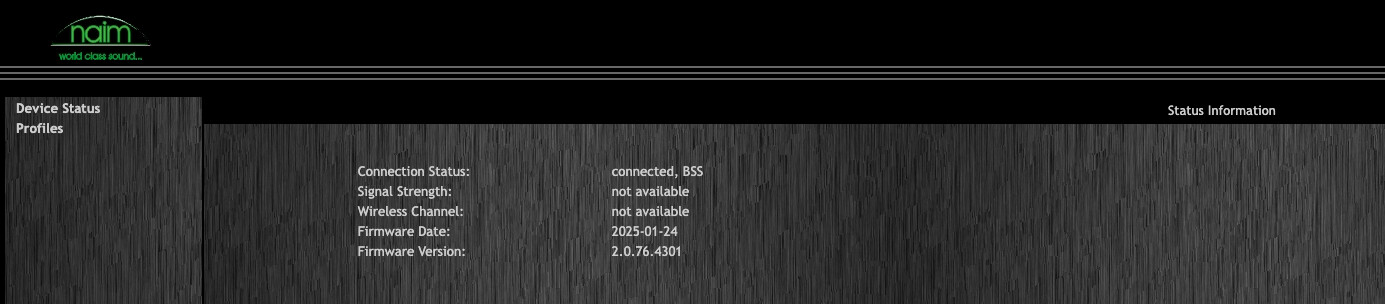
It’s a reply to my question? I don’t see what does it mean vs my question. Please explain Simon .
I know a few consumer manufacturers use it in product marketing, but you or I at least don’t see it in formal technical documentation for streaming architectures.
If you refer to the foundational documents of network streaming architectures, there is no concept of ‘bridges’. But of course there is nothing stopping anyone creating a network bridge that translates one network protocol to another. But such a device has not rendered the encoding as audio, to do that you require a renderer, which is usually referred to as a streamer now.