I’ve been doing some thought experiments to better understand how digital attenuation works at the binary level for both 16‑bit and 24‑bit audio. My goal was to check the statement that DSP‑based volume changes reduce sound quality and dynamic range. I’m not a digital‑audio expert by any means, so I used AI tools to help me learn. So please correct me wherever my reasoning is wrong.
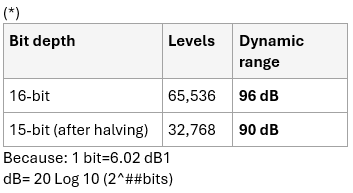
The examples below illustrate what happens when you halve a sample (×0.5). Halving always corresponds to–6 dB and reduces the effective resolution by one bit (*). I chose halving because the math is simple and makes the consequences easy to visualize.
These are raw binary examples to show what the DSP or DAC actually receives.
16 bit sample times 0.5
Before: 0100 1110 0010 0000 (representing number 20000)
After: 0010 0111 0001 0000 (representing number 10000)
So I lose 1 bit (of resolution).
Upsampling
When a 16‑bit value is expanded to 24‑bit, the usual method is to shift left by 8 bits (## times 256 (2^8)), adding eight zeros to the right :
0100 1110 0010 0000
0100 1110 0010 0000 0000 0000 (representing 20000 * 256 = 5120000)
24 bits time 0.5
0100 1110 0010 0000 0000 0000
0010 0111 0001 0000 0000 0000
Genuine 24 bit sample time 0.5
0000 0001 0011 0100 0101 0110 (representing 76,246)
0000 0000 1001 1010 0010 1011 (38123)
conclusion
So no matter whether the audio is 16 bits or 24 bits
Halving =–6 dB = losing 1 bit of effective resolution. ( *)
Impact on samples/levels
2^15=32,768 levels
2^16=65,536 levels
The amplitude of a song/ is halved, makes sence
Impact Dynamic range within a song
Original music (example):
Peak level = 20,000 (binary: 0100 1110 0010 0000)
Quiet part = 5,000
Dynamic range: 20,000−5,000=15,000=12 dB difference
After ×0.5:
Peak = 10,000
Quiet = 2,500
Dynamic range:
10,000−2,500=7,500=still 12 dB
Because dynamic range depends on the ratio, not the absolute values:
DR=20log10(Peak/quiet)
As both peak/quiet is 4, no impact.
My conclusion
Even though halving reduces effective resolution by one bit (*), a 15‑bit dynamic range still provides ~90 dB. This is far above the ~40–50 dB required for my listening environme nt.
With 24‑bit material, losing one bit is irrelevant: you still have 23 effective bits, well beyond the analog SNR limits of DACs or amplifi ers.
The dynamic range of the music does not decrease when digitally reducing the level. Only the absolute amplitude decreases.