The preamp section of the original NAIT5 has a gain trim on all inputs… which went AWOL on all subsequent variants. But I’d have to agree that Naim have sometimes made some odd design choices.
Hi all,
Over the last days I’ve been experimenting again with the gain structure of my system (NDX2 → NAC 252 → 250DR). I originally focused on Roon’s volume leveling/attenuation, but then remembered that the NDX2 itself also has internal digital attenuation. I forget that this option even exists and found it while searching/GPT-ing.
I turned off System Automation, which normally forces the NDX2 to stay in fixed output mode, and only then the NDX2’s own attenuation controls become available.
Once active, the NDX2 applies attenuation in its 32‑bit digital domain, before the DAC. This is important because it lowers the actual analog voltage going into the NAC 252 – which is exactly where the gain mismatch happens with modern 2.1V sources. The nice thing is: this applies to all sources coming through the NDX2:
– iRadio
– Tidal/Qobuz
– AirPlay
– Roon RAAT
– UPnP
I tested this setup last night and was positively surprised. The volume control became smoother and better behaved, channel balance was perfect, and nothing felt “digitally compromised”. I’ll keep comparing NDX2 attenuation against Roon’s DSP attenuation, and also against the “no‑attenuation at all” scenario. But so far, the NDX2 option looks like a very elegant gain‑trim solution.
Below is a short overview I made (with the help of AI) that summarises the pros and cons of the different approaches. Hopefully this is useful to others running a 252 or other Classic preamp with a modern 2.1V source.
Summary of Attenuation Options (NDX2 → NAC 252)
1. NDX2 Internal Digital Attenuation (Variable Output)
Pros:
• 32‑bit digital attenuation before the DAC
• Reduces analog voltage into the preamp
• Fixes sensitive low‑end of the 252 volume pot
• Applies to all NDX2 sources (Tidal, iRadio, AirPlay, Roon)
• Transparent at moderate levels (–6 to –12 dB)
Cons:
• Requires System Automation = Off
• Extreme attenuation (< –15 dB) not ideal
2. Roon DSP Attenuation / Volume Leveling
Pros:
• 64‑bit high‑precision DSP
• Great for track‑to‑track loudness normalization
• Works regardless of the NDX2 output mode
Cons:
• Stream is no longer bit‑perfect into the NDX2
• Does not reduce the actual analog output of the NDX2
• Easy to accidentally combine with other attenuation
3. Analog Attenuator Cables
Pros:
• Direct analog voltage reduction before the 252
• Works with any source
Cons:
• Adds components into the signal path
• Can affect dynamics and impedance matching
• Not recommended by Naim unless unavoidable
4. Do Nothing (Fixed Output, No Attenuation)
Pros:
• Pure, simple, bit‑perfect
• Original Naim intended behaviour
Cons:
• NDX2 output (~2.1V) is hot for the 252
• Volume often sits around 7–8 o’clock
• Channel balance not optimal at those low settings
• Very sensitive volume control
I hope this overview helps others who are experimenting with gain staging between Naim streamers and preamps. I’ll keep testing and will report back once I have more listening time with each option.
Cheers, Frits
Hi @Stevesky
During my search on DSP topics related to the NDX2, your name popped up quite a few times.
Could you please check whether I understand the following correctly?
I’m trying to confirm some technical details about the NDX 2’s internal architecture, and I hope someone with detailed knowledge of the platform can clarify.
My current understanding (please correct me if I’m wrong):
-
The NDX 2 uses a SHARC DSP for digital signal processing.
→ Do we know which SHARC model it uses, and what the internal resolution / word‑length is for digital attenuation (e.g., 24‑bit fixed, 32‑bit float, 40‑bit, etc.)? -
For D/A conversion, Naim uses the Burr‑Brown PCM1792A, according to documentation and reviews.
→ Is there any Naim‑specific digital filtering applied in the DSP before the DAC stage?
Reason for the question:
I’m trying to understand how the NDX 2 handles digital attenuation. My assumption — and please correct me if this is off — is that it may behave similarly to the newer NCX DSP platform, where a –6 dB / 50% attenuation typically costs roughly 1 bit of effective resolution, which is generally negligible given modern DSP headroom.
I’d like to confirm whether this behaviour applies to the NDX 2’s SHARC implementation as well, or whether the internal architecture works differently.
Thanks in advance!
I’ve been doing some thought experiments to better understand how digital attenuation works at the binary level for both 16‑bit and 24‑bit audio. My goal was to check the statement that DSP‑based volume changes reduce sound quality and dynamic range. I’m not a digital‑audio expert by any means, so I used AI tools to help me learn. So please correct me wherever my reasoning is wrong.
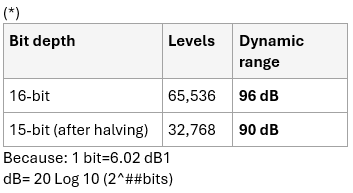
The examples below illustrate what happens when you halve a sample (×0.5). Halving always corresponds to–6 dB and reduces the effective resolution by one bit (*). I chose halving because the math is simple and makes the consequences easy to visualize.
These are raw binary examples to show what the DSP or DAC actually receives.
16 bit sample times 0.5
Before: 0100 1110 0010 0000 (representing number 20000)
After: 0010 0111 0001 0000 (representing number 10000)
So I lose 1 bit (of resolution).
Upsampling
When a 16‑bit value is expanded to 24‑bit, the usual method is to shift left by 8 bits (## times 256 (2^8)), adding eight zeros to the right :
0100 1110 0010 0000
0100 1110 0010 0000 0000 0000 (representing 20000 * 256 = 5120000)
24 bits time 0.5
0100 1110 0010 0000 0000 0000
0010 0111 0001 0000 0000 0000
Genuine 24 bit sample time 0.5
0000 0001 0011 0100 0101 0110 (representing 76,246)
0000 0000 1001 1010 0010 1011 (38123)
conclusion
So no matter whether the audio is 16 bits or 24 bits
Halving =–6 dB = losing 1 bit of effective resolution. ( *)
Impact on samples/levels
2^15=32,768 levels
2^16=65,536 levels
The amplitude of a song/ is halved, makes sence
Impact Dynamic range within a song
Original music (example):
Peak level = 20,000 (binary: 0100 1110 0010 0000)
Quiet part = 5,000
Dynamic range: 20,000−5,000=15,000=12 dB difference
After ×0.5:
Peak = 10,000
Quiet = 2,500
Dynamic range:
10,000−2,500=7,500=still 12 dB
Because dynamic range depends on the ratio, not the absolute values:
DR=20log10(Peak/quiet)
As both peak/quiet is 4, no impact.
My conclusion
Even though halving reduces effective resolution by one bit (*), a 15‑bit dynamic range still provides ~90 dB. This is far above the ~40–50 dB required for my listening environme nt.
With 24‑bit material, losing one bit is irrelevant: you still have 23 effective bits, well beyond the analog SNR limits of DACs or amplifi ers.
The dynamic range of the music does not decrease when digitally reducing the level. Only the absolute amplitude decreases.
2 Likes
I have used my ears to determine if SQ is affected when using the variable volume mode (digital domain) of my ND5XS2. My ears say: SQ is affected. Could be ‘confirmation bias’, but I do not think so.
1 Like
For me it is the other way around. By having my attenuator on my 252 around the 9 o’clock , the spatial sound stage is much better. Of course, i will keep testing trying a record/song at exact same sound level.
… which is absolutly crucial. Often stated, but more often ignored.
1 Like
I have Roon>ND5XS2>nDAC>SN3 and have headroom management (in Roon) set to -5db so that I can get the SN3 volume up to 8-9 o’clock for normal listening and avoid any channel imbalance (that plagued me with the Naim XS) and get the SN3 into it’s happy place.
2 Likes
@whatu1tme2b @Innocent_Bystander @AndyR
Over the weekend I ran a small test that some of you might want to try as well.
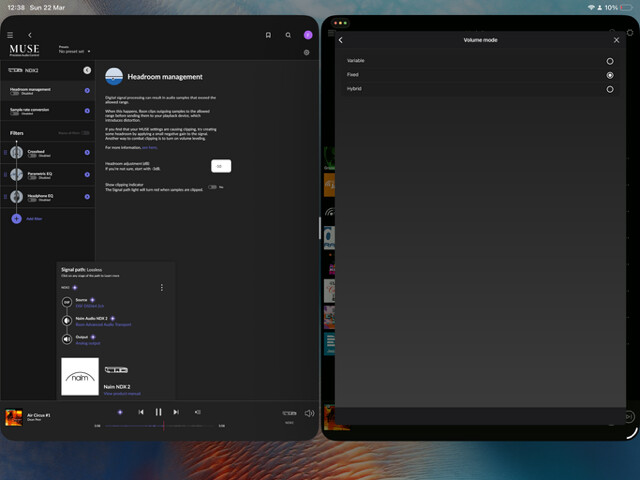
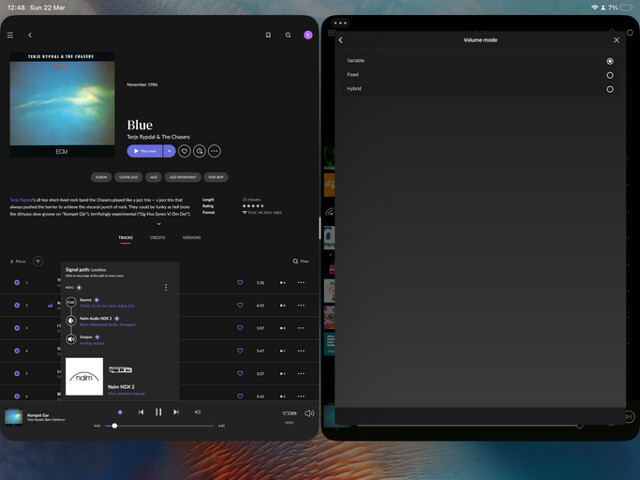
I picked a couple of tracks (both DSD and PCM) that have a naturally lower recording level, so I can comfortably play them above 9 o’clock on the volume control without being blown off the couch. I then set the variable volume in the NDX2 to 100% and switched between Fixed, Variable, and Hybrid modes (see attached), Notice the slices in the right bottom, this tells me the variable is on.
When switching, I couldn’t hear any difference at all—neither in sound quality nor even the switch itself. This suggests that all audio signal paths go through the SHARC DSP in the NDX2, regardless of whether volume control is enabled or not. This tells me that my above comment above does not come with additional sounds quality penalties ( NDX2-252 & Headroom,Volume leveling in ROON & NDX2 Attenuation - #25 by fritsveer ).
My next step will be to repeat this test with the variable volume set to 50% and compare again with matching levels (exact dB). That’s a bit more challenging, as even a 1–2 dB difference is audible, especially in the bass.
May be i will be testing an analog attenuation cable.
3 Likes
When using variable volume mode at 100%, there is no sound difference compared to fixed volume. Due to the 100%, there basically is no digital processing applied. The difference comes when lowering the variable volume mode percentage.
2 Likes
the fact that there is no audible difference between 100% and the various attenuation settings tells me something important:
It strongly suggests that the DSP is always in the signal path, regardless of the attenuation mode you choose.
If that’s the case, then the DSP will be doing the attenuation exactly as described earlier — mathematically clean, with no expected audible degradation.
Based on the math and the way digital attenuation works, you should not hear a difference.
Of course, perceived differences might still happen, but we have to stay realistic and trust the science behind it.
That said, I’ll keep digging — always fun to learn more about what’s really happening under the hood.
I also trust Naim. Naim said that the digital attenuation was a requirement for certification of one of the streaming services (I think it was Spotify Connect). But it was implemented, more or less, as an afterthought and would result in sound quality degradation if used.
This is at least one of the threads that mentions it. But I remember there are other, more recent, threads:
2 Likes
I think you might be over-interpreting what Naim have actually said. You are cherry picking your interpretation to suit your belief. Changing the gain in the digital domain in itself is unlikely result in audible degradation - but changing the overall gain structure might cause a different part of the signal path to behave audibly different.
And yes, this is just me asserting my view…
1 Like
You are right. My opinion is based on what I read and hear. My opinion is personal and not proven by scientific data.
1 Like
Thanks everyone for all the replies and discussion.
I’ve been experimenting with 50% attenuation (≈ –1 bit) over the last few weeks, and it has genuinely brought the joy back into listening for me. I’m finally hearing the full spectrum again—the depth, left–right balance, and all the fine details.
It seems that my “normal” listening level was giving me less pleasure because of balance issues and a reduced sense of stage presence.
With the attenuation in place, everything just locks in better for my ears and my system.
Must admit I learned also a lot on attenuation in the meantime as well.
2 Likes
I recently got my Russ Andrews DIN cable with -19 dB attenuation based on the findings of @whatu1tme2b. And actually I’m perplexed by the difference in sound quality compared to the stock DIN cable. Even straight out of the box, with no burn in yet, the difference is huge. The sound is much more relaxed, more open, and much more enjoyable than before. There was some harshness in the sound before which is now completely gone. Maybe the NDS and 282 are not a match made in heaven due to the high output voltage of the NDS and the low input sensitivity of the 282? Also, inbalance at low volumes is gone  Thanks for this thread all! Learned a lot from this.
2 Likes
Very good to read! I am also very happy with it. It may be the cable or the fact that the amp is now in a more optimal operating window due to the increased volume. Anyway, it works very well.
2 Likes
This topic was automatically closed 60 days after the last reply. New replies are no longer allowed.