He’s not a number he’s a free man. 

1 Like
Mr. Jones……..
ATB, J

Thanks for the informations.
You may be interested by the new Absolute Sound number.

“ > THE PREVIOUS LIMITATIONS IN CROSSTALK CANCELLATION HAVE BEEN LARGELY RESOLVED BY THE RECENT EFFORTS OF A PRINCETON UNIVERSITY SCIENTIST, EDGAR CHOUEIRI.
BACCH’s fullest implementation is the BACCH-SP a stand-alone digital processor, manufactured by Theoretica Applied Physics, which can also serve as a DAC, ADC, and full-function preamplifier. A consumer creates a unique crosstalk cancellation filter utilizing miniaturized in-ear microphones and can store up to six additional filters for other listeners or when alternative loudspeakers are deployed (making a new filter takes only a few minutes). The BACCH-SP comes with head-tracking camera, either an optical device or an optional infrared sensor that functions in the dark to assure the filter continues operating even if the primary listener moves around a bit. There are less costly, software-only versions of BACCH that don’t require an individual’s in-ear measurements; this “universal” XTC filter needs only for the listener to input the angle his speakers form with the listening position to accomplish a good percentage of what fullboat BACCH can do.
The extent of the dimensionality achieved with BACCH does vary with the nature of the original recording, with the most impressive results obtained from binaural (“dummy head”) recordings, followed by those captured with simple microphone techniques, followed by multitrack recordings. Still, the results with run-of-the-mill pop material can be ear-opening. There are literally millions of stereo recordings dating back to the Eisenhower administration that can be more fully spatially realized to reveal more musical meaning. ■
1 Like
The graphs don’t really give an indication of the effect of temperature or humidly. It shows results of various combinations of A+B vs C+D vs E+F.
To analyse the effect of temperature you would have to vary the temperature, but keep the absolute humidity constant.
20c/50RH vs 23c/42RH vs 25c/37.5RH
To analyse the effect of humidity you would have to vary the humidity, but keep the temperature constant.
I’ve no idea what those graphs represents.
But I would say there is no way of knowing if the amount of dip is due to accumulative effect of increased temperature plus increased humidity.
It could be that increased temperature alone would drop the dip further than shown, BUT the increased humidity pushes the dip up.
1 Like
Hi @Fatcat , thanks for posting. I can see that the axis are not clearly labelled.
X axis is frequency in Hertz.
Y axis is magnitude of transfer function of applied filter gain in dB.
Indeed your observations are correct. What I was trying to show was that in the computational modelling that the Linn software undertakes to correct for low frequency room resonances:-
small adjustments are made to the runtime filters to correct for the changes to speed of sound waves as influenced by temperature and humidity.
The variations come from changing temperature and humidity values from default 20 deg C and 50% relative humidity that the software has coded within it.
If you want to read up in detail about the various problems with undertaking computational fluid dynamics evaluation for real spaces there is quite a bit of material out on the web.
Linn have chosen to use one of the more ‘simple’ approaches, perhaps because it is easier to code if writing from scratch. This is the Finite Difference Time Domain method, which literally calculates the velocity and pressure equations for the air volume in the room step by step in a time evaluation, based on a pre allocated grid density of computation points.
There are several other algorithms that one can use. What a good modeller is supposed to do is cross validate between results obtained using one method (e.g. FDTD) with another method (eg Finite Element Moddeling or FEM).
I did have quite a discussion with the Linn Tech Director on this topic during my ‘Fitness for Purpose’ discussion with Linn.
If you look to my thread, there is an appendix added to my improved method for tuning one’s room with Linn SO.
The link to the appendix is here….
FYI, there are well established commercial tools that one can buy for which there are CFD add-ons. COMSOL multiphysics is such a tool.
Linn used the COMSOL tool (video evidence is available for this) to design their new 360 loudspeaker range, so should have had the possibility of at least cross validating anything they wrote internally.
So it is explicit that the calculations of Linn software are entirely due to the modelled temperature and humidity adjustments, the real question is do those calculations bear any resemblance to reality. Which can be confirmed by acoustic measurements at the appropriate associated temperature and relative humidity’s.
1 Like
Would this graph help?
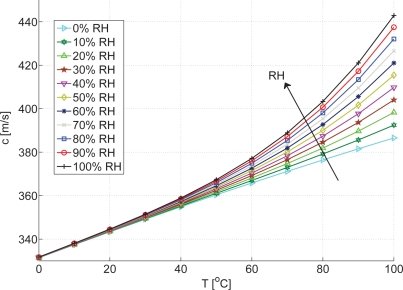
(p = 101.3 kPa; 314 ppm CO2)
van Schaik et al. (2010) High Accuracy Acoustic Relative Humidity Measurement in Duct Flow with Air. Sensors (10) 7421-7433.
1 Like
So I can conclude I didn’t received a correct response?
Yes.
That indicates change in humidity has very little effect on the speed of sound compared to change in temperature at 20 or 30c.
Temperature change has quite an effect on the speed of sound.
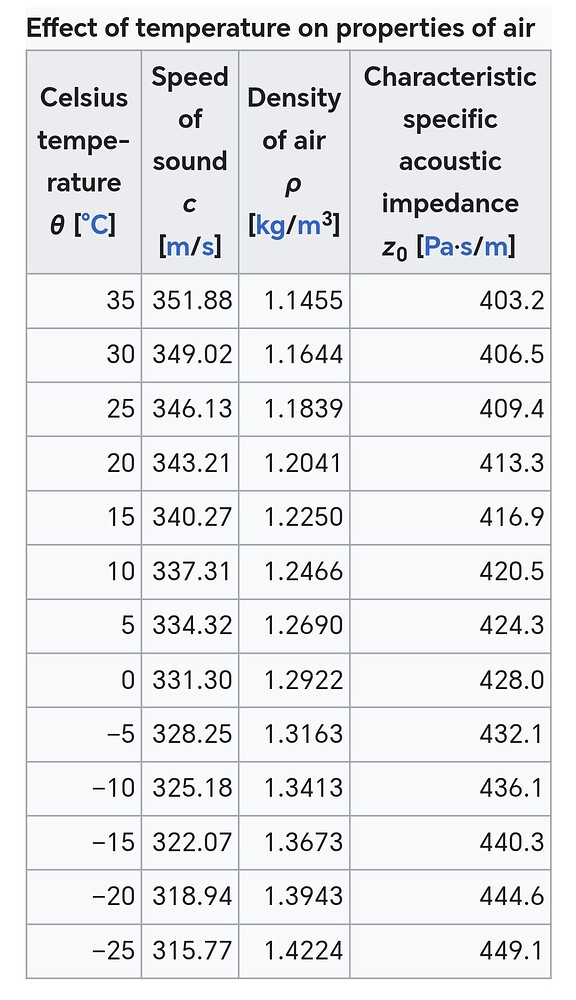
In percentage terms, 20 > 25C gives about a 0.8% change in c.
Difficult to read the graph in detail at room temp, but looks like going from 30 to 70 RH at 20C would give a bit less than that.
Of course, neither of these results proves that these changes are imperceptible to humans!
2 Likes
It doesn’t make sense, to a non scientific guy but with some logic in my little brain.
If humidity in the air doesn’t impact the sound, how explain that the sound is different inside the water?
I am an old git…and lived through the whole Peter Belt wave of madness…I have to confess at trying bits and pieces which were even given away free in the hifi press … it was all utter nonsense…and ultimately relied on one question - ones self perception of sound. He was onto a winner as nothing can be disproved…its a bit like how you perceive colour can you be sure what you see is the same as someone else…etc etc. What really matters is pure physics … electrical, acoustical etc. not weather you attach a tiny piece of foil to your mains plug…you get the drift. Its fun to read about…I would love to chat to Jimmy Hughs who fell for this hook line and sinker…
Hi @frenchrooster , I think the point Fatcat is trying to make is that temperature change has the much bigger impact on the velocity of sound in typical living space environments. Humidity variation also does have an impact on the velocity of sound, but within reasonable expected conditions that one might have in a given domestic living space, the effects on sound velocity are less severe.
FYI, in my work to establish the ‘Fitness for purpose’ of Linn SO, I varied the environmental sliders independently, so I do/did have some sensitivity curve data (of room resonance CF, Q and gain) for each environmental parameter.
PS: I did not know there was going to be so much forum interest in this!
1 Like
The graph and table merely indicate the changes in speed of sound with respect to humidity and temperature.
At 20C increasing the temperature to 30C gives an increase of 5.81m/sec
At 20C increasing the humidity from 30RH to 70RH gives an increase of approx 0.8m/sec.
But that only indicates that there is a change in a parameter due to temperature and humidity change. That information doesn’t tell us if changes to the speed of sound are audible.
There will be other parameters associated with sound, that will be effected by temperature and humidity change.
2 Likes
Air, even saturated with water vapour, is still a gas. Water is a liquid. That’s the difference.
2 Likes
To understand the audibility question, look no further than the simple test of the results of my masked randomised trial with 6 participants.
Link to the method introduction are here.
https://community.naimaudio.com/t/english-premier-or-international-hifi-pre-season-training-want-to-join-in/38767/205?u=edmund-of-essex
And results here…..
1 Like
Re your obviously correct observation……..
One such example is the absorption performance of the acoustic panels fitted in a room.
1 Like
Can we say that higher the air humidity in the air is, faster the sound will be transmitted?
Yes, the speed of sound get slightly faster as humidity increases. So resonant frequencies etc also go slightly higher.
1 Like
I’m not sure I can explain without getting into molecules etc, but simplistically sound travels faster in liquids than gases because molecules are closer together in liquids than they are in solids, so they bump into each other more when vibrating. Sound is and even faster in solids for the same reason. If you google speed of sounds in solids, liquids and gasses you’ll probably find some explanation meaningful to you. Humid air is just gas: at maximum humidity something like 75% nitrogen, 20% oxygen, 4% water vapour (gas not liquid) and small amounts of other gases including carbon dioxide.
1 Like