A few years ago I upgraded from RP10 + Aria + Apheta to RP10+ Aura + Aphelion… a significant upgrade. I can’t say I have noticed to issue you mentioned. No doubt that the detail is there in spades and my best ‘reference’ LPs (eg. Aja, Hats, Solid Air) sound fantastic, but I haven’t noticed that the Aphelion/Aura makes lesser pressings sound worse than they should. Am I understanding correctly?
Less forgiving is the word I would use.
I certainly couldn’t get on with the aphellion2, unless every record I played was well produced.
There are other cartridges that will fit ok to the rega P10, but you need to be careful as they like small, light weight and this will limit things, unless you want to start messing about.
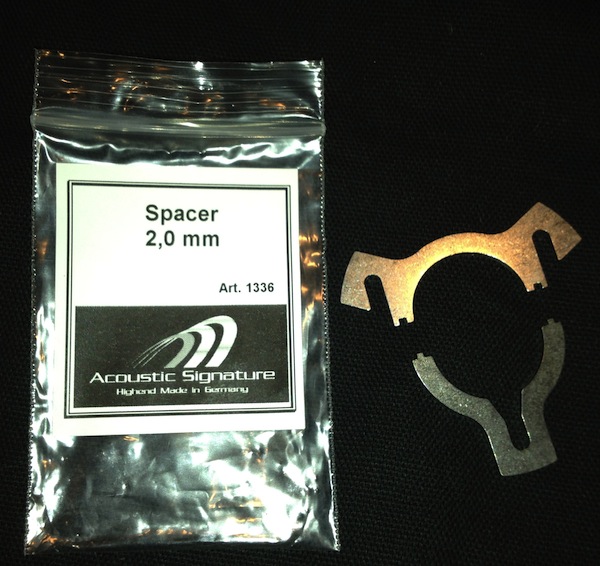
You have acoustic signature Rega spacer set, these are shims which can be fixed without removing the arm. It’s straightforward.
It’s the only way to choose other cartridges.
I use a shim on my Rp10/Delos and waiting for my P10/Kleos now. The sound with my Delos and shim is better, for my tastes, than the Apheta 2 I tried.
You have not a lot of carts that can work well on Rega arm, because they have to be relatively light.
Van den Hull work very well too.
Maybe Dynavector.
Except if you subscribe to Rega’s point of view that VTA is irrelevant and VTA adjustment is a psychological condition more than a technical one (from the Rega book where they are not mincing words )
I think if you want a more “forgiving” cartridge then maybe stick with an MM. Unfortunately, if an LP is poorly mastered, it’ll sound poor and rather flat regardless. Upping the ante at the front end will probably not improve that, and may well better reveal the poor mastering. However, a poor cut can sometimes be ameliorated with a different cartridge, or at least with a different stylus. Some LPs with very long sides, and or very tight packed and possibly shallow grooves can often replay poorly on many stylus profiles. This is where a different profile may go some way to getting the best out of those grooves. Think something like a Shibata or a Micro Line profile. Certain Micr-lines much as the made by A-T can be a revelation here, restoring some LPs previously set aside as beyond redemption, especially replaying the inner grooves. And for secondhand vinyl, some LPs can sound worn and disappointing if replayed with certain profiles, but can be totally rejuvenated with a change of profile that can find a previously unplayed area of the grooves. Of course, with all of this there’s no panacea, as you may not like the cart performance as a whole, and the issue of how good or bad the original mastering was, is ever present.
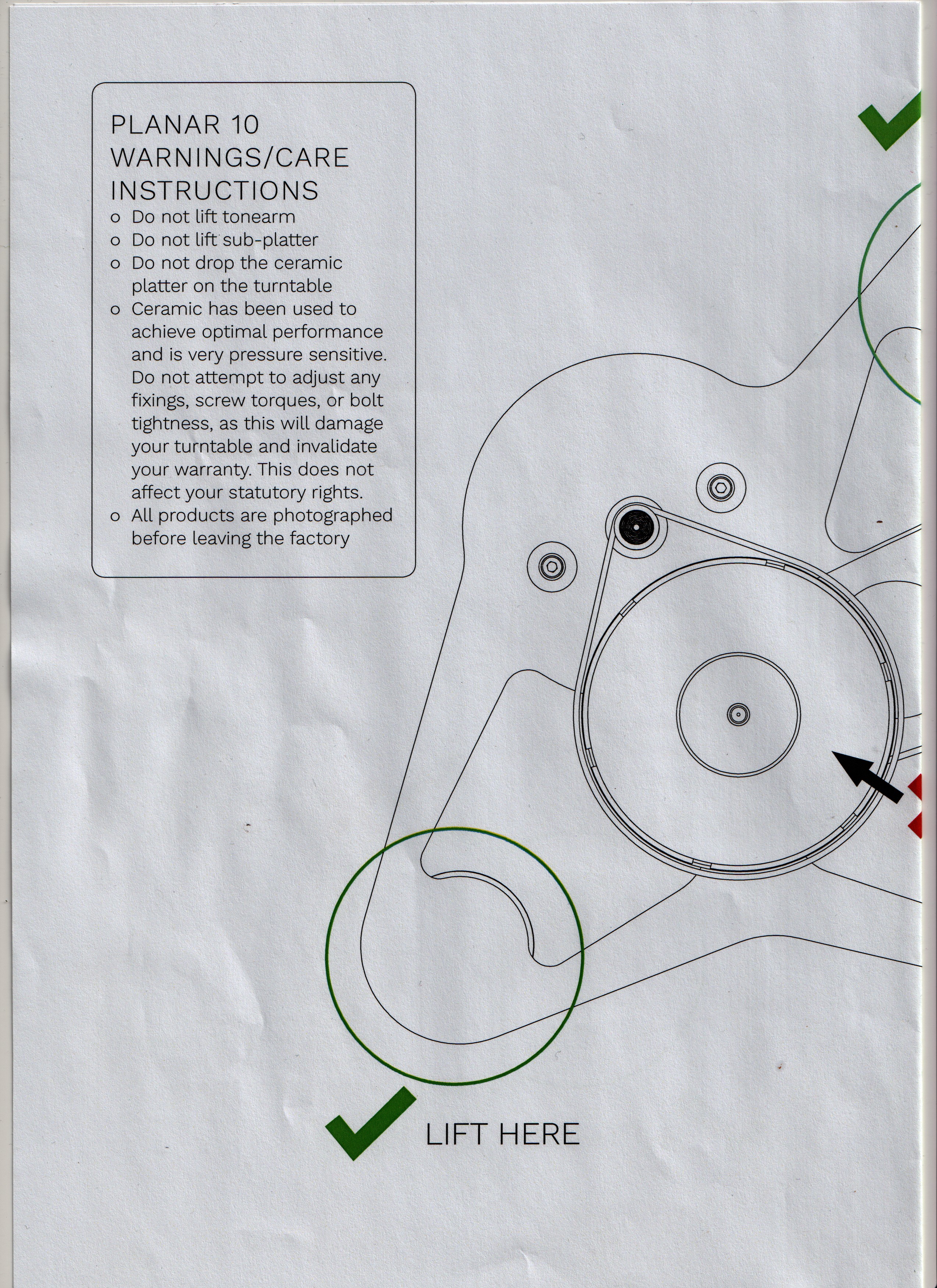
Rega has a warning on the sheet that comes with the P10.
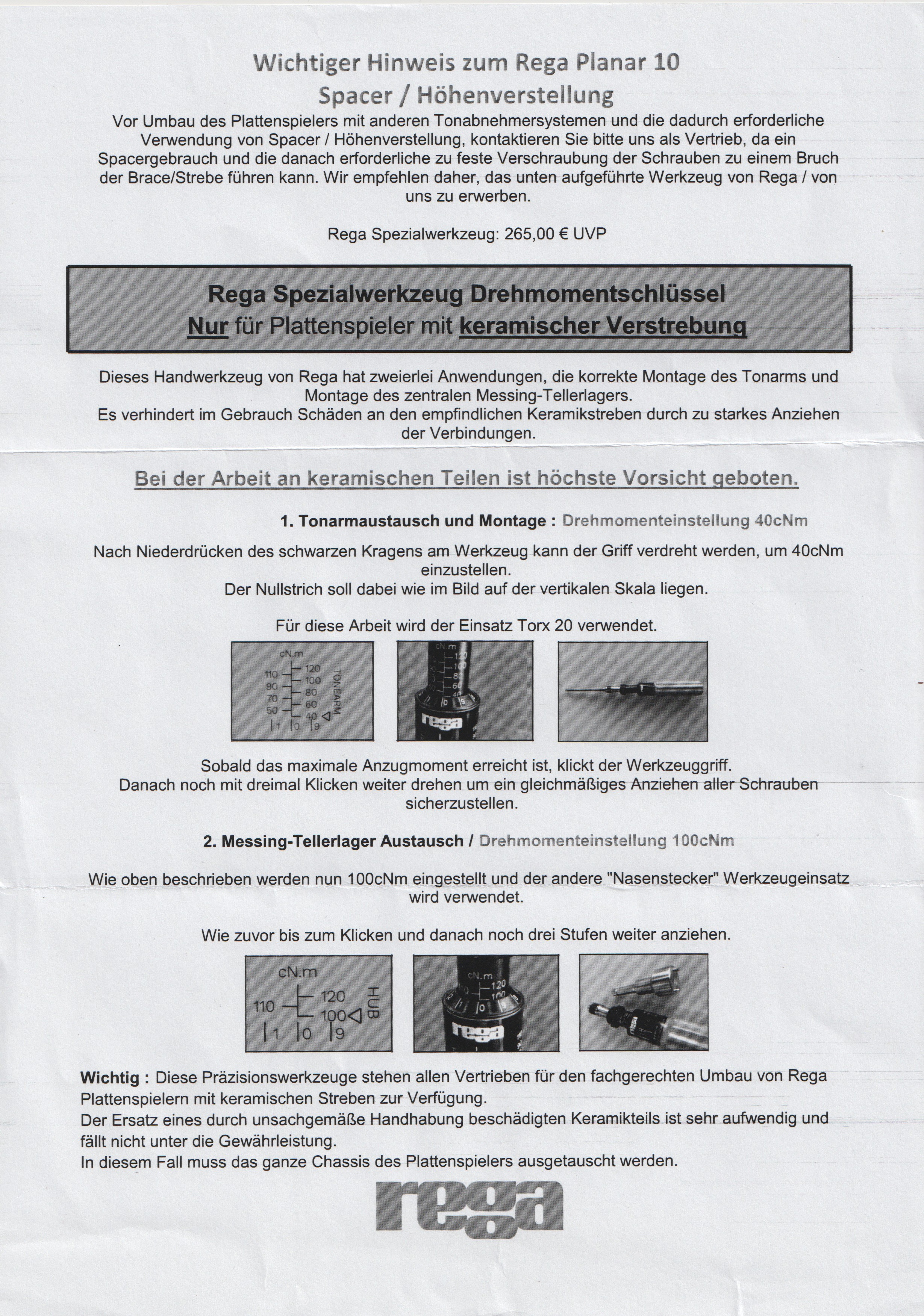
The German distributor adds two additional sheets in German, one with a more stern version of Rega’s warning and the instruction to buy Rega’s torque wrench that is specific for P10, and another detailing the use of said wrench
I will share next week, when I will receive the P10 and Lyra Kleos. I ordered the acoustic signature shim, very easy to mount. My dealer sells Rega since 30 years.
If unfortunately the shim doesn’t fit, I will not accept the Rega P10 and the Lyra Kleos. The Rega cart doesn’t interest me at all.
However I am quite sure it will be fine.
The above is about a separate torque wrench for loosening and refastening the arm to the plinth to add spacers. The ceramic brace easily breaks - this fact is printed on the included Rega sheet, but not the info about the special tool. The latter is added by the German distributor with instructions and the stern warning to never fasten the arm or the platter bearing to the plinth with any other tool
It’s not the reason in my case. My dealer tried to mount the Kleos without a shim but said to me that it needs 2mn shim to be levelled. Without the shim I can’t use the Lyra Kleos.
I send a mail to my dealer to tell him about the Rega recommendations.
In all cases the dealer will set up the cartridge, not me.
I am not sure a wrench is needed with the acoustic signature shim.
I don’t know what levelled means in this case, just saying that Rega says that even several degrees of VTA make no difference. Also not saying if they are right, just reporting what they wrote in the book.
Of course, in some cases the difference may be so extreme that a cartridge cannot be used at all without a shim.
Here is the additional sheet from the German distributor. Only German of course, but it specifically says that fastening the arm after adding a spacer can easily break the brace and they very much recommend the special Rega tool:
And here is the additional included instruction sheet for the special P10 wrench (I don’t have the wrench, this all came with my P10), with instructions for fastening arm after adding spacers, or for the platter bearing after changing it. Also repeats the breakage warning, says that “working on ceramic parts requires the highest care” and adds that all Rega dealers use this to fasten arm/bearing on TTs with the ceramic brace; breaking the brace means a whole new plinth is required:
Michael Fremer explains how to use the acoustic signature shims for Rega: From Analog Planet
“ l situation.
Rega does make spacers that you can insert under each of the three screws locking down the latest iteration Rega arm but that requires you to remove the entire arm, put the spacers on the screws and then lock them down. And if the spacer you chose doesn’t provide sufficient height or produces too much lift, you have to remove and start over. Not fun!
. The German turntable manufacturer Acoustic Signature and designer Gunther Frohnhoefer have a great solution in the form of spacers that only require you to loosen the screws. You don’t have to remove the arm. The Stainless Steel spacer set allows you to adjust the height from 0.5mm to 3.5mm in 0.5mm steps. You can see from the image how the ingenious design works.”
 )
)