Whilst undertaking some internet searching, I came across a very small number of links to companies developing 6-DoF studio audio mastering and production tools.
Is there anyone on the forum (musicians or audio engineers) who have been involved with or had experience of this kind of technology? If so, could you please share your opinions (if permitted)?
For anyone else - if the above title search is used (or very similar) - perhaps you will find the links to the same companies. What are your views about this technology for the future for home audio?
You presume correctly. However, given your post I did look up Dream Theater’s Six degrees of inner turbulance? and watched all of the 41:15 video on YouTube - excellent- thanks for the question!
To help confirm the topic I was referencing, try also incuding Zylia and/or Voyage Audio and/or BBC and/or AES Journal in the search strings.
PS: You may find links to work by META on the topic.
I could reply either - so yes - on topic. Actually, I have very little specific knowledge of the technology promoted by the two company names I incuded above.
I came across this information today when searching the web using a search term of ‘6 degree of freedom loudspeaker’. The search did not produce the information I was looking for - instead it gave me the links I described above.
Nevertheless, I am genuinely interested in the general area of ‘6 DoF audio processing’ - do you have some specific experience you are able to share? It would be great if you do.
Also, in one of the links I found, the DANTE interface seems to be becoming the defacto industry standard for modern Audio/AV information stream sharing in post production?
This was interesting as the Naim CI-102 includes a DANTE interface as does my Magico Sub Bass.
KII audio implemented the Dante interface in their new KII Seven active speakers and they call their whole approach the new way to modern home entertainment.
Many thanks for the information. As a result of your post I have spent a bit of time researching the Kii product ranges. Lots of interesting technology and speaker architecture that addresses both mixing/mastering studio requirements and (untreated) home HiFi environments with essentially the same product (that you mentioned) - the Kii Seven.
I can see that the studio version of the Kii Seven has the Dante interface, but it is not quite clear to me from the Kii website that the home HiFi Kii Seven does. (Do you have any more knowledge re this detail difference?).
PS: I am NOT in the market for new loudspeakers - it is just that in my experiments with the Naim CI-102 (on home loan) I did not get round to using the Dante interface - for a three main reasons.
The protocols my switches supported were not fully compatible to be able to support Dante.
I needed a Dante ‘Master’ capable control (software on my PC) which I did not have.
I ran out of time.
However I am interested in home audio products/technologies that might become ‘game changing’. Hence my starting this thread on the ‘6 DoF Audio’ topic.
Thanks for pointing this out. The improvements I see this year (since its basic introduction in 2020/2021) were announced by Apple at WWDC - 2025. The additions of lossless format for the Spatial Audio (up to 24 bit at 48kHz sampling - needs a USB C cable), lower latency in certain applications and the marketing term / ‘closed’ standard of Apple Spatial Audio Format (ASAF), which luckily is still compatible with Dolby ATMOS.
In addition to ASAF there is the compatible codec - the Apple Positional Audio Codec (APAC). However it does also seem as if Apple have now incorporated body movement sensing/meta data into the Spatial Audio format for better VR headset experience!
Having looked at these developments - perhaps I will get an Apple smartphone along with some new earbuds to replace my Sennheiser Momentum M2 IEi in ear buds which are 10 years old!
Have you (or any forum members) tried any of these things - and if so - what are your impressions?
you’re right, the home Kii 7 doesn’t include DANTE.
The Kii Seven was already on the market for the pro-audio world for a year, before the release for consumers.
This was because Kii Audio wanted wireless streaming to be 100% functional and sound-perfect for the consumer market. In the pro-audio world, wireless streaming offers no added value, and Kii adapted its marketing strategy accordingly.
Pro-audio uses a wired system, and the extremely robust system called DANTE Audio (DANTE stands for Digital Audio Network Through Ethernet) already existing for this purpose, was implemented. It’s practically the international standard at the moment, and that’s why it’s also included in the pro Kii 7. Because it’s an existing system with fixed, proprietary protocols, its integration into the Kii Sevens was also relatively straightforward.
For the consumer market, however, Kii Audio targeted a completely different approach : the discerning music lover who’s willing to pay a premium for a great-sounding hi-fi system, but also pays close attention to the lifestyle aspect of the product and wants to see and use as little equipment (and therefore cabling) as possible. And then you quickly arrive at a wireless solution in the living room. WISA didn’t seem to be the right option as Kii Audio thought they could do better and they developed their own system. Kii Audio has managed to keep the clock jitter equally low (and significant lower than WISA) in both speakers, and if you’re aiming for the ultimate impulse response in a wireless speaker system, the synchronization between them truly is “as close as possible.” That’s why the Kii Seven sounds slightly better wirelessly than wired, which is also what consumers who choose a high-end wireless system expect.
(All credit for this explanation goes to Max Delissen, who reviewed the Kii 7 for the hifi-medium hifi.nl in the Benelux).
Given what energetic discussion seems to be breaking out on other threads (e.g. re room treatment) and before I load more posts on my ‘Audio Grade Solder’ thread regarding loudspeaker cable selection (hopefully this weekend)……
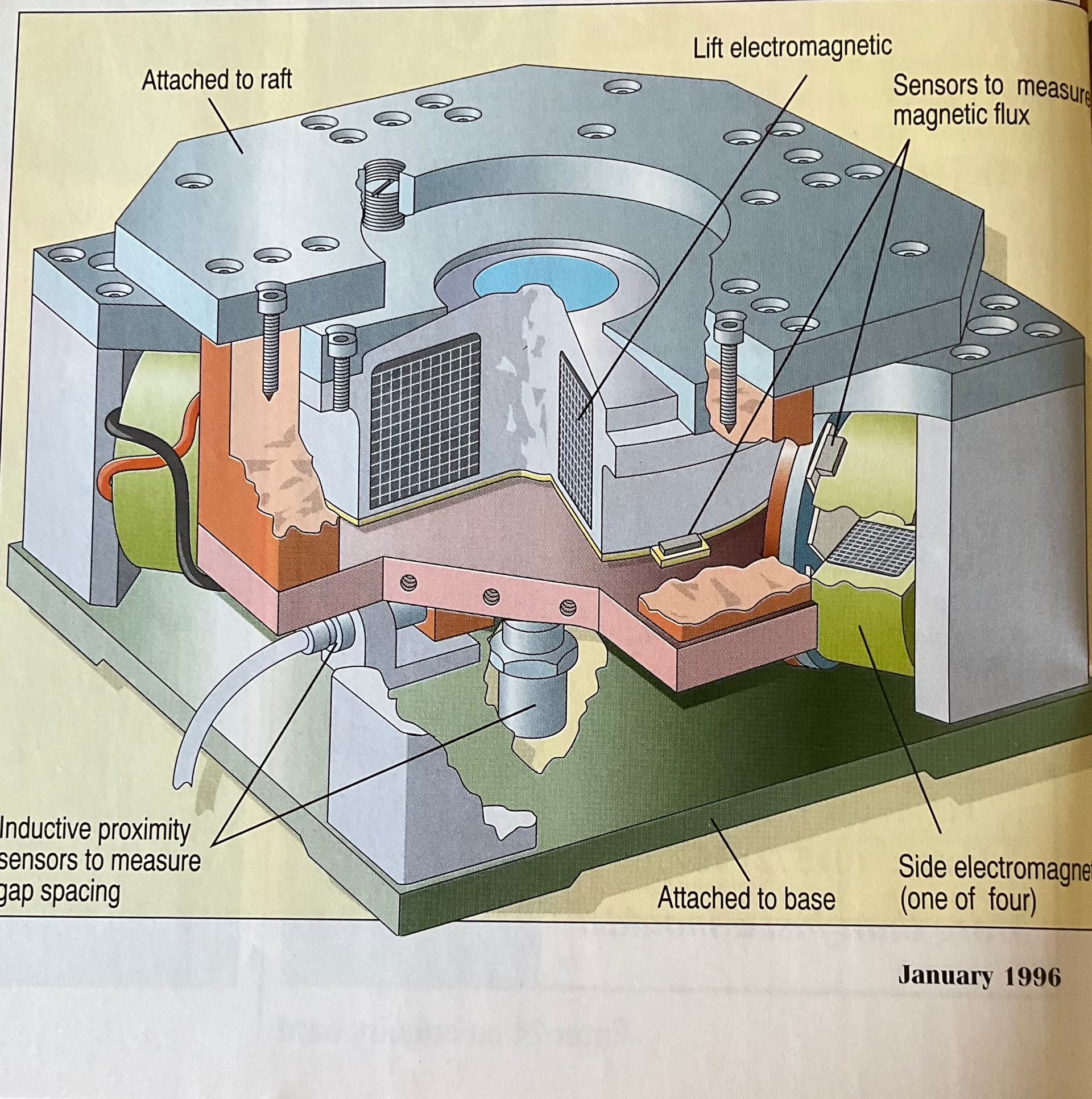
How about under a headline of ‘Technology from the Past’, this Six (6) Degree of Freedom (DoF) ‘loudspeaker’ that I worked with/on (with others) in the very early 1990s?
Original Image and Publication: GEC Marconi Research & GEC Alsthom Gas Turbines, Eureka Magazine.
Original Image of the publication: Author provided, no reuse.
Any Naim forum members work on similar things to this - whose technological developments might have provided beneficial insights for the audio industry. Do please share any thoughts and questions (if permitted).
discussing directly with Kii Audio, they confirmed there’s actually not difference between the Kii Seven “home” and “pro”. Both versions have Dante and the built-in streamer. In fact they are totally identical. That might be changed 2026, but how or what wasn’t more specified.
Many thanks for checking with the manufacturer. It makes sense that the internal capabilities are the same. It probably saves on costs when presenting ‘two’ models for different customer groups.