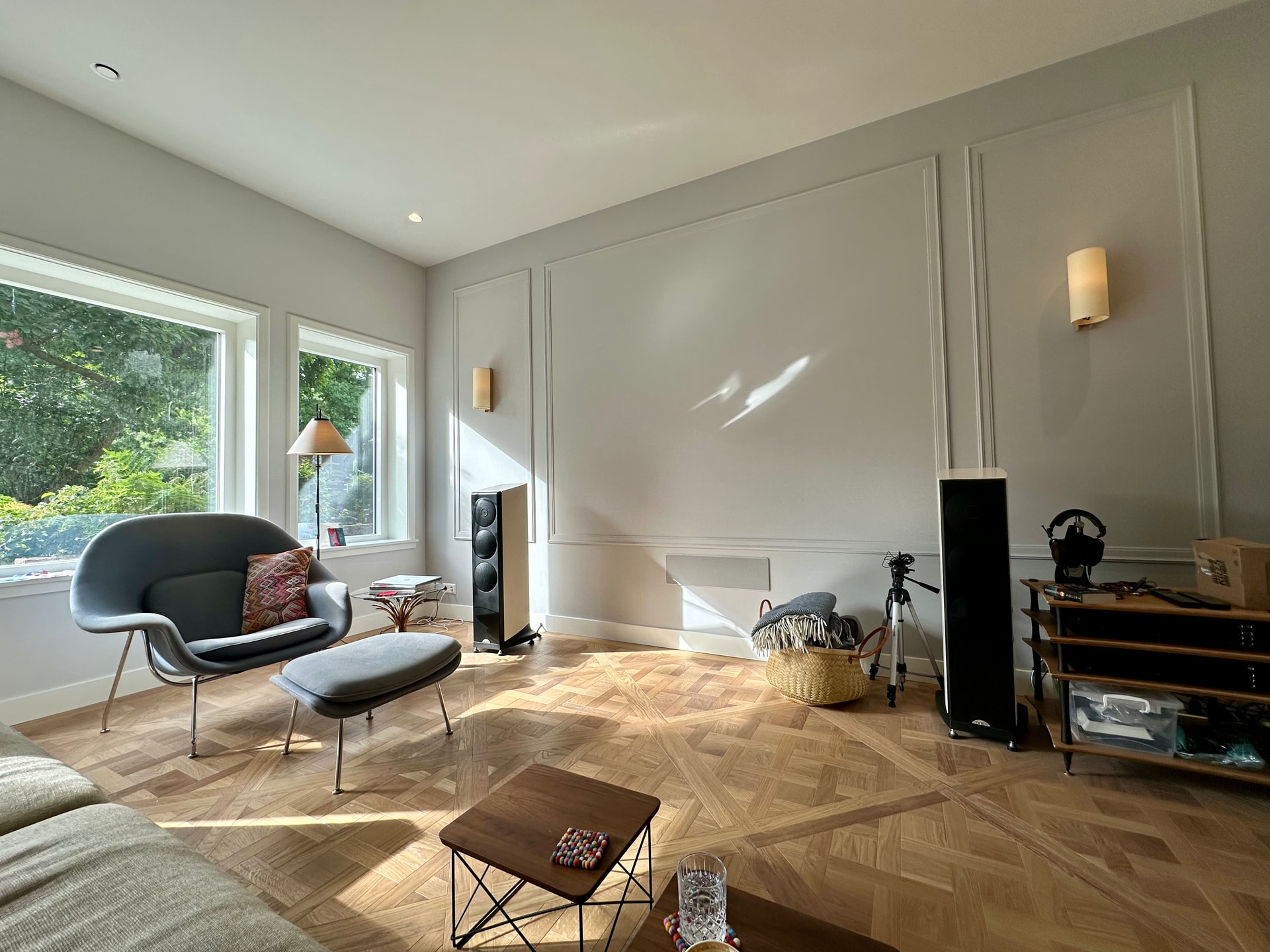
We now have a larger room and more distance from the listening position to the center of the speakers (about 260cm). Also, for video reasons, the Ovators are further apart than they used to be before, now about 235cm.
The sound was somewhat flat, too centered and missing that stereo immersive feeling. The temporary lack of a rug I thought, but then I tried something different for me.
I never did toe in, so tried that a couple of degrees. The change is stunning. All good now. I never would have thought the impact could be that immense. Is the consensus that when having the speakers further apart from each other, a toe in is the way to go?
It certainly can help; however, it is not about the size of the room but how the room plays/reflects the sound. Toe-in can help focus the sound stage and often brighten the sound a little.
While there are prescriptive ways to go about getting the speakers placed well, they should be taken as a starting point for good sound in a room.
Room treatment of some kind can have just as much effect on the sound as speaker placement; in fact, in a room with poor attributes, speaker position can only have a small effect on improving sound without some work on improving the room.
I would say it depends entirely on the particular speakers and the room. Experimenting is the best way to go to see what works best in your particular circumstances and for your priorities and tastes. There really are no hard and fast rules. Yes getting it just right can make a huge difference, so worth the effort.
I agree with the other comments. It totally depends on the speakers, the room, the distance between speakers and the distance to the listening position. I have my current speakers (Spendor A4.2) since December 2025. I spent a good time moving them around to find the best position for my situation. The speakers are currently 2.6m apart and the listening position is also 2.6m from each speaker (equilateral triangle) with approx. 10 degrees toe-in.
I would try different distances, 60cm, 90 cm, the soundstage usually comes alive and the bass tightens. Room dependent of course, so YMMV, but certainly worth trying.
I very much enjoy watching Erin’s Audio Corner. Very helpful, unpretentious and he kinda knows his stuff. Suggest you may have a look at that too if you have a little spare time.
I think I am happy with what I achieved actually. When the room is more decorated (curtains, rug), I will optimize further. The question I started the topic with remains: speakers closer together that sounded great without toe in, is it logical that a toe in is required when placed further apart. But perhaps not, a coincidence might very well be the case.
Toe-in breaks the standing wave so should give a degree of extra clarity. HOwever, the BMRs have exceptionally wide dispersion characteristics, so don’t require the same amount as more directional speakers.
From the Ovators’ manual:
.1 Positioning
The performance of any loudspeaker will be influenced
by the room and position in which it is located. Even small
changes of loudspeaker position can significantly influence
the sound. Changes of room contents, the introduction of
significant piece of furniture for example, can also have an
effect.
The following paragraphs constitute only a general guide
to Ovator positioning. Every listening room is different and
you may find an alternative positioning solution works best
in yours.
In general, try to choose a site for the speakers where they
are located between 2.0 metres and 4.0 metres apart,
clear of room corners, and where each one is between
0.25 metres and 1.0 metre away from a solid rear wall.
The distance between the speakers and the rear wall is
the aspect of positioning most likely to require
adjustment as the speakers run-in and you
become familiar with their performance in your
room.
4.2 Room Layout
If the Ovator is moved closer to the rear wall the
low frequency elements of music will become
more prominent. However this may be at the
expense of bass clarity and timing.
Note: There is no need to angle the Ovator
inwards towards the listening position but doing so
may be a useful fine-tuning adjustment.
The primary listening position should be central
between the loudspeakers approximately the
same distance away as they are apart.
Try to position each Ovator within a similar “near-
field” acoustic environment and with similar
acoustic characteristics along the side walls
towards the listening position.
Note: Different near-field acoustic environments
and characteristics would be created by, for
example, heavy curtains and glass windows, or a
plasterboard wall with and without bookshelves.
It will depend hugely on the specific speakers and the room itself, e.g including how far the speakers are from the side walls, the reflectiveness of surfaces in the room, the horizontal dispersion of the speakers, and of course your personal preference. Personally I have generally had all my speakers toed in, typically pointing to point a bit behind the listening position, which with both sets of PMC speakers I’ve had was what the manufacturer recommended. Inevitably that means if they are moved further apart but listening position unchanged they would be toed in more. (Interestingly the two sets of IMF speakers I had before PMC had a horizontal response that was skewed due to the drivers not being in a vertical line, so as well as degree of toe in they could if desired be swapped between the two channels.)
Only any standing wave between the front baffle and a flat surface directly in front, like the back wall, and I suspect that would be a smaller contributor to the sound compared to the increase in HF energy at the listening position if speakers point more directly at you.
Ooh, a round room - fascinating! A few years ago I was exploring the possibility of having a home built from scratch, and in so doing contemplating and contemplating what would be the best shape and practical size for the music room. I rejected round because there would be a focal point diametrically opposite each speaker (same distance from wall), email which didn’t seem ideal. I decided on pentagonal (slightly squashed regular), with a sloping ceiling, giving no parallel walls like the circle but obviating the circle’s reflection images. Unfortunately affordable land in the desired location proved not to be available and I abandoned the pipe-dream.
Living in a light house would be pretty cool but sadly not!
The room is a challenge but the Naim atom he and my ATC 20’s work well given the room constraints and method wise I get the toe in to cross just in front of where I listen ( don’t want acoustic treatment in this room as it’s a family room!)
The room is 5m diameter and 2.8m ceiling!
My wife would actually love some room treatment, as we just moved in and still have no curtains nor rug . Further than that I have no sound treatment wishes.
So for now: hard surfaces, 3.1m heigh ceiling, 5.5m wide by 4.5

 . Further than that I have no sound treatment wishes.