‘Audiophiles buy music to listen to their Hi Fi’ Alan Parsons
2 Likes
Should we match our speakers to the room?
That’s a highly polarising topic!
But why polarising?
Well, because science very clearly contradicts “experience”.
So who’s right?
…
I’m in the middle of the Atlantic, on my little sailing boat.
All around me, right out to the horizon, the ocean is flat.
A straightforward observation: everything is flat as far as the eye can see.
Conclusion based on experience: the Earth is flat.
The problem is that the experience is biased.
Why? Precisely because I’m on the ocean.
Climbing up to Mont Blanc is sufficient to contradict my first experience.
The conclusions drawn from the sailor’s experience are all wrong, because the experience isn’t relevant for answering the original question: is the Earth flat?
And it’s exactly the same with the question in the title.
Enjoy the video :
9 Likes
Hi Thomas,
I just wanted to give you thanks for originally creating this thread and for the last couple of video links that you have posted. All good sources of information for informed debate and discussion.
Every day is a school day:- having watched the long video I listened to the Mariah Carey track ‘My All’. As a result of what I heard - and as an experiment - I have decided to remove some diffusion from my front wall to see if I can achieve superior consistency in the acoustic presentation of the particular recording referenced in the video. Thanks for posting the link!
Also, I want to thank @BBK for highlighting the typical 2 metre separation for loudspeakers used in studios. However, instead of experimenting with Roon or other DSP correction matrix tools, I did the simpler thing of … moving my loudspeakers slightly closer together. I also moved the listening position slightly to maintain the equilateral triangle for the loudspeakers and listening position. This small change produced a more pronounced perception of depth in the soundstage and as a great side effect, the Linn Space Optimisation software concluded it had less work to do.
Thanks to BBK for the detail postings on this thread.
3 Likes
2m, 3m, 4m… spacing depends of course on your listenng distance! In studios it might be less than in larger domestic lounges.
With my last speakers, I determined optimum positioning using theory refined with REW measurement, best listening position distance from front wall being pretty close to the theoretical 0.38 of room front-back distance, speakers each in front of the 3.6m wide window, IIRC about 2.7m between baffle dentres. Though heavy speakers were easy to move, ‘walking’ them to beyond the window sides to a resting position, OK for non-critical listening. When I changed to my current speakers, effectively immoveable, I didn’t want them in front of the window. Instead they are close to the previous speakers’ resting positions, baffle centres maybe about 4.2m apart, and best listening position 4.4 m from front wall = 0.62x dstance from front to rear walls ( - 0.38 from rear).
(All measurements from memory.)
2 Likes
Hi I_B,
I was certain I had the best position for my loudspeakers before I made my recent adjustment. It was practically an equilateral triangle to the listening position with a 2.3m separation instead of now 2m. The loudspeakers were 1.06m from the front wall as was the distance of listening position to back wall. This arrangement was necessary because the room is 4.52m long by 4.12m wide by 2.4m high and I need to accommodate the TV screen on a electric mount moving forwards and down for when we watch movies.
In this very cube like situation, the loudspeakers were stimulating the front-to-back axial mode of the media room more than I would have liked. Nevertheless, Linn SO figured this out and was providing appropriate (nulling) correction for the axial modes front-to-back (~37Hz) and left-to-right (~42Hz) and also second harmonics of these when interacting with the floor-to-ceiling axial mode (~72Hz), all in a spatial region very close to the listening position. It also sounded pretty good.
Now that I have moved the main loudspeakers and listening position - and also added the Titan Sub Bass (very close behind the listening position) - I have much more control of the room modes. Consequently Linn SO has decided it does not need to do anything apart from very small shallow null (of less than -1.8dB at 82Hz) to account for the different left and right pressure profiles at the listening position. I estimate that these differences are due to the windows in the right wall and the entry door at the back right of the room which has less deep acoustic treatment compared to the back left of the room. Now the room sounds even better - more depth to the soundstage, more ‘believable’ on recordings of live concerts.
1 Like
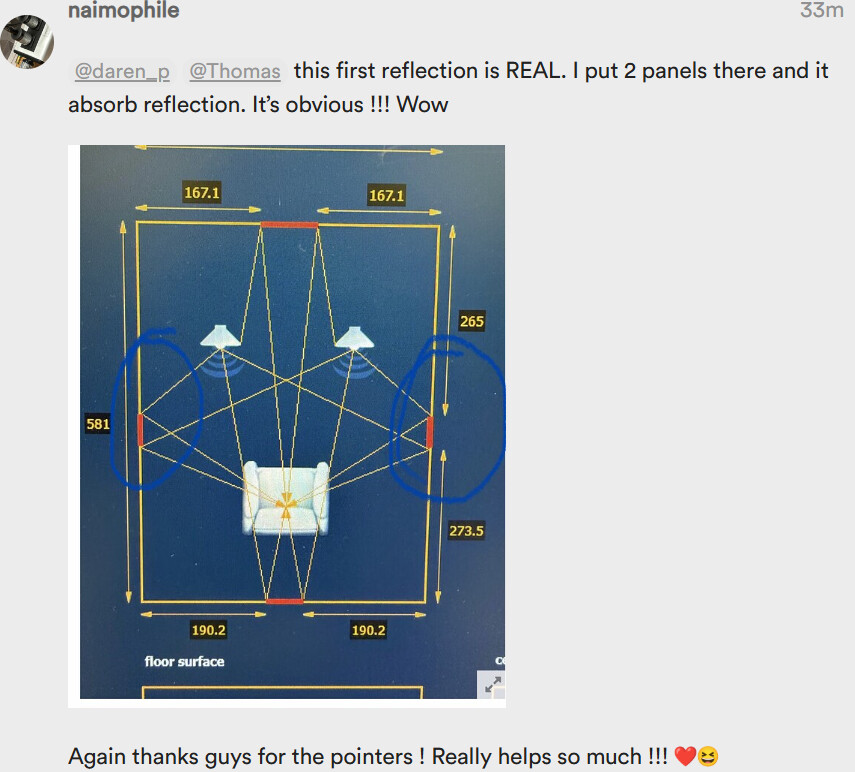
@naimophile
I’m moving the conversation to the appropriate thread. 
Yes, the positioning, thickness and material of the panels are absolutely critical.
That said, your diagram contains a few small inaccuracies. Sound doesn’t always behave like that.
I’ll tell you more if you like.
Cheers,
Thomas
2 Likes
And re first reflection points, how critical depends on distance - once side walls are more than maybe 1.5m away from speakers the muddling effect starts to decrease, ditto rear wall distance behind listener. Front wall is less significant as IIUC it is higher frequencies that are most responsible for muddling the sound, and they radiate far less behind the speakers.
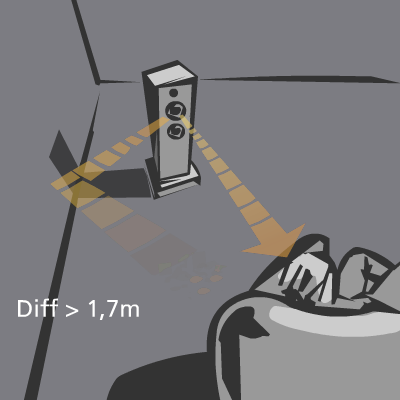
Here is some further information posted on the Audio Physic website, basically you want the reflected sound distance to be greater then the direct sound by 1.7m.
Acoustical Perception 5
The spatial information relating to a sound source is mainly detected by the brain in the first five milliseconds, everything which follows will at first be ignored. Sound travels at 1.7 metres (5.6 ft) in five milliseconds. If the sound of a reflection has to travel 1.7 m (5.6 ft) more than the direct sound of the source, then it will have no influence on our spatial perception.
1 Like
@Thomas that diagram that @naimophile posted is just a screen shot from a link I posted to help calculate where first reflection points on all 6 walls are located for your actual room.
1 Like
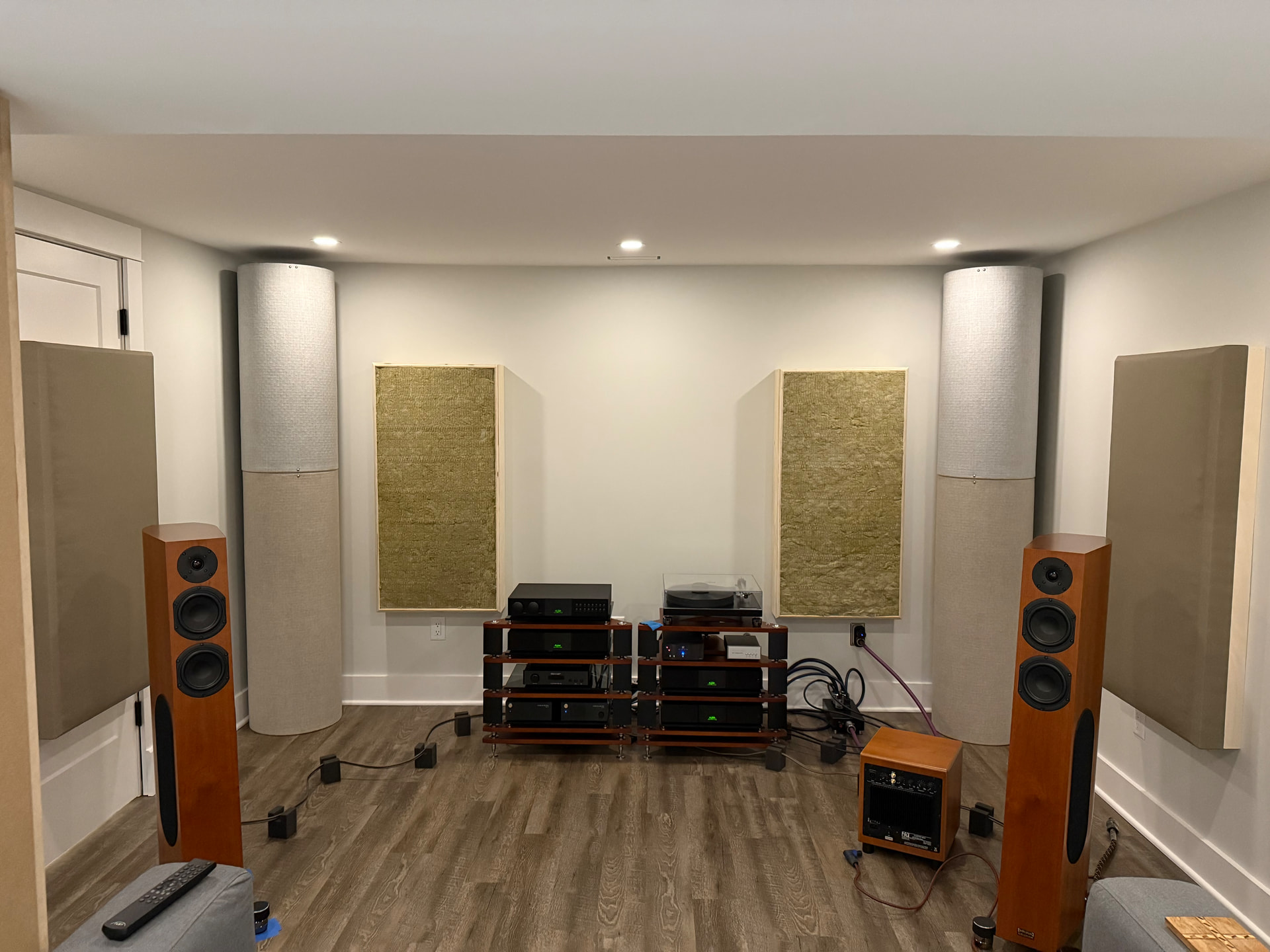
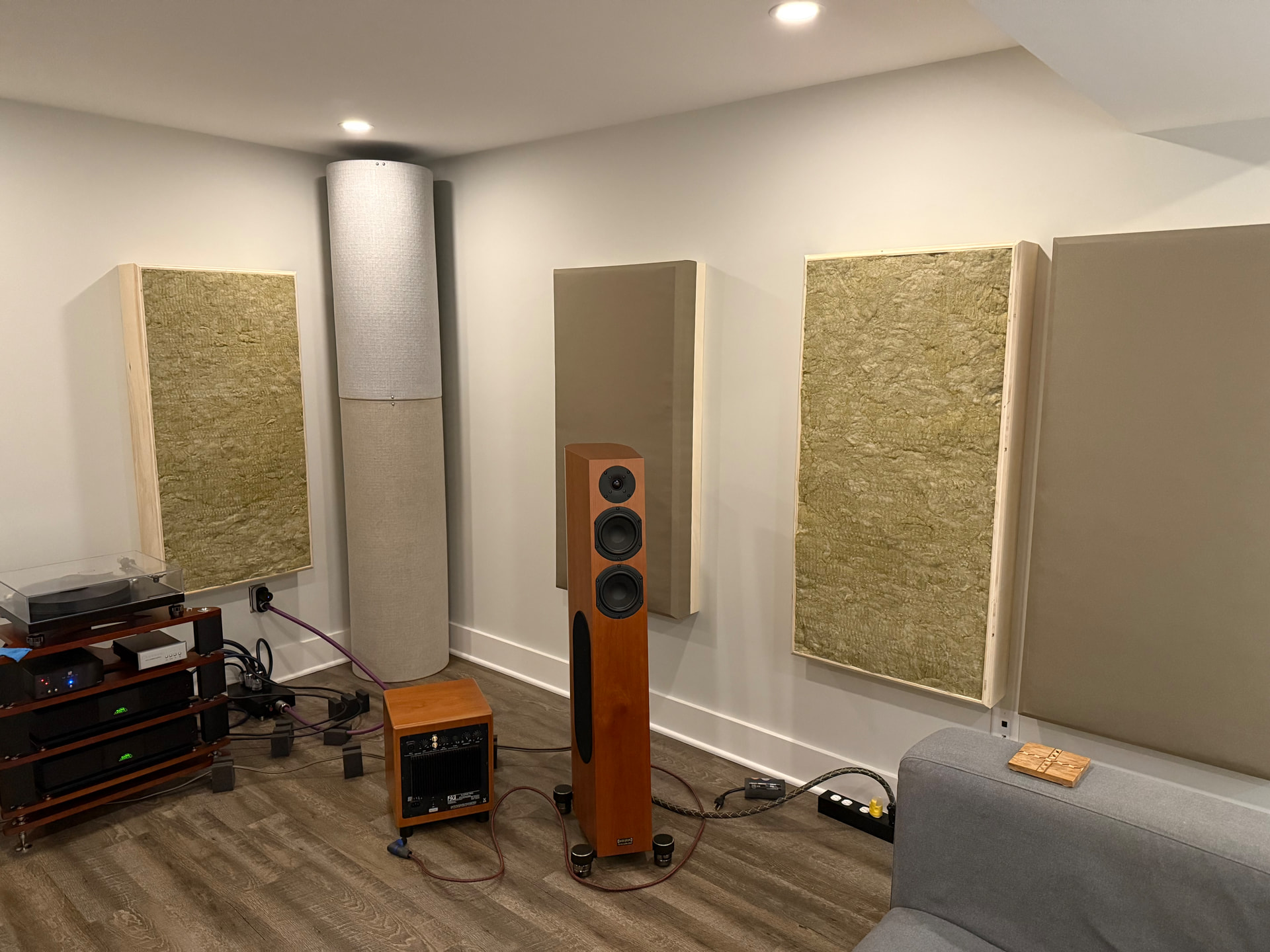
After close to 3 years since I started making/modifying previous DIY panels for my new at the time dedicated listening space, I’m happy to report I finally ordered 21m of acoustic fabric to cover said panels  Looks like this will be one of my projects over the Christmas break.
I’ll attach a few previous pics to give an idea of the room. You’ll notice some of the panels are covered, while some not. The ones without covering I made specifically for this room, while the other ones are previous panels I had made. I modified these panels after realizing they weren’t performing as good as they should, so I extended their frame & swapped out the type of insulation.
It was interesting, in that I had 5 of these previous panels that were in my old space that I had made for me by an acoustic company. So I initially placed 2 on the side wall first reflection point, 2 on the front wall & one on the rear. These panels were ~3.5” thick, to be fair the manufacturer said I should go thicker but they were for a shared space & didn’t want the panels to be excessively thick (not knowing the compromise at the time). I wanted to add more panels & built to a different spec for my new room so I started with the two panels on the front wall, they were built ~8” thick & using a different insulation fill. What was a real eye/ear opener for me is that when I put these on the front wall, they had more impact on sound vs the previous panels on the side wall first reflection, which didn’t make much sense to me, as the side walls should have more impact. This lead me to believe my previous panels weren’t performing at the same level. I then proceeded to extend their frames to make them 5.5” & install a different insulation that was less dense. This made a very large difference.


6 Likes
Interesting I note you use the words spatial perception: my understanding is that the worst effect of early reflections from near reflection points is a muddling of the sound, the brain unable to differentiate between the information in the direct sound and that in the reflected, effectively causing smearing of the sound. Spatial perception is indeed another factor. And of course even with walls some distance away reflections can make the sound quite unlike that captured in the recording, and the balance there is to try to have a reasonable/realistic ambience with neither excessive reverberation nor unnatural deadness, and of course the degree of evaporation in domestic rooms can be hugely with structure, decor and content, some likely to benefit far more than others from acoustic treatment additional to anything needed to suppress excessive early reflection.
Purely out of curiosity, did you consider doing some of the panels the same colour as the wall so they blend in, or using fabric printed with artwork?
Not my choice of words, just a cut and paste from the Audio Physic website (possibly due to translation from German) 
I can say years back in a different space, without any acoustic treatment at the time. I significantly changed the toe in of my speakers, this lead to the reflected vs strait sound on the sidewall to be greater then the 1.7m distance, which had a massive impact on the sound. At the time it removed a massive amount of harshness, it was like I was finally listening to the speakers themselves for the first time. It was a revelation for me at the time.
As mentioned, the panels that did have covering were old panels that I modified. So the fabric will be removed from them & they will all be done in the same colour fabric, Duvaltex/Guilford of Maine FR701 Silver Papier, which matches most of my ASC bass traps & will blend in with the walls much better 
My two lower bass traps at the front of the room are finished in a slightly different colour of the same fabric. I have thought about re-covering them to match but I may swap them out at some point. They are ASC 16” Supertraps, where as all the rest are ASC 16” ISOThermal traps, which perform better. So I may swap them for matching colour 16” or even step up to 20” versions….
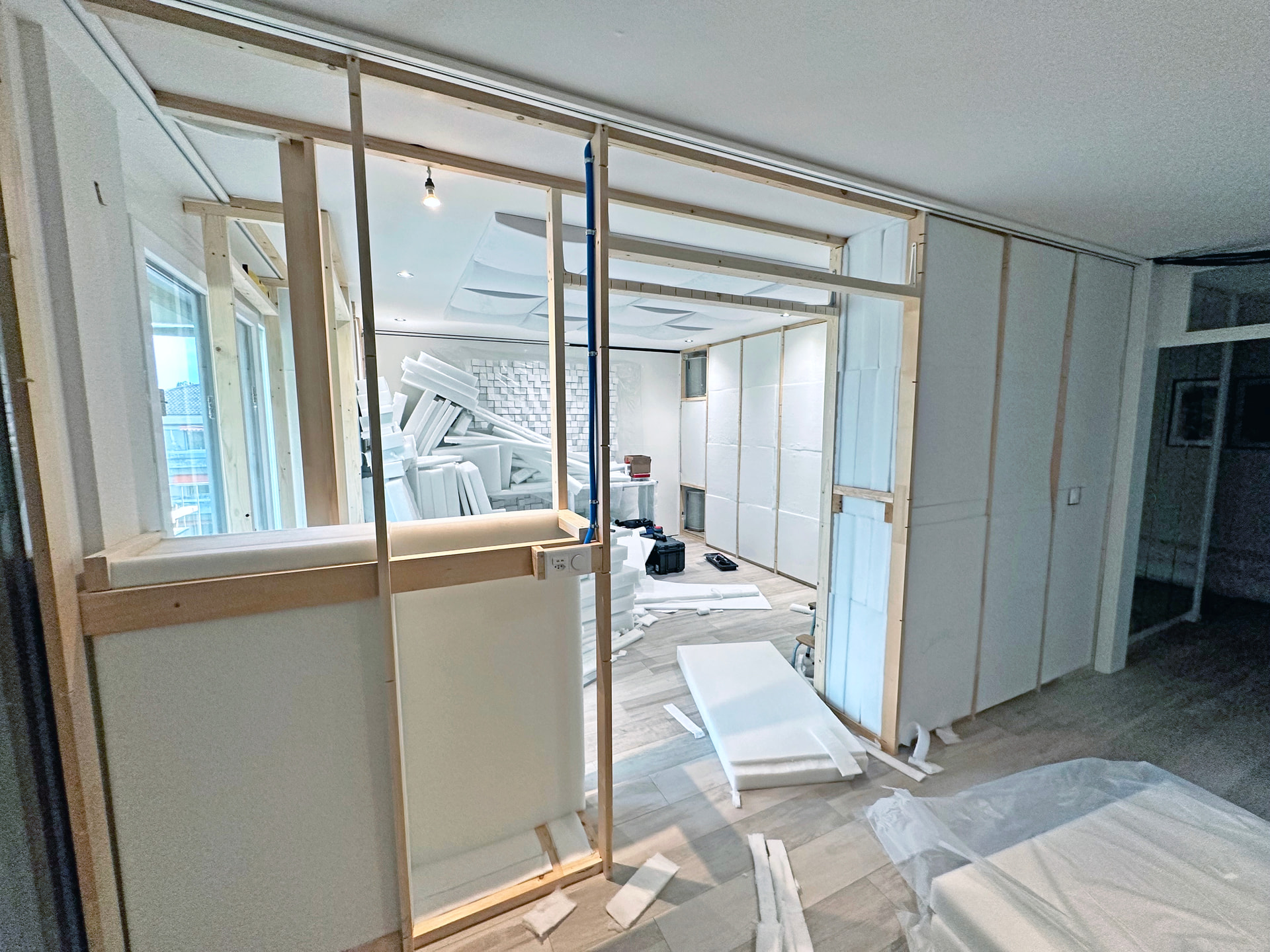
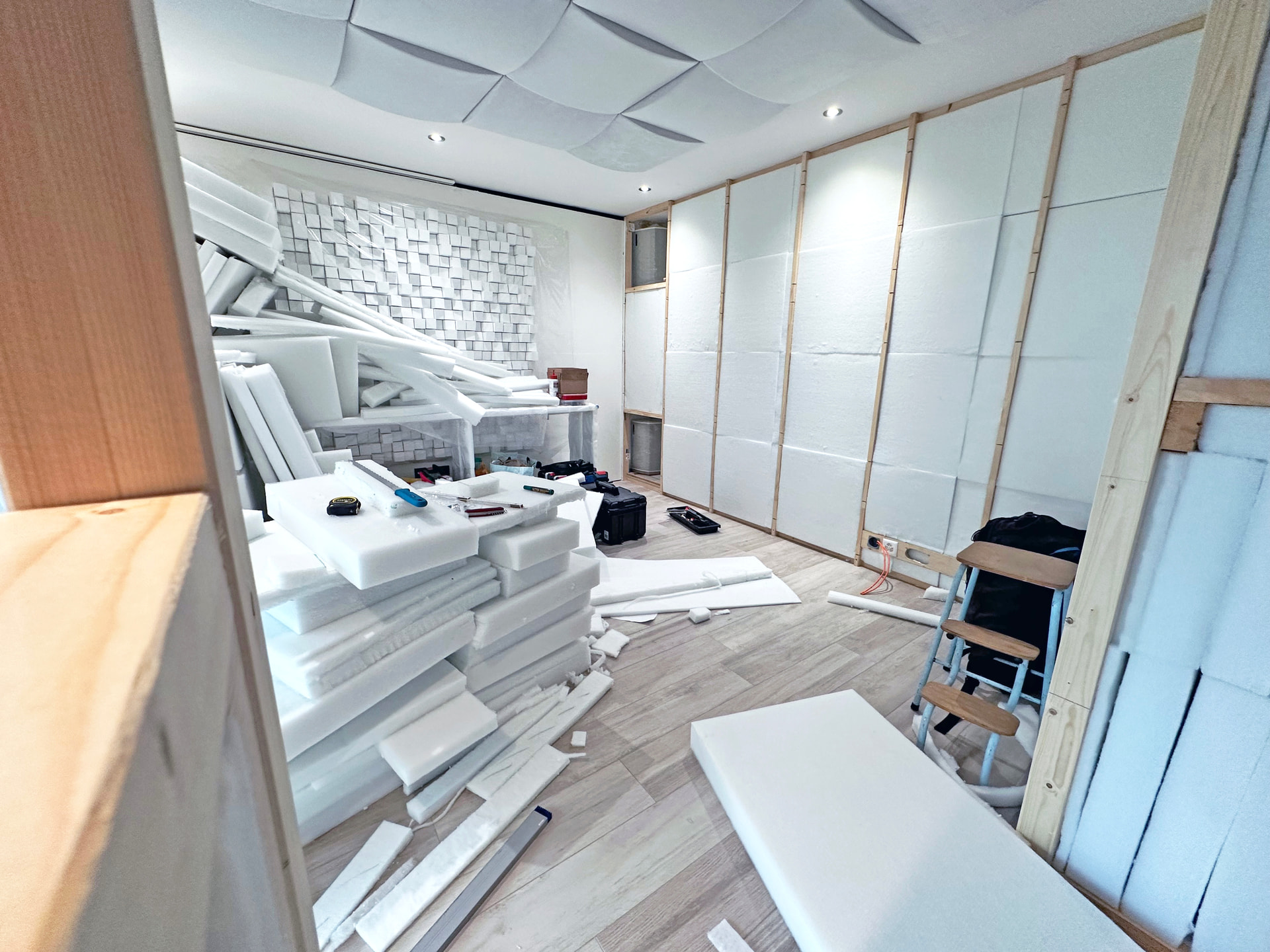
Here are two photos; they should give you an idea of the work involved. It felt like it was never going to end… 
But as I said before, it was absolutely worth it. The end result has exceeded my expectations by a very wide margin.
If I had to choose between my Magico M2s with a properly treated listening room, or a pair of Magico M9s without the room, I’d take the M2s and the room without a second’s hesitation.
Good acoustic treatment is what allows you to truly hear what your speakers are capable of.
Cheers,
Thomas
Edit :
Just a few straightforward details about the acoustic treatment used:
-
The diffusers on the front wall are Vicoustic Multifuser Wood 64 panels (180 cm x 180 cm).
-
On the ceiling, I simply installed 16 x Vicoustic Cinema Round Premium panels.
-
In the corners, I’ve placed 4 x PSI AVAA C20 units. The PSI AVAA C20 absorb virtually 100% of frequencies between 15 Hz and 150 Hz over an effective surface area of around 4 m² each. They’re basically acoustic black holes…
-
The white material you can see all around is Caruso ISO-Bond, with a flow resistivity of around 5,000 Pa·s/m².
-
The total treatment thickness, from floor to ceiling, is between 50 and 52 cm (the ceiling height is 2.50 m).
-
A thickness of 50 cm allows for some rather impressive theoretical absorption figures, as shown below , and this is clearly confirmed by listening. The bass reproduction is…hard to describe.

11 Likes
Impressive Thomas, so if I’m understanding correctly is that 3 or all 4 walls that are filled with ~50cm of the ISO-Bond? What is then used as the finished material/product covering these “false” walls?
2 Likes
Three walls.
The front wall is a mix of light diffusion and absorption.
I covered the wooden framework with two layers of acoustic fabric, Camira Lucia Abodo, purchased from camirafabrics (dot com).
Edit :
Only a single layer of fabric hides the four PSI AVAA C20s.
I spoke with a PSI engineer, who confirmed that this setup is perfectly fine.
3 Likes
I find your room really interesting Thomas, what made you decide to do so much absorption, as this typically isn’t something you see (at least not that I’ve seen)? Did you have professional input or have/had measurements done?
Hi daren_p,
In the end, my journey has been fairly straightforward.
My first “proper” system was a SuperNait 2.
It was a lovely setup.
But for the kind of music I listen to, it wasn’t ideal.
For some good old Pink Floyd, absolutely brilliant!
For a violin concerto… not quite so much.
So I bought the 252DR/300DR combo.
I installed it, let it run for a few days, then sat down for a proper comparison.
And honestly? Huge disappointment!!!
Yes, there was a difference, but nothing remotely earth-shattering.
Pretty underwhelming, actually.
That’s when the penny finally dropped: the problem wasn’t the hi-fi at all, it was the room, or rather, the complete lack of room treatment.
So I treated the room.
Read a few things. Watched a couple of videos. Job done.
Despite having a solid scientific background, I’m like many: rather lazy.
I only did half my homework.
Room acoustics is actually a very simple topic.
Truly not complicated at all.
But you have to tackle it the right way round.
You must start by treating the bass.
You really, really must treat the bass first!!!
Otherwise, to put it bluntly, you’ll inevitably make a complete mess of it.
And yes, I made a mess of it.
Almost twice.
So what does “making a mess” mean?
Simple: absorbing the highs and mids while letting the bass run riot and smear all over the music.
That said, even a bad (well, not so bad) acoustic treatment dramatically opens up the stereo image.
It doesn’t just open it, it stabilises it. It’s quite striking, actually.
And of course, you suddenly hear loads of details that were previously masked by room-induced distortion.
So yes, I was happy…
But the bass was still thoroughly dreadful.
Most people are so used to muddy bass that they think it’s normal. I don’t.
I’d rather have less bass than bad bass.
So I went back to reading, properly this time.
My goal was a symphony orchestra (within the limits of my speakers, obviously).
In the end, what we’re aiming for is actually very simple, really simple:
A reasonably uniform decay time across the audio spectrum. Or, to be realistic, from about 40 Hz to 20 kHz.
Easy to say. Very hard to achieve, especially in small rooms (Under 50m2).
So I looked at how mastering studios are treated, particularly rooms under 50 m².
The conclusion was clear:
cover as much surface area as possible with at least 40 cm of acoustic absorber.
That’s exactly what I did.
The result is nothing short of stunning.
I haven’t taken any measurements yet, but purely by ear, it’s frankly astonishing.
So, if you’ve got a dedicated room and you’re willing to sacrifice some floor space, go for it!
It’ll cost you far less than a new piece of equipment. And the result…
I’ll repeat what I said earlier:
I would take a pair of M2s in a treated room over a pair of M9s in an untreated room any time.
Even though I’m a bit of an audiophile geek, I don’t see my system as a trophy at all.
What I’m really after is a symphony orchestra!
Cheers,
Thomas
EDIT :
Just to be clear, I’m not saying my room is perfect, it isn’t!
A truly perfect listening room would first and foremost need a predetermined geometry, which means building it from scratch.
That said, for a normal living space with a 2,5 metre ceiling, it’s hard to do much better. 
I’m getting the best out of my equipment, and I have my symphony orchestra. 
If I ever move, I’ll have a purpose-built room designed from the ground up.
But that’s not happening any time soon.
14 Likes
@Thomas do you feel that you have effectively removed the room from the equation? Or putting it a different way rather than being like a room the size it is (or was before you made it smaller!), and rather than being a completely dead space like and anechoic chamber, is it more like having no food, the walls not being there, a bit like being out in the open at a quiet time? I asked the best thing I have ever heard from any was not a particularly high-level system, but just a decent system in a garden away from buildings, effectively removing the room from the equation.
Also I need to use four of the AVAA C20s. Did you consider the C214, which though more expensive on paper sounds as if one might do the same as two C 20s?
1 Like