My current room size is ~12.5’ x 19’ or ~238sqft(22m), I might have missed it, what is your room size?
It is funny sometimes, I’ve posted room pics before & have got comment like it “must be a dead sounding room”, which I find rather humorous. My previous room which had 5 3.5” panels installed, combined with soft furnishings & thick carpet was more dead sounding then my current room which has 6 5.5” panels, 4 7-8” panels, 2 14” bass panel in both rear corners & 8 16” ASC ISOThermal tube traps in the 4 corners.
Room treatments can be rather expensive (my panels were cheap but the ASC traps not so much) but in the long run, probably saves you significant sums as I find I no longer have the constant urge to upgrade. This is due to going to shows & dealers & listening to sometimes significantly more expensive kit that doesn’t sound any better or often worse then what I already have. Now I know if I got said piece of kit home for a demo, I’d likely be more tempted. But it’s nice being content with what you already have (have been putting off multiple upgrades I previously planned).
I’m pretty happy with my room currently (started on my re-covering of all my panels over the weekend), I have space left open on the front wall as I was planning on trying some diffusion there. Also thinking about adding some treatment to the ceiling but have held off as I may finally swap speakers, which may end up in a different position. My other thought was about adding a scatter plate to the large panel centered between the booshelves at the rear of my room.
I can only agree, I have partially treated my room and the effect has been dramatic for me. If you don’t do it, you’ll never understand what your gear can do in my opinion.
That’s a lot of questions packed into just a few lines!
I’ll do my best to answer them.
No, of course not
But it is treated well enough that what I hear now is coming mostly from the loudspeakers, not from the room.
The room itself isn’t any smaller.
I haven’t added walls.
It’s exactly the same size as before.
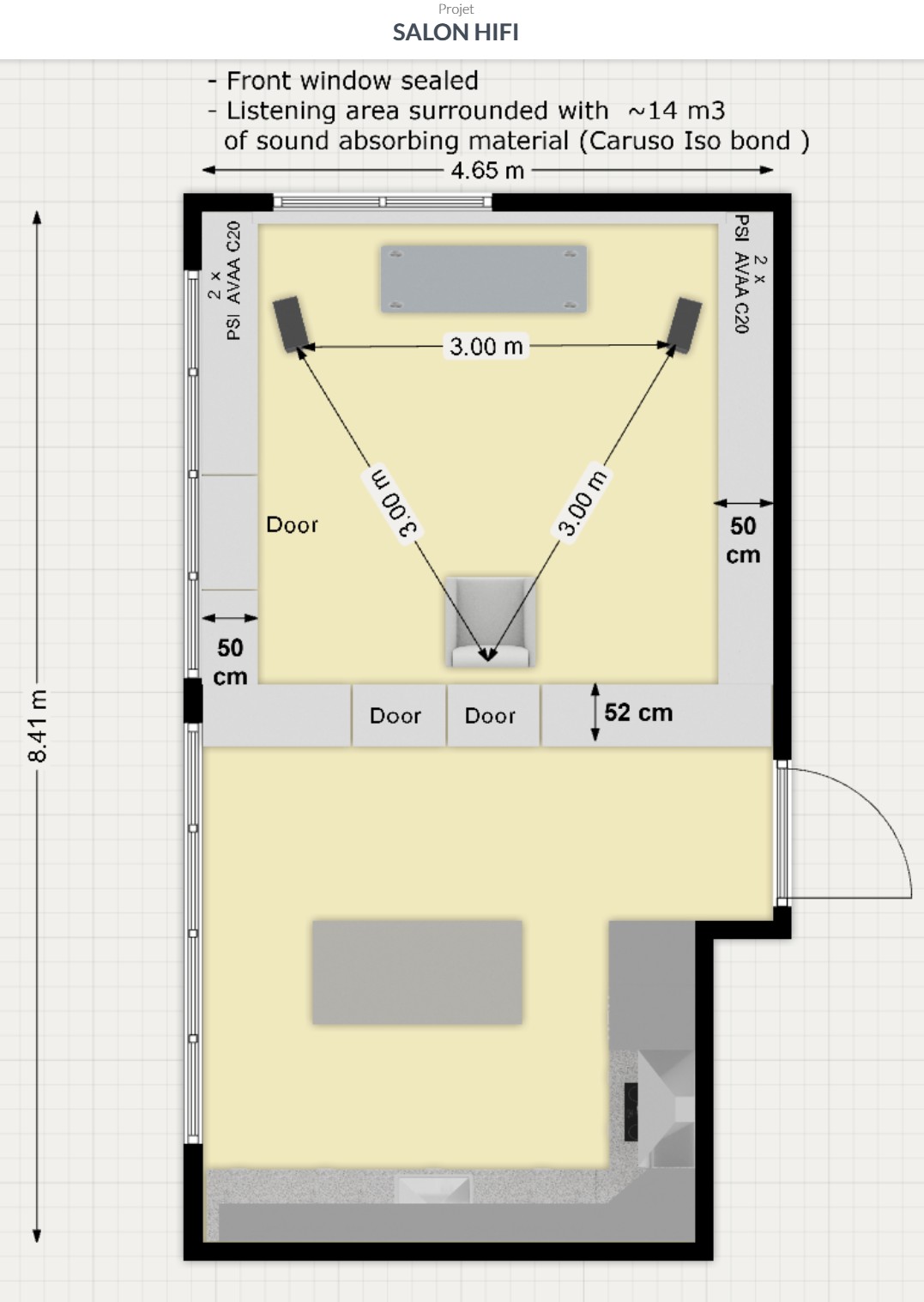
All I’ve done is add a large volume of Caruso ISO-Bond.
From an acoustic point of view, the room is still 38 m².
As for the “dead space” , I’m not a big fan of that expression.
It’s usually the result of a misunderstanding, or at least a semantic shortcut that creates confusion.
In theory, and only in theory, an anechoic chamber would be the ideal listening room.
In practice, being inside one is deeply unpleasant for human beings.
It’s uncomfortable, unnatural, and not something you’d want to spend much time in.
And in any case, turning a normal living space into an anechoic chamber is simply impossible.
So in our context, both “dead space” and “anechoic chamber” don’t really mean much or make any sense.
Now, on that point, I do agree with you
If you remove the walls altogether, and there’s no wind and no background noise, that would be the perfect listening room.
Must be Glorious!
Though you’d probably need some fairly serious kit to fill it properly, if I may say so. Say, a pair of Magico M9s and a couple of Soulution 717s running as monoblocks…
But to answer your question more directly:
what you really experience in my room is silence.
There’s no noise. Truly almost none at all.
It’s quite surprising at first, then it becomes deeply calming.
And, above all, it allows you to listen to very quiet sounds properly.
Which makes perfect sense for pieces like the first movement of Mahler’s 2nd Symphony (which has a dynamic range of around 24!).
When the room gets out of the way, the music can finally whisper… and you can still hear it.
Now let me try to explain what I mean by good acoustic treatment.
This will get a tad technical, but just a tad.
There are three key concepts to understand (among others):
- Room geometry
- Decay Time
- RT60
– Room geometry: –
This is largely a theoretical concept, and only really useful if you’re building a room from scratch.
It allows you to choose your problems, so you can then deal with them properly.
– Decay time : –
Decay time must be as uniform as possible across the spectrum.
This is very easy to understand when you see it on a graph, but harder to put into words.
If the decay time differs too much between the low and high frequencies, you get a time smear.
In simple terms, the bass is still ringing while the music has already moved on.
And yes, you can hear it.
Very clearly!
You just don’t realise how bad it is until it’s fixed… and then someone puts it back.
That’s when it becomes truly unbearable.
– RT60 : –
Everyone knows the RT60 figure, at least a bit.
What’s less obvious is how closely it’s linked to decay time.
The longer the RT60, the worse the problem I just described becomes.
## So what makes a good listening room? : ##
Well, I probably shouldn’t phrase it like that.
Everyone has their own taste, after all.
Let’s say instead : a room where you hear what’s coming out of the speakers, rather than what’s bouncing around the room, should have:
An even decay time and a relatively short RT60
That’s what’s often called a “dry room”.
And honestly, it’s extremely enjoyable.
Especially if you care about stereo imaging.
The image doesn’t just widen, it locks into place.
Regarding the PSI AVAA C20s, I have four of them.
When I bought them, the C214 didn’t yet exist, so I couldn’t compare.
I’ve read about it since, but I haven’t tested it myself, so I don’t really have an opinion.
What I can say is that placement isn’t trivial.
And unfortunately, you need several units.
I’ve had a PSI engineer at my place twice.
My placements aren’t perfect.
But they are good, they’re in key locations (corners).
Given the sheer amount of passive absorption I have, I could almost live without the AVAAs. Let’s say they’re the icing on the cake.
I hope that answers your questions.
And sorry if I was a bit unclear.
Acoustics is a subject I really enjoy, but I have less free time than I used to.
Meaning I’m spending way to much time writing
BTW, I wasn’t in an way suggesting that a completely dead room or, worse, an anechoic chamber was in any way desirable, and going too far in that direction wouldn’t make for a pleasant or even necessarily good listening environment.
Regarding playing in an open space, when I did that it was with a decent system but far from top end (but of course fullrange speakers. It really did sound as if there were musicians using the patio at the end of the garden as a stage, more info in this link if interested: https://community.naimaudio.com/t/whats-the-best-sounding-system-youve-ever-heard/11188/25
In my present room I had been waiting for the opportunity to have some structural alterations done before adding whatever treatment is necessary: I did an assessment of it a few years ago, using REW, and it’s not bad (aided by size and abnormal shape (irregular hexagon with one axis of symmetry) , but it would definitely benefit from reducing decay times. However a sparsity of available corners (only 2 wall right angles, one with a door and other with a central heating radiator, leaving the half corner above radiator, as the only available tricorner, plus some of the wall-ceiling corners for bass traps as next best positions for bass traps led me to feel I’d be best with active traps, hence my specific interest in that.
My perfect room of course would be none as just discussed, and part of me has been wondering what it might be realistic to do/achieve… However before the opportunity came to start things there came a change of plan and, not previously envisaged, we will be moving home, so I have to start from scratch, and both a smaller and rectangular room, so treatment needs will certainly be greater…
I’ll have to go back to basics, starting with fundamental consideration of layout: The most likely room will be some 3.65m x 6.6m. If that ends up being the best room then my basic choices are 1) Speakers firing down the room, but then inevitably close to side walls so substantial treatment on those walls before I even think of anything else, though bass trapping of course. 2)Another option is variant of that, but building a false wall at the front, each side angled, soffit mounting the speakers tp obviate all comb filtering. 3) The third is firing across the room, speakers close to wall, nearfield with listening position at rearmost 38% position, and side walls very distant. A bit more research, and likely some initial room teats once I wnow for certain which one I’ll be playing with - meanwhile your detailed description and pics of yours give food for thought - thanks!
They’re a long way from the electronics anyway.
And compared to the magnets inside the speakers, they’re pretty insignificant.
More generally, there’s really nothing to worry about with magnets. The magnetic field drops off with the square of the distance, so it fades very quickly.
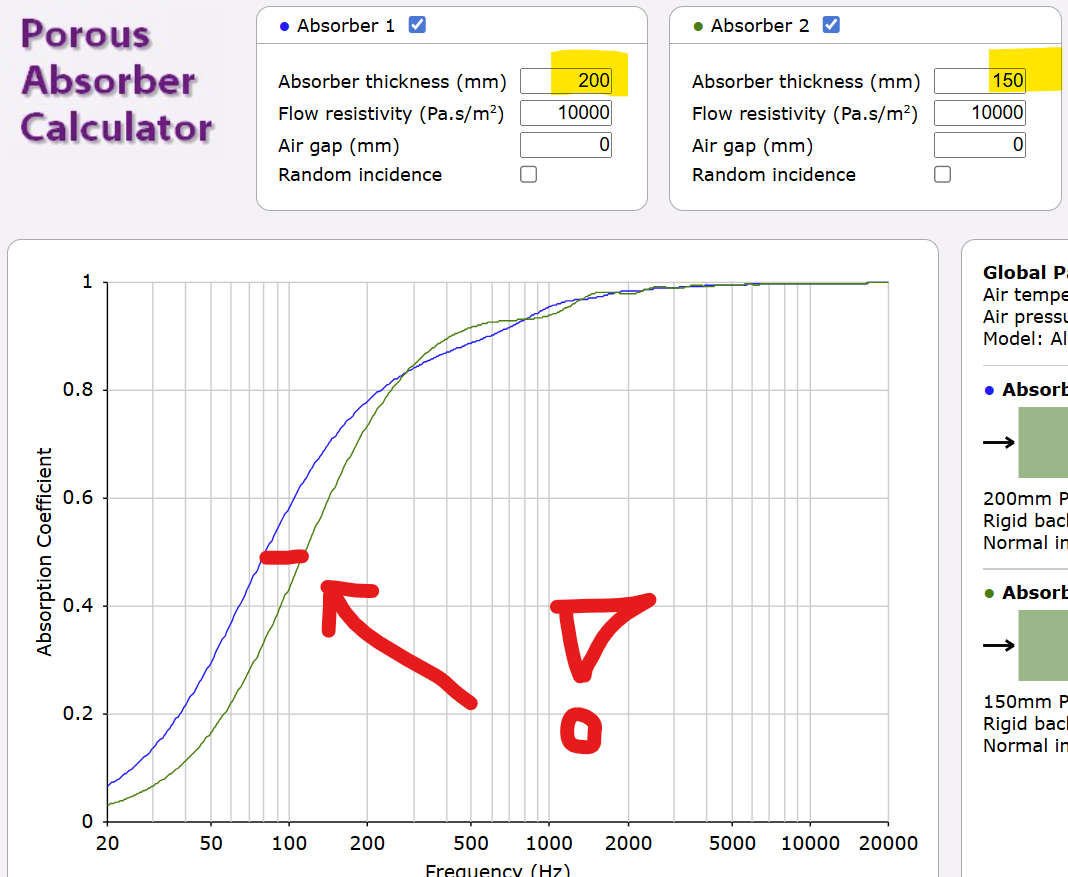
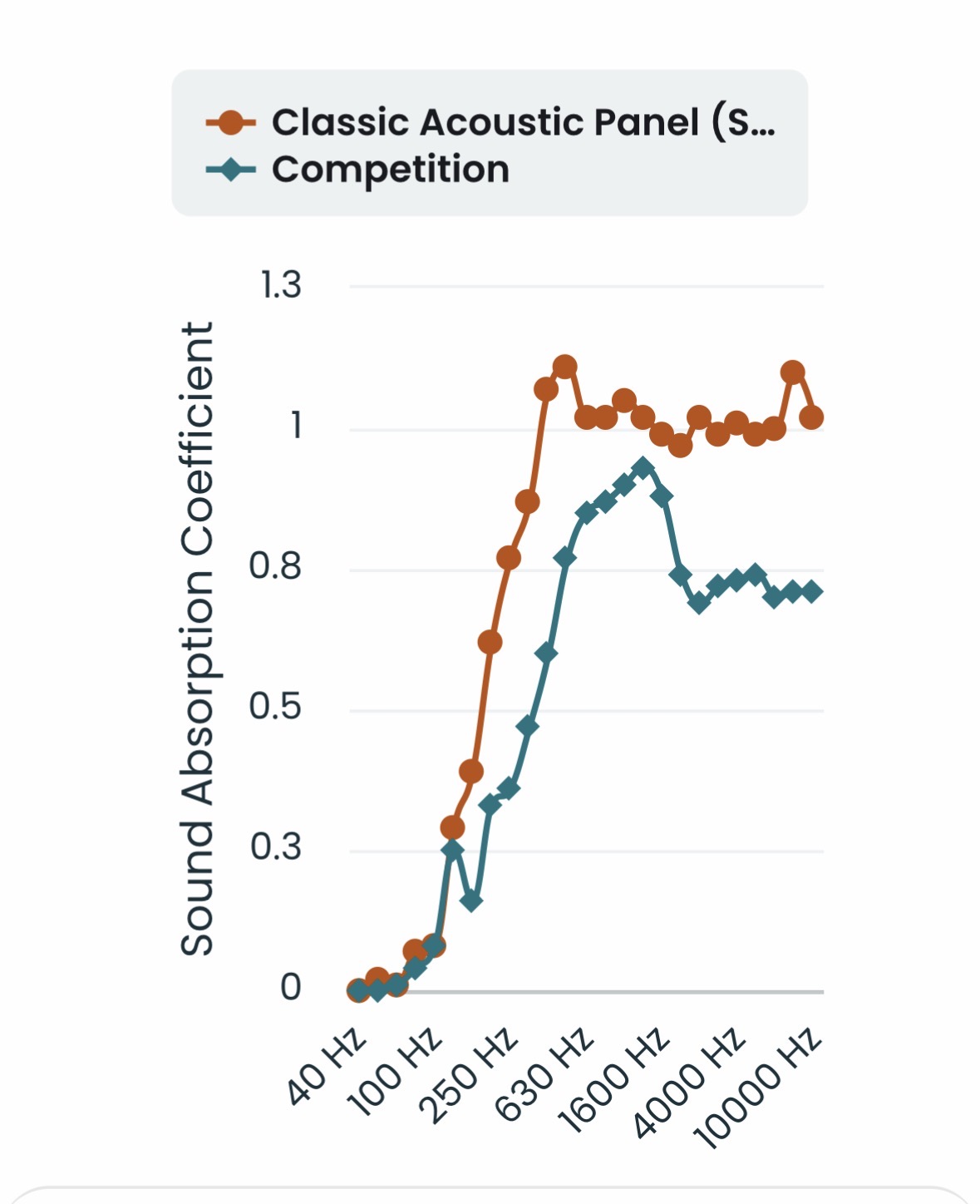
Then it must be a scientific mystery of the 21 th century, as my absorbers are 5 cm thin and the results are very significant: from uncontrolled and nebulous bass to a distinct and sharp one. No bass issues anymore.
5cm won’t do anything with lower frequencies. Physics. I’m guessing what happens is you reduced issues in mid/highs letting your ears hear a more focused bass.
Thanks for the detailed reply Thomas, lots of great info there. To touch on some of your comments, yes with regards to diffusion I was aware depending on the type of treatment, you need to be a certain distance for it to work properly. As mentioned this is why I was holding out on the ceiling as if I change my speakers it may change both speaker position & listening position. I wasn’t sure about absorption vs diffusion (if I have the required distance for said diffusion treatment) but I was curious to try something like Vicoustics DC3/4 in that location, as they’d be easy to play around with/move around without doing damage to the ceiling. Absorption may be the better option & will also likely play around with a combo of them both.
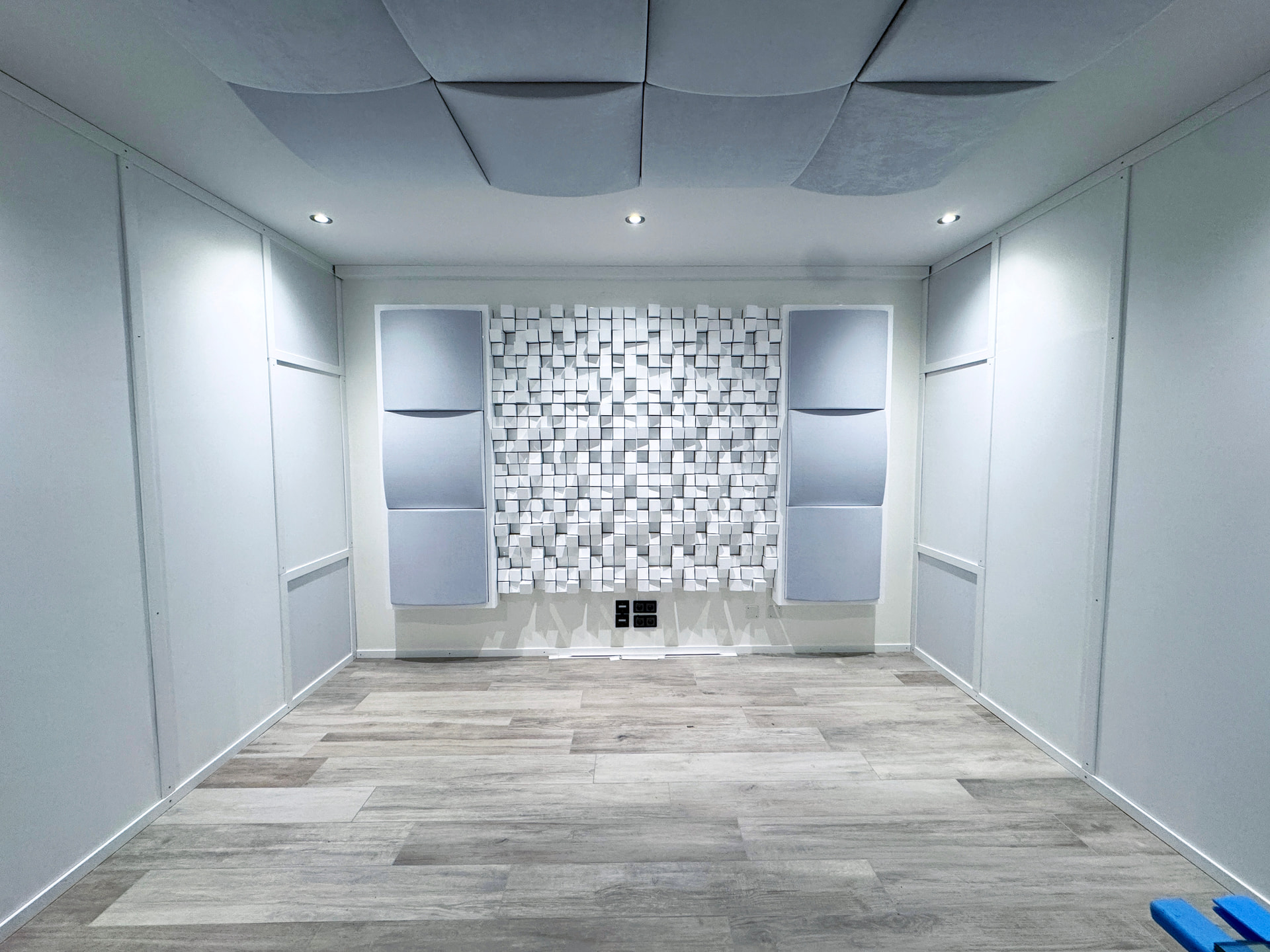
For the front wall, what I was thinking about was something like a pair of GIK Q7D Quadratic Diffusors with ~6” (15cm) deep wells. The panels that are currently installed on either side of where these would be placed are 8” (~20cm) thick. These are then flanked on each corner, floor to ceiling with 16” ASC tube traps, which absorb well below the 100hz range (probably reach down to ~30hz but obviously are not super effective at that level, with physics being physics)
I did pick up a UMIK-1 Mic a while back to take some measurements but haven’t gotten around to it. There is a member of a local audio classifieds website that does a lot with room acoustics & has extensive knowledge on the subject, was actually thinking of having him come in & take measurements to get further knowledge & help me with understanding how to properly apply what has been measured. He also has an assortments of acoustics treatments to try if needed, which is always a nice option to verify the effectiveness before purchasing.
In my room I haven’t been too concerned with making my panels even thicker as my thinking is that the ASC tube traps in all for corners are what do the real heavy lifting below ~250hz (combined with the two rear corner traps behind the ASC traps that are 15” (38cm) deep. Just as you say, I now find bass quality in regular rooms severely lacking. Currently my only real complaint is a bit of a suck out ~70hz in my listening position, that I’d like to clean up a bit better.
My room, I built from scratch in my basement, so I was able to pay better attention to wall/ceiling construction for better sound proofing from exterior noise. I made use of acoustic drywall, MLV, SONOpan, putty pads around wall penetrations, acoustic sealant in all gaps. HVAC was run to the room, but I installed muffler on the supply ducting & sound absorption panels in the return ducts. Also added butyl rubber dampening on all ductwork running in the ceiling as I didn’t want the potential for any possible rattles. This has really helped with all the low level details, as you say, if the listening environment isn’t quiet enough, doesn’t matter how good the kit is, you’ll still be missing details. Also ran a dedicated circuit to feed the kit, with cryo treated wire.
I did a ton of reading before building the room & on room acoustics & treatments, what I learned is the more you learn about room acoustics, the more you realize how little you actually know about room acoustics
Edit: Side note, Thomas you are an enabler! I’m just finally in the process of covering/recovering all my acoustic panels/bass traps to match after close to 3 years & you come in here & talk about extending them! I’m not going to scrap all the covering I’ve just done (as I’m about half way done) but though an ordering error I should have about 9 yards of acoustic fabric left, could always make some extensions & cover them….. also have some acoustic insulation left, hmmmm……..
Since my last post was already way too long, just to add on the rear wall, didn’t do diffusion there as I wasn’t initially sure if my listening position would be the typically 5-6’ required space (currently not an issue). I’ve been happy with just absorption on that wall, but was curious on the impact of just adding a scatter plate on top the the large center panel.
From what I gather (which may be wrong), if you have the required listening distance, people typically add diffusion in smaller room to artificially sort of act like making it acoustically a larger space. So if you have a smaller room & its lacking in say sound stage width, adding some diffusion at the first reflection points on the side walls may help acoustically expand the sound stage. Now I guess one could argue a small space is probably still going to benefit more with as much broadband absorption as possible, so like many things, always some sort of compromise (but could always look at using a combo of both)
BB, let put it simply.. I moved to a new apartment last February. Set up my system and played with speakers positioning a long time. Was disappointed by the sound. The high frequencies were shrill, or the bass not focused and distorted.
I asked some help from a professional, he gave me some advices, but his entire prestation would cost me 5k, including panels .
I decided to follow my instinct and added step by step these panels, then covered the opposite wall, behind me, with 3 cm foam wood panels.
The sound now is the best I have ever had. Nothing, to my ears, is lacking. The drums and percussions are fast and dynamic, the voices very incarnated, natural, and the bass tight and resolved.
So what can I say more? Maybe I am in an illusionary state of mind, persuaded that all is very nice sounding, but in fact not?
You had yourself acoustic issues in your room, with your ex 552/500, that you couldn’t resolve. But you seem to know how to treat acoustically a room. You ended finally with a Nait 50. Was there an impossibility to treat your room?
My room is too small to take the amount of acoustic treatments for bass. I still want it to look like a room and not a studio I’m very happy with the acoustic balance today. I know it can be better but that would mainly require a bigger room. You do what you can with what you have
Active traps like the PSI AVAA unts would seem ideal, apart from high cost, though if considered (as the room should be) as a fundamental part of the system and as much a part of getting sound right as every other component, maybe the expense is entirely worth it. Of course a home trial highly desirable. I certainly expect to be checking this one out after an upcoming house move if the room can’t accommodate adequate passove trapping or if the cost of that looks like approaching anywhere near as much for anticipated similar effeciency. https://www.stereophile.com/content/psi-audio-avaa-c214-active-bass-trap
My time is a bit limited today.
So I’ll keep it short.
Well, I’ll try!
I’m off for some climbing in an hour!
Yes, the PSI AVAA C20s are genuinely very effective.
If you can’t accommodate 15 m³ of absorbers like I did, then the only realistic way to deal with bass below 150 Hz is with PSI AVAA C20s or C214s.
The main difference between the C20 and the C214 is that the C20 is purely analogue, and therefore probably a lot faster.
The C20 is more professionally oriented, aimed at mastering environments.
I suspect the C20s are more precise, more reactive, maybe.
But honestly, I don’t know.
I’m not the kind “I think that…”.
The best thing to do is simply to call PSI, which is what I did before buying my four AVAA C20s.
In my view, 4 to 6 AVAA C20s combined with a few 17–18 cm thick panels at the first reflection points is an elegant and relatively non-intrusive way of treating a room.
The problem, is the cost.
I listened to Jean-Pierre by Marcus Miller yesterday afternoon.
The bass hits hard!
But it doesn’t linger, if you will.
It’s fast, tight, ultra-precise. Razor-sharp!
Wow, astonishing!!!
I tried that same track back in 2020 in my living room with only a “light” treatment.
What a nightmare…
I simply gave up…
After that, I listened to Marcus Miller only through headphones.
Now I’m back to that kind of bass-heavy music on my speakers system.
By the way I have no doubt my panels had an important effect on the lower frequencies, soundstage and depth improved dramatically. I couldn’t be any happier! I suspect it might depend on the type of foam used and the specific needs/limits of the room.
I agree and glad we share together what science denies.
It may also be the characteristics of the speakers. I guess that with my light treatment, putting some Focal Grand Utopia in my room would be a sonic disaster.