One benefit of living in the Northern Tundra….. No pesky neighbour issues……
4 Likes
Yes I’m looking forward to listening to them.
It’s is a very old townhouse in Jaen, Andalusia we were told by our neighbours it’s one of the oldest house in the village.
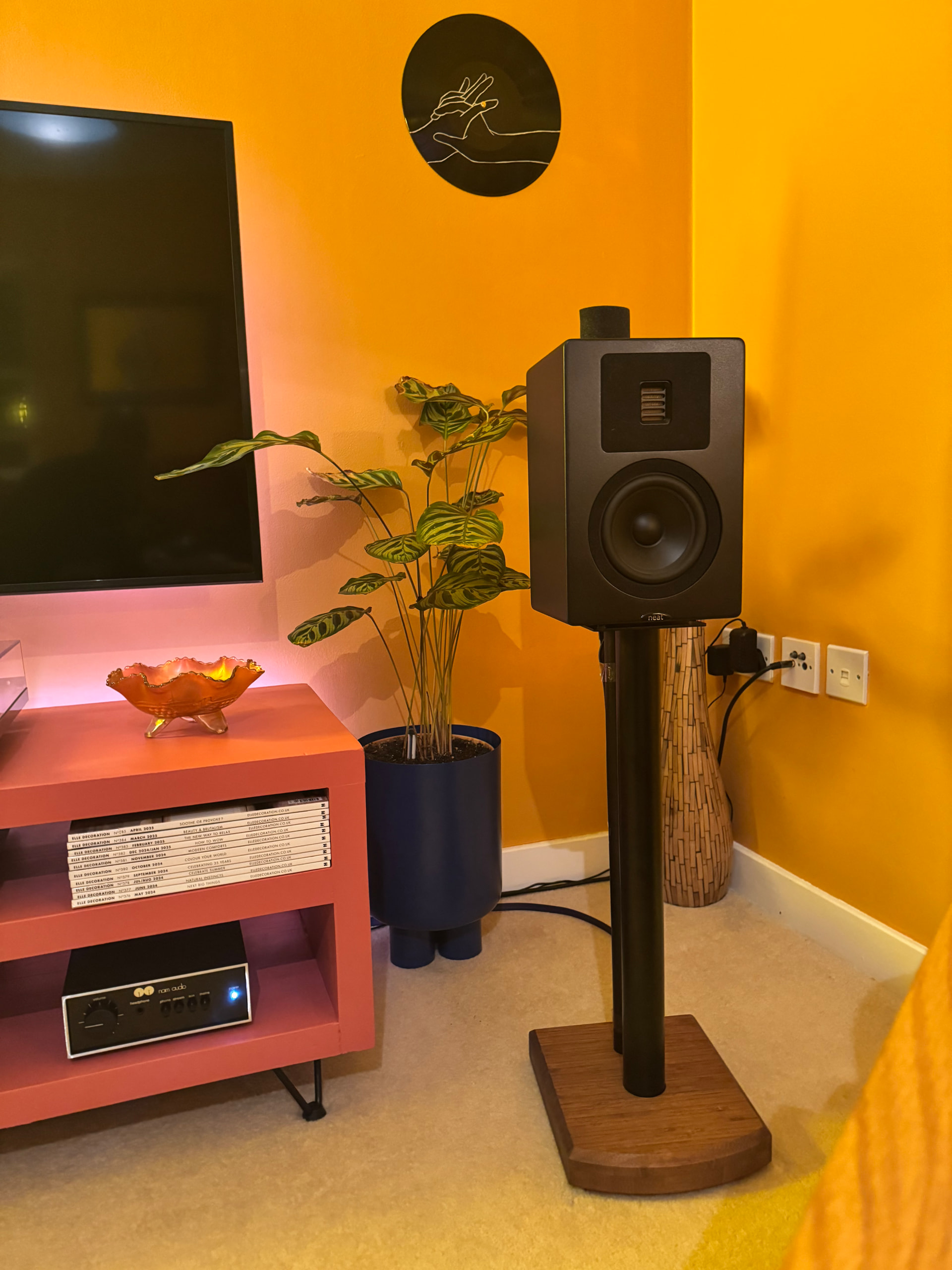
Couldn’t wait and did a round trip around the M25 and came back with a pair of Petites.
They’re absolutely awesome! Hearing the NN50 in a different light 
20 Likes
Look great, what finish is that? Looks like the original satin black as opposed to black oak?
I really like the matt finish.
1 Like
Yes it is the Satin Matt black.
1 Like
Brand new or ran in ?
I always fancied a pair for my study but am restricted with walls and boundaries effecting the rear ports
You taken the foam bung out? I have mine closer to a wall ( fed from my N50/nd5xs2/ndac) and haven’t played with the bungs ( yet)
You know there is no difference to which direction the port faces? The only requirement is that the port is at least its diameter difference away from a boundary for it to be not affected…
Low frequencies emanate from around a speaker … not the direction of drivers or ports.
Some poorer designs leak higher frequencies through their ports and they may bounce off a wall etc.. to produce reflection effects… but that is something different.
having a speaker close to a boundary can cause room boundary effects (SBIR) if not designed for it and cause a poor and inaccurate eq response such as boomy bass or thin treble, but that is not to do with the direction of the port…
You can reduce the size or fill the port to limit the low frequency response of the speaker and let the SBIR in fill the lower frequencies… but very hit and miss with trial and error with fine speaker placement to balance out
1 Like
According to AI (front vs back port)
Bass-reflex (ported) enclosure behavior is dominated by the Helmholtz resonance of the cabinet/port system. Port placement (front vs rear) does not materially change the tuning frequency itself (assuming identical internal volume and port geometry), but it does affect boundary interaction, radiation summation, and perceived bass behavior in-room.
Below is the practical acoustic impact.
1) Boundary coupling & room interaction
Rear-firing port
-
The port output is directed toward the wall behind the speaker.
-
Low frequencies are omnidirectional, but proximity to the rear boundary increases acoustic loading.
-
Results:
-
Elevated bass amplitude (boundary gain).
-
Greater risk of boomy / overhung bass if placed close (<20–40 cm) to a wall.
-
Stronger excitation of axial room modes (front–back modes).
-
Front-firing port
-
Port output radiates directly into the room.
-
Less immediate boundary reinforcement.
-
Results:
-
Tighter perceived bass when placed near walls.
-
More predictable response across placements.
-
Reduced boundary-induced peak exaggeration.
-
Implication: Rear-ported speakers are more placement-sensitive.
2) Phase summation at the listening position
At tuning frequency (Fb), the woofer cone excursion is minimized and the port contributes most of the output.
-
With a front port, the path length difference between woofer and port to the listener is minimal → more coherent summation.
-
With a rear port, the port output reflects off the wall before reaching the listener → introduces:
-
Additional path length.
-
Phase shift dependent on distance to wall.
-
Possible constructive or destructive interference.
-
This can alter perceived bass smoothness around Fb.
3) Transient response & perceived “speed”
Strictly speaking, port orientation does not change system transient response (that’s governed by alignment/Q, tuning, damping).
However, perceptually:
-
Rear ports near walls can produce longer decay due to room reinforcement and modal ringing.
-
Front ports tend to sound “faster” or “tighter” in sub-optimal placements.
This is a psychoacoustic + room effect, not an enclosure physics change.
4) Port noise (chuffing) audibility
-
Front port: Any turbulence or chuffing is directly audible.
-
Rear port: Cabinet and wall partially mask port noise.
Designers sometimes place ports rearward for this reason in small hi-fi speakers.
5) Midrange leakage through the port
Ports can leak internal midrange energy if damping is insufficient.
-
Front port: Leakage is directly radiated → can color the lower midrange.
-
Rear port: Wall reflection attenuates and diffuses leakage → less audible.
High-end designs mitigate this with:
-
Long ports.
-
Flares.
-
Internal lining.
6) Placement flexibility
7) Measurable frequency response differences
In an anechoic environment:
- Virtually none (if tuning and geometry identical).
In real rooms:
-
Rear ports show greater LF variance depending on wall distance.
-
Can create +3 to +9 dB reinforcement below ~150 Hz.
8) Design trade-offs (why manufacturers choose each)
Rear-ported when:
-
Aesthetic preference (clean baffle).
-
Port noise masking desired.
-
Speaker expected to be stand-mounted away from walls.
Front-ported when:
-
Intended for near-wall placement.
-
Studio monitors (predictability).
-
Compact living spaces.
Quick engineering summary
-
Port tuning (Fb): unchanged by orientation.
-
LF extension: unchanged.
-
In-room bass amplitude: higher with rear port near boundaries.
-
Phase interaction: more complex with rear port.
-
Placement sensitivity: higher for rear port.
-
Noise audibility: higher for front port.
1 Like
In short as I say no difference in orientation of port on bass frequencies, but higher frequencies can be affected by cancellation effects of higher typically mid frequencies.
Some speakers use downward or inward sideward ports to reduce the effects of higher frequency leakage reflections in smaller rooms.
Personally I find sound absorption panels behind the speakers on the walls helps absorb any mid frequency leakage from ports.
Respectfully, in my experience this is not true in real world terms (rooms) because of this:
We don’t live in anechoic environments but in real life rooms where the above applies.
They only get better.
I used them with the default port blocked at first but then used them for a while without any bung finding the sound more open. With the very noticeable change in sound at about 100 hours I’ve the bung back in finding this the best balance overall now.
1 Like
I can simply refer you to real world loudspeaker design.. the quote from the web ‘AI’ site conflates SIBR and port placement with respect to different frequencies.
In my experience I have never found any difference on direction of port with respect to bass frequencies .. which is indeed how speakers are designed and indeed how physics works…with respect to bass frequencies in actual rooms. SIBR will affect speakers whether ported, or infinite baffle designs… and it’s their boundary proximity design tuning that is relevant, not the direction of the port.
In an anechoic chamber there are no reflections so of course higher mid frequencies that leak from lesser speaker designs won’t be reflected, as well air rushing sound.. this is in audio is often called ‘port noise’.
I can suggest a search on specialist speaker design sites…or alternatively the following video resource on YouTube does indeed describe common misconceptions about rear and front facing ports and what actually happens with speaker ports in the real world… and in the real world apart from noticing port noise there is no real difference… the video is in accessible real world language so easy to understand.
@Richard.Dane hopefully this fine it’s a non commercial tutorial by a loudspeaker manufacturer which is accessed via YouTube… it’s perhaps better suited to this forum than more technical explanations that perhaps many might not understand and corrects mis understanding / incorrect assertions and conflation from generalised web summarising tools (ie web AI) quoted earlier on.
I have had Dalis with rear port and they just didn’t work whereas the ATC have much better success being non ported.
1 Like
Simon, it’s a video from a manufacturer, so it falls under “commercial”. You can of course summarise or paraphrase from it.
Thanks Richard, I did previously summarise it and several others, but sometimes some on the forum need to see the references themselves. It just shows the dangers of using web aggregation AI sites on more specialist subjects where there is a lot layman misunderstandings, it can summarise common misconceptions and present as facts.
I guess we have expressed the dangers of web AI aggregation sites before on this forum.. and the importance of not relying on them, but treating them more as entertainment or as a sifting tool of references.
2 Likes
They were used from a friend but barely used and in mint condition so needed to be ran in.
1 Like
Nice one. I think the satin black is now discontinued
2 Likes
I’ve got them a little closer to the wall than I had the Rega so around 50 cm without the bungs at the moment.
Haven’t had a huge amount of listening time but so far like the weight sound wise without the bungs.
By the weekend they should be run in a bit and will have more time to listen.
1 Like
They are yes which is a shame unfortunately.