Hi,
a few years ago I bought a pair of titanium screws to replace the stainless steel ones that came with my cartridge. The freebies, there were two pairs, were either too short for a secure connection or too long, with nearly half of the threaded parts sticking out beneath the cartridge. As both headshell and cartridge body were made of aluminum, I wanted to try a different material.
The screws not only turned out to be extremely well made, they improved the sound, too. I can’t say whether this was due to the dissimilar metals, lower weight or anything else, but I was clearly audible.
As I’m about to return to my unthreaded Koetsu cartridge, I started looking for matching nuts.
To my surprise the search engine pointed to an article by Roy Gregory, former writer at HiFi+ and other places, who enthused about titanium screws, with a huge caveat. According to him, titanium is extremely prone to gall with other metals. He even declares that “you need to use an anti-seize compound on any titanium screw threads – at least if you ever want to get them undone again“.
As I have the same set of screws with at least three different cartridges without encountering any problems, things clearly aren’t that bad. But I still wonder if I have just very lucky so far.
Are there other current or previous users of titanium screws out there and have you ever had problems with them?
Given they are expensive (Koetsu Rosewood, DV XV-1s, Lyra Atlas Lambda) I use the mounting screws that came with my cartridges. Lyra provides three lengths and says one can try them all to see if they sound different.
I use all kinds of titanium bolts and parts on my bicycles (and my primary road bike has a titanium frame), but regardless of stainless steel or titanium I always use grease on the threads when fixing bolts to bike parts. However, my tonearm head shell doesn’t go on rainy bike rides with me and doesn’t require 5-6 nM of torque on the bolts, so I don’t bother with grease or other anti-seize when fixing cartridge bolts, titanium or otherwise.
The Lyra has a titanium cartridge body, so it stands to reason the mounting bolts might be ti as well. I’ve never used anything on the bolt threads and never had a problem removing them either. Just don’t over torque them. One does not need to tighten them very much at all. Slightly thumb tight with the long end of the hex wrench does the trick. Don’t insert the short end and use the long end to crank it down.
Changing the screws for lighter or heavy ones, would need the tracking weight adjusted to match and setting exactly the same using a good quality gauge.
As if you dont adjust the tracking weight and change the screws it’s certainly going to sound different, with the different weight.
Just be aware that any grease or lubricant used on bolt threads will have an effect on the amount of torque required to tighten and, if you are looking to tighten to a set torque value, may well result in over-tightening and may damage parts.
As Richard has ppinted out, beware of fasteners that are lubricated. Most torque values are for dry fasteners. If the threads are then lubricated/ greased then applying the same torque will over strain the fastener.
Agree with the bike analogy. It’s quite different at the very low torque of a cartridge bolt. Vertere produce bolts designed for thumb tightening directly…
I was always going to try titanium screws with my Aro, but still haven’t got round to it. Not sure if I ever will.
I’ve used titanium screws since the late 80s on a racing car, but I was actually put off by using titanium in critical applications. I was torquing one up and its head snapped off. Titanium is very hard and brittle, doesn’t stretch much and so the limit of elongation is in a short range. I very much doubt it was a manufacturing fault, as they were from British Aerospace. Those days, they were very difficult to get hold of and no Google to help out.
Titanium can apparently gall on threads, not only on other metals, but itself too. The answer is to apply a tiny bit of lubricant. This won’t affect how the screw holds, but will affect the torque. Not just a measured torque, but the feeling by hand (if that makes sense). I’ve never had a galling problem, but there again, in car use, I use lubrication on all threads.
Would I want any problems with a tiny thread in use with my irreplaceable Aro? No. Think I’ll stick to the stainless supplied by Dynavector.
I hadn’t thought about the Lyra Titan, although a Kleos was among the cartridges I fastened with the titanium screws, so thanks for pointing that out.
Riding a bike, even on a road, should subject its parts to much higher forces than a cartridge body or headshell will ever see. Because of this I don’t think Mr. Gregory’s sit pin example holds much water.
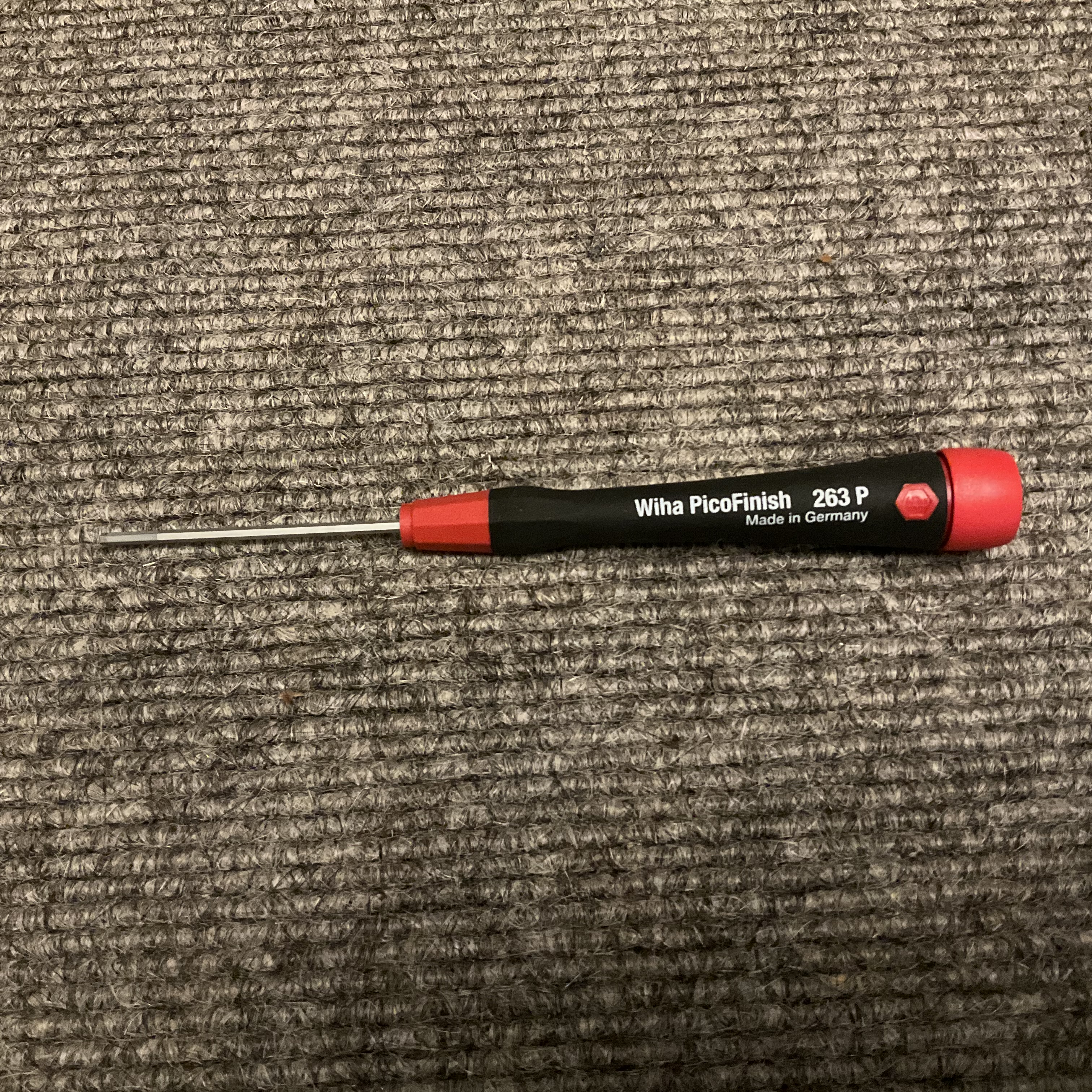
To keep the torque in a safe range, I stay away from the L-shaped wrenches and use this instead:
That’s obviously a thing to remember. When I went from the stainless to the titanium screws, I made sure to measure the tracking force with the old screws and adjusted the counterweight accordingly.
Thanks for pointing out the aerospace connection. I’m involved in a project with an aerospace supplier that is about to be finished next month. The lead engineer mentioned their experience in working with titanium. For some reason I hadn’t thought about asking him. So much for keeping work and hobbies apart.
Presumably galling (pick up) takes place as the nut is tightened. This will increase the coefficient of friction, resulting in less tension in the screw for a given torque.
Maybe he simply prefered the sound produced by a slightly less crushed cartridge.
Since the Lyra Lambda Atlas has a ti body, I asked my contact at the U.S. distributor about his thoughts on using ti mounting bolts. The ones that come with it (three different lengths) look like steel to me. They have that fluting around the bolt head, typical of SS bolts that ti bolts usually lack (at least in my experience with bicycle parts).