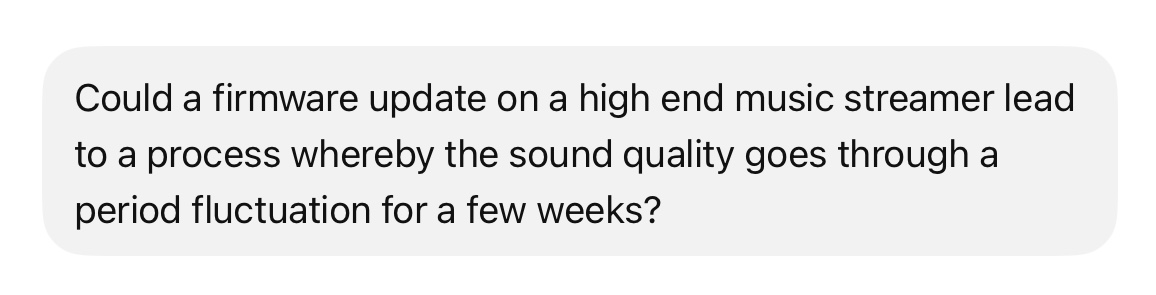
I agree, worths reading. Gemini Pro is quite clear: Based on the question in “image_e885c4.png”, the short answer is technically no, but psychologically yes.
Interesting reading though, and of course, I am fine with everyone finding reason where it fits.
" From a strict engineering and computer science perspective, a firmware update changes digital code—the software governing how the streamer’s processor, DAC (Digital-to-Analog Converter), or network interface operates. These changes take effect instantly the moment the device reboots. Digital code does not physically “settle,” “burn in,” or fluctuate over a period of weeks.
However, the phenomenon described in the image is widely reported and discussed in the high-end audiophile community. Here is a breakdown of why someone might experience this perceived fluctuation:
1. Psychoacoustics and Brain Adaptation
If the firmware update tweaked the streamer’s digital filters, FPGA timing, or DSP (Digital Signal Processing) algorithms, the actual sound signature may have changed. Your brain, which was heavily accustomed to the “old” sound, takes time to adapt to the new presentation. During this adjustment period, your perception of the audio can fluctuate wildly. It might sound incredibly revealing one day, and harsh or fatiguing the next, until your hearing finally “re-calibrates.” In the audio world, this is often referred to as “ear burn-in.”
2. Hyper-Critical Listening
After applying an update to a high-end system, listeners tend to engage in highly analytical listening. Because you are actively searching for differences, you enter a heightened state of awareness. You might start noticing recording flaws, variations in your local power grid, or slight changes in your room’s acoustics (like temperature or humidity) that were always present, but you are now attributing those normal day-to-day variations to the firmware update “settling.”
3. Background Processes
Occasionally, a major firmware update might trigger background tasks on the streamer, such as re-indexing a massive local music library, fetching new metadata, or rebuilding databases. If the streamer’s CPU is working overtime, it could theoretically introduce minute amounts of electrical noise or jitter into the signal path. Once those processes finish, the sound might “clean up.” However, this usually takes hours or a few days at most—not weeks.
4. Thermal Equilibrium (The Edge Case)
High-end analog audio gear is highly sensitive to operating temperatures. If a firmware update fundamentally changes the device’s power management—causing the internal processor to run hotter or cooler than before—it could slightly alter the thermal equilibrium of the sensitive analog output stage. Even so, hardware components generally reach a stable thermal state within a few hours of being powered on.
The Verdict The 1s and 0s in the new software are not physically maturing over a few weeks, but the listener’s brain is absolutely working through an adjustment period. When a firmware update alters the timing or digital math of a familiar system, giving it a couple of weeks of normal, relaxed listening is usually the best approach to see if you actually enjoy the new sound profile."

 ) 3.12 further.