Out of interest are you paying by DD with an option to just pay what’s used rather than a fixed monthly amount or do you manually pay for what you use?
Many companies seem to have a higher tariff for ‘pay as you go’ even if your account is in good order.
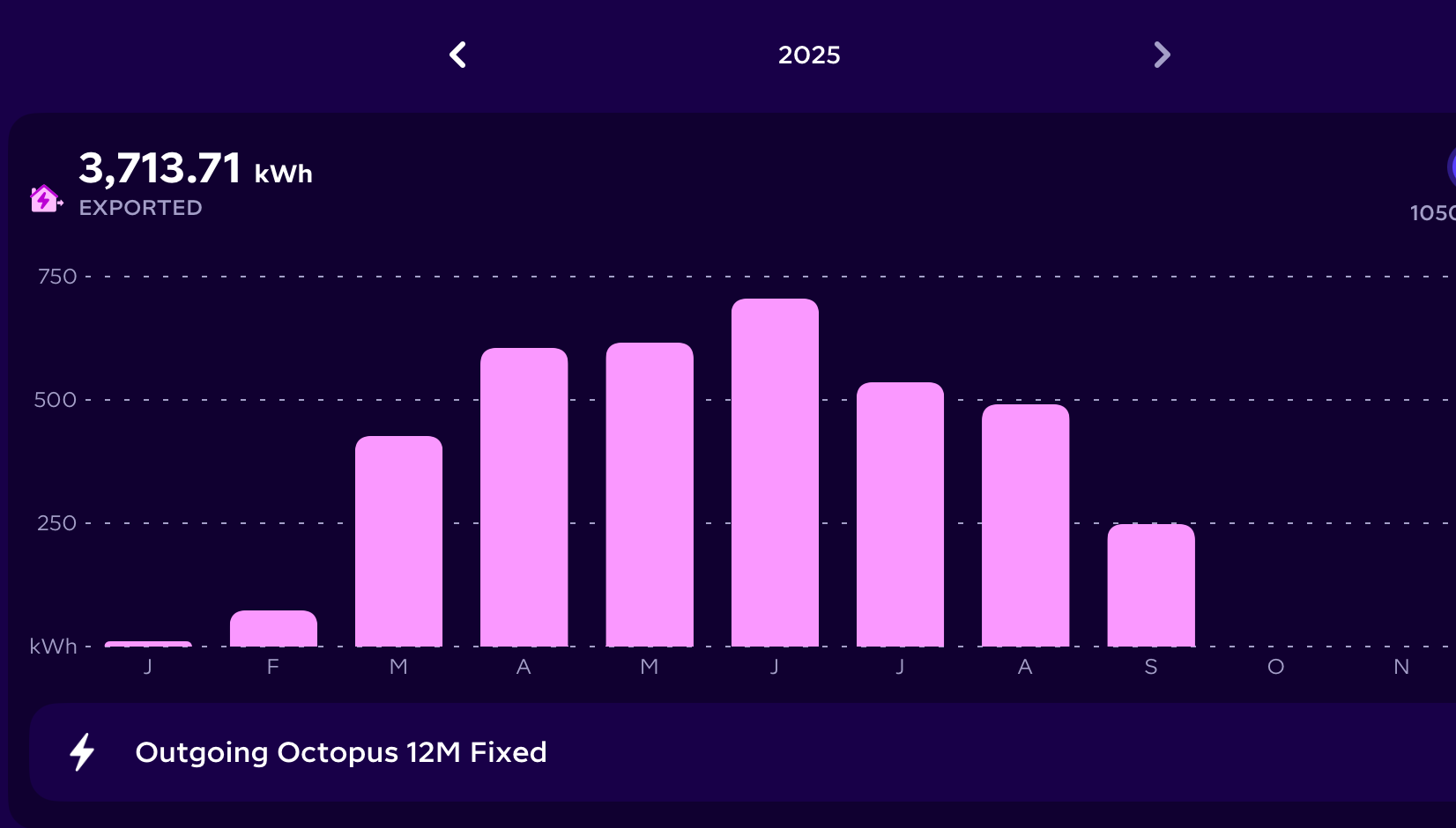
We’ve had better monthly generation so far this year in every month compared to 2024, although September hasn’t been great so far.
We beat last year’s total on 31st August.
Hm, just entered my generation for Sep so far into my stats, and it works out that the last 7.5 months is better than the whole of last year - brilliant! That could add up to a 12%+ increase by the end of the year, which brings it back to the levels I got in 2019/20/21/22/23. So to answer my original question, it does seem like 2024 had a ~10%, but now we are back to normal yearly generations
There will of course be regional variations. For us in a usually cloudy part of N. Wales May ‘25 was the best month ever for both generation and export. June and July were both better than last year, but also both lower than August.
Our local grid is struggling today (see the grid voltage graph above). The 3.68kW figure often quoted is actually the result of 16A x 230V. So when the grid is struggling the effect of the fixed current limit is increase the power pushed on to the grid!
I’d suspect a large percentage of that is the loss / resistance on the utility feed to (and from for generation) your house.
I don’t know if you have a 50 amp or 100 amp house fuse… I understand that will determine the size of your feed and its relative losses to your house.
Even with our 100 amp overhead feed (thick cables) I see the mains voltage drop in respect to my local heavy demand in my house. The voltage slightly rises on heavy export…
We have 100A feed, although the DNO asked for 95A import restriction for our inverter (battery charging). We are supplied off poles though. I’m told if I want G99 I will have to pay for infrastructure improvements, which would be silly money. I manage quite well just exporting back to the grid for long enough to overcome the solar high point by using the battery and leaving enough to get through the day before charging the batteries again.
Yep it sounds like local losses and limitations then
Luckily my overhead feed (via poles as you put it) is not limited and I have a G99, but the village had its old 3 phase common return exposed wiring along with new poles upgraded 10 or so years back - so now our distribution is from an overhead single thick insulated multi phase cable for most of the village .. regulation has been a lot better, and no more regular power cuts.
Does that come from your inverter? If so, have to calibrated it? The reason I say that, it is because my inverter used to read ~10volts above what I measure with a voltmeter. Thankfully the inverter does have a setting where you can adjust what it reports
No it is from the Zappi. The Inverter is fairly accurate based on the export/ import figures it reports. I check these with the meter the following day.
I have wondered whether to report the excessive grid voltage to my DNO now I have my own reliable monitoring. It can’t be good for equipment to have to deal with 255-260 V.
When I had the over voltage issue a few years back, the inverter would report it and shut itself down for a few minutes. I reported it to Scottish Power, who were really good, and came and plugged in a meter to the incoming feed to the house, and left it there for a week. That’s when they realised the substation was incorrectly configured.
Of the course the effect on Naim stuff, is to increase the transformer humming levels
I’ve had a similar experience where my inverter frequently shows voltages in excess of the permitted level albeit briefly in most cases. I spoke to my installer who said that the grid was struggling in our area due to the high number of G98 installations pushing more power onto the grid than it could cope with. Scottish Power seem to be dragging their heels on fixing this as it would require extensive infrastructure replacement.
The installers view was that too much money had been put into grant funded installations and not enough into grid upgrades.
I was quite close to the substation, so already I’m receiving higher voltages, as they have to allow enough to reach the houses on the far end of the leg and stay in spec (Voltage drop over distance). I suppose the ultimate fix would be to have shorter legs and more substations - which aint going to happen easily.
Did you do a multimeter test on your mains to see how accurate your inverter was? Ideally you would do it as close to the consumer unit as possible - e.g. a near plug socket.
I didn’t do a test myself, but SP did send a guy round to test the incoming supply. At the time it was within the permitted limit so they consider themselves to be off the hook.
We are not close to the substation, so the issue seems to be down to the amount of rooftop solar export that the grid is struggling with. I suspect I would have to rattle my cage quite a bit to get them to address is, but yes, monitoring it myself and keeping records could be the next move.
I’m about 3 houses down from the substation. When between us we proved that our supply was often above 260V, they changed the tappings down by one, and now I average 245V.
I wanted it lower to reduce the PS humming further, but they said they couldn’t because of the furthest house on the leg may get out of spec. So I requested they actually check the voltage at the furthest point to see if that was true. Unfortunately they wouldnt do this, but to me that was the obvious answer, and even more so as more people get Solar energy.
As your inverter will track the voltage (which is in line with what SP measured), then you have a great way to keep an eye on it and have the ability to provide proof to them that they have gone out-of-spec which presumably they would have to manage to prevent damage to domestic equipment.
I still don’t have the pv panels. I saw a good deal nearby of Euro 100 including microinvertor nearby. Here in the Netherlands the prices have really come down!
You want to look at efficiency weight and size as well.
For many semi modest and mid sized domestic installations of upto 16 panels DC strings can be most efficient rather than micro inverters, especially if you also use batteries to regulate and store the solar generation.
But yes prices have massively come down over the last 24 months… including inverters, hybrid inverters, and batteries as well as photo voltaic panels.
BTW micro inverters used to be notorious RFI generators, especially the cheaper ones, but I understand many have improved significantly now.
SolarEdge seem to have at last got my warranty replacement inverter working reliably. More precisely their servers and the inverter seem capable of working together to allow the owner to decide on grid charging and discharging. I don’t want the anxiety of not being able to control these myself if external systems fail (as they did) and have asked to be able to use the tool the installers use albeit not for configuration purposes. Next step will be to run completely independent of the grid!
Slightly related on Monday we had an Aircon installed in our upstairs bedroom opposite the door to our long landing. It can blow air out the door down the landing which now stays warm including my wife’s office area in an alcove with a dormer window next to the bedroom. Currently ticking away at 1kWh/day with the main ASHP heating overnight at its lowest temperature of 33C on the GO night tariff. I can export back to the grid in the evening before recharging the battery.